Your Product Is Never Done (And That's Exactly Why It Wins)
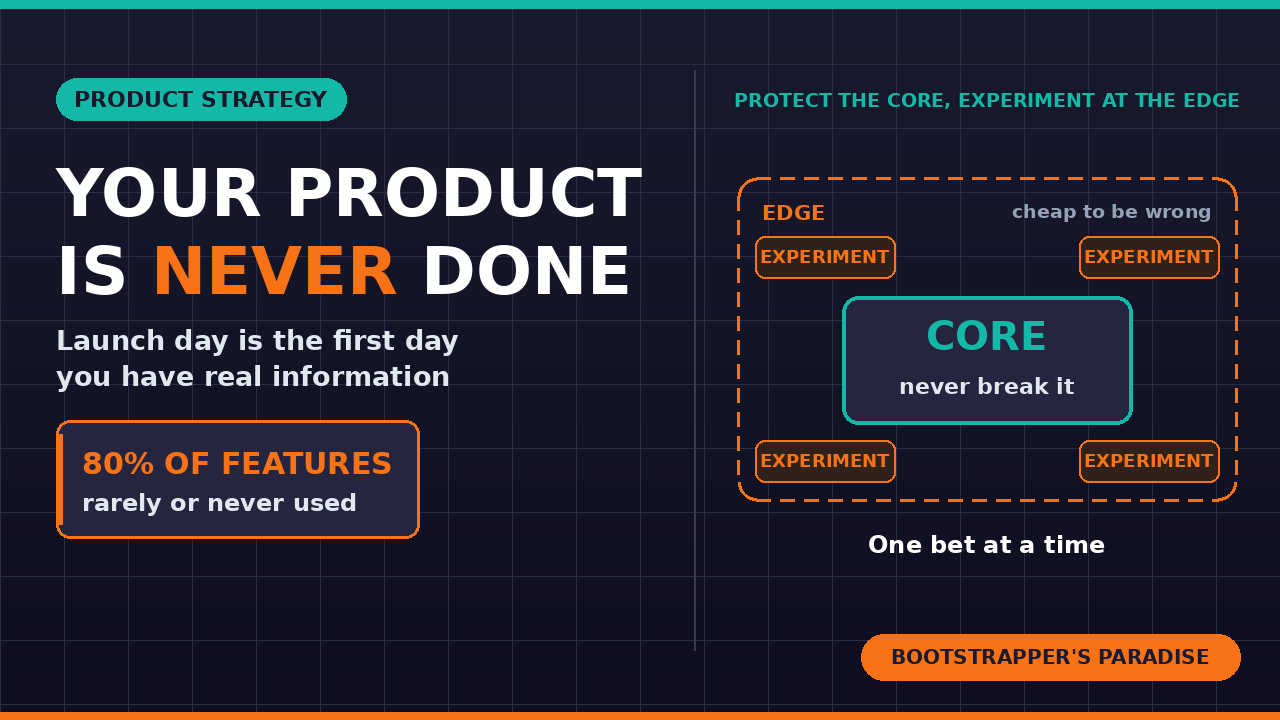
Launch day is the first day you have real information. Learn how to protect your core, experiment at the edge, and keep building from evidence.
A lot of founders picture building a successful SaaS business going something like this. You ship the product. The feature list is done, the bugs are squashed, you've got paying customers, and then you sit back and relax.
Anyone who's been in this game as long as I have will tell you that's the exact opposite of how it goes. Not only are you not finished, you're probably just getting started.
Here's the part nobody tells you. Launch day is the first day you have real information. Everything before it was a guess. Everything after it is evidence. The founders who win aren't the ones who were best at guessing, they're the ones who kept building on the evidence while everyone else was celebrating.
Your product should never be considered done. Let me show you how to decide what to build next, how to avoid the mistake that costs companies hundreds of millions of dollars, and how to figure out what success should actually look like for you.
Shipping is the starting line
Let me explain what I mean by "never done," since most people hear that and picture a boring treadmill.
Three things change the day you ship.
Your customers stop being hypothetical. Up until launch, you're working from interviews, from surveys, from what people said they'd do. After launch you finally get to see what they actually do, which is a completely different data set.
Your market keeps moving. The problem you solved is a snapshot of what your customer needed this year. Their business changes, their tools change, their expectations change. A product that stands still is quietly getting worse relative to the world around it.
Your competitors get to see your answers. Everything you shipped is now visible. The only durable advantage you have left is the speed at which you learn from customers they don't yet have access to.
So "never done" isn't about grinding forever. It's about accepting that your product is a living thing in a moving market, and your job is to keep it in step.
80% of features get ignored
Here's where a lot of founders take that concept, before they fully understand it, and run straight off a cliff with it.
They hear "never done" and assume it means "ship more stuff." So they ship more stuff. More settings, more toggles, more tabs, more of everything.
The data on that is brutal. Pendo ran a study across 615 software subscriptions and found that around 12% of features generate 80% of daily usage. The other features are rarely or never used. They estimated the wasted research and development spend across public cloud companies at roughly 30 billion dollars, which is an insane number.
Think about what that means for a solo founder. Every feature you build carries a cost that never shows up directly on your books. It has to be maintained. It has to be supported. It has to be explained in onboarding. It sits in your UI forever, making the few things people actually want harder to find in a sea of things they don't care about.
So "never done" does not mean "ship everything." Volume isn't the point. Direction is the point.
Protect the core, experiment at the edge
Your product has two zones, and they follow opposite rules.
The core is the workflow your customers depend on every single day. The thing they'd call you about at 11pm if it broke. In the core, your job is stability. Don't redesign it for fun. Don't move it. Don't "modernize" it. If you're going to change it, improve it in ways nobody has to relearn.
The edge is everything adjacent. New workflows, new integrations, the next step in the process, the thing that happens right before or right after your product does its job today. That's where you experiment, that's where you take swings, that's where being wrong is cheap.
Here's what happens when you get that backwards.
In May of 2024, Sonos shipped a full redesign of its mobile app. The intent was reasonable enough, modernize the software and set up for future products. What actually shipped removed things people used every day. Sleep timers. Alarms. Accessibility options. It broke setups that had worked for years.
The company's CFO later told investors the app launch hurt revenue by at least 100 million dollars. Sonos put 20 to 30 million dollars into fixing it, laid off around 100 employees, delayed product launches, and the CEO stepped down eight months after the release.
That's a company with over a thousand employees, and it nearly took them out. They didn't fail at innovation. They innovated in the wrong zone. They rebuilt the thing customers depended on instead of extending it.
Stability in the core buys you permission to experiment at the edge. Break the core and you don't get to experiment at all. You get to spend a year apologizing and trying to save your business from extinction.
Feedback is a map, not a menu
If you're not just adding features, how do you decide what goes at the edge?
Something I tell the founders I coach all the time: you have to read feedback differently than most people do.
Most founders treat feature requests like a menu. Customer orders it, you cook it, you serve it. That's exactly how you end up with the 80% nobody touches.
Treat it like a map instead. Every request has three layers, and the request itself is the least useful one.
Layer one is what they asked for. "Can you add a CSV export?"
Layer two is the job behind it. Why do they need that file out of your system? What are they doing with it once it leaves?
Layer three is the destination. If they're pulling data out every Friday to build a report for their boss, the request was CSV export. The destination is a report they never have to build. Those are two very different products, and only one of them makes you harder to leave.
I run into these constantly. Support tickets, cancellation reasons, the workarounds people build in spreadsheets around my product. Those spreadsheets are the highest-signal thing you'll ever see, since a customer who built a workaround has told you exactly where your product stops and their problem continues.
That's what seeing around corners actually means in SaaS. You're not predicting the future out of thin air. You're following your customers one step further down the road they're already walking, then building them a bridge before they have to find another creative way across.
Run two tracks
Here's the tension. The business you have pays the bills today. The business you're becoming doesn't pay anything yet. Kill one for the other and you're gambling.
So don't choose. Run both.
Netflix is the cleanest example of this. They launched DVDs by mail in April of 1998. Red envelopes, no late fees, a direct shot at the trip to the video store. Streaming was the vision from the very beginning, but the technology just wasn't there yet. So they ran the DVD business as the engine and kept working the streaming track alongside it, until streaming finally launched in January of 2007.
Nine years of running the business they had while building the business they were becoming.
At your scale that looks smaller, but it's the same shape. Track one is your core, and it gets reliability, performance, polish, the boring improvements that keep churn low. Track two is one edge bet at a time, shipped to a handful of customers who asked for it, with a decision date on the calendar.
One bet at a time. Not five. A solo founder running five experiments is running zero experiments and getting five half-finished features out of it.
AI keeps the hits coming
Here's what changed, and it's the reason this whole approach is even available to you as one person.
The loop used to be expensive. Idea to prototype to shipped used to be a quarter of work. So you had to be right, so you moved slowly, so you shipped less, so you learned less. That's the trap the old playbook put founders in.
Leveraged correctly, AI collapses that. Not because it writes code for you, since anyone who's tried vibe coding a real product knows where that ends. It collapses because of context. When your codebase, your conventions, your architecture, and your customer's language all live in a file your AI reads every session, you stop re-explaining your product every time you want to change it.
My workflow is boring on purpose. Requirements first, then modules, then tasks small enough to verify. AI builds, I test, I iterate, and whatever I learned goes back into the context file so the next build starts smarter than the last one.
The result is a week instead of a quarter. When the loop is that cheap, being wrong stops being expensive, which means you can test at the edge constantly. That's how you keep the hits coming for your customers, and they feel it. A product that visibly improves every month is a product people don't go looking to replace.
Success is a spectrum
Now the part that trips people up emotionally, since this determines whether you actually enjoy any of this.
Success in software isn't one door. It's a spectrum, and the internet only ever shows you the extreme examples.
An analysis of over 1,000 micro SaaS products, cross referenced with the MicroConf independent SaaS survey, puts roughly 70% of them under 1,000 dollars a month. About 18% land in the 1,000 to 5,000 range. The median profitable micro SaaS sits around 4,200 dollars a month.
Look at those numbers without flinching. A product doing 500 dollars a month is not a failure. It's a side hustle that pays for something real in your life, and it's running while you sleep. A product at 4,000 or 5,000 a month covers a mortgage. A product that clears 10,000 a month replaces most jobs in this country.
Every one of those is a legitimate outcome. The mistake isn't landing in one of them. The mistake is landing successfully in one while measuring yourself exclusively against another. Comparison really is the thief of joy.
So pick your tier on purpose. That decision changes everything downstream. If you want a side hustle, you optimize for low support load and near-zero maintenance. If you want the thing that replaces your income, you optimize for retention and expansion. If you want the big outcome, you go find a market where the problem is expensive and repeats.
Same skills, different targets, completely different roadmaps. Know which one you're building.
Why this never gets boring
One more thing, and it's the honest reason I'm still doing this after fifteen years.
I can't stop thinking about the next version. I'll be in the middle of something completely unrelated and I'm redesigning a screen in my head, or working out the feature that takes three steps out of my customer's day. That's not discipline. It's not grit. It's just fun.
That matters more than it sounds. This work rewards people who enjoy the process, since the process is the whole job. Nobody sustains ten years of it on willpower alone. Fall in love with the building and you get the compounding for free, and your customers benefit from it.
If you try it and you don't enjoy it, that's real information too. Better to learn that on a side project than five years into something you bet the farm on.
Your playbook to follow
- Separate your core from your edge. Write down the three workflows customers depend on daily. Those get stability and nothing else.
- Mine your feedback for destinations, not requests. Support tickets, cancellations, and every spreadsheet workaround your customers built around your product.
- Run one edge experiment at a time, shipped to the customers who asked for it, with a decision date on the calendar.
- Cut what doesn't get used. Look at your feature usage this month and be honest about what belongs to that 80%.
- Pick your tier. Side hustle, sustainable, or life-changing. Then build the roadmap to match.
Where to go next
If step two is where you're stuck, I built a free tool for exactly that. The Problem Finder walks you through pulling the real problem out of what your customers are telling you: tools.bootstrappersparadise.com/problem-finder
If you'd rather work through your roadmap with me directly, I work with a small number of founders for private 1:1 coaching: bootstrappersparadise.com/#coaching
Your product isn't done. It's never going to be done, and once that stops feeling like a burden it starts feeling like the best part of the job.
Ready to Build Your Own SaaS?
Learn how to go from idea to launch in my free 5-day email course — no coding or big budget required.
Start the Free Course