Will AI Agents Kill SaaS? Three Strategies to Make Sure Yours Survives
AI agents are changing how software gets bought and used. Here are three practical ways SaaS founders can make their products agent-ready without abandoning today's customers.
Imagine a 24/7 employee who never gets sick, never calls out, never takes a vacation, and can handle entire workflows from start to finish.
That's an AI agent.
For business owners, it's one of the most exciting prospects in a generation.
For SaaS founders, it's terrifying. Because if an agent can do the whole job, why would anyone pay for the software?
Today I'm going to explain why that fear is real, why it doesn't have to kill your business, and the three things you should do right now so that agents accelerate your SaaS instead of threatening it.
I'm Sean. I've spent 15 years bootstrapping SaaS businesses, and now I help founders like you. Let's get into it.
What Is an AI Agent?
Before we talk strategy, let's make sure everyone understands what we're actually talking about.
An AI agent is an autonomous digital worker. Not a chatbot that just answers questions. Not an AI feature bolted onto existing software. A fully autonomous system that can:
- Observe a situation
- Make decisions
- Take actions
- Complete an entire workflow without humans directing every step
Think about what a human employee does in customer support. They read the ticket. They look up the customer's history. They check the knowledge base. They decide on a resolution. They write a response. They update the CRM.
An agent can do all of that end-to-end without stopping.
The exciting part for business owners is obvious — a 24/7 employee who never gets sick, never calls out, never needs training twice, and can handle thousands of tasks simultaneously. That's an incredibly compelling value proposition for any business that relies on human labor for repetitive workflows.
Why This Is Causing Panic in SaaS
This is a big part of the fear behind the so-called "SaaS apocalypse." But it isn't just about per-seat pricing dying. It's about something more fundamental.
Here's the logic chain that's terrifying investors:
- Traditional SaaS gives a human a tool to do their job better
- The human still does the job. The software just makes them more efficient
- An agent doesn't need a tool. The agent is the worker
- If the agent can read the ticket, look up the history, and write the response — why does the company need the ticketing software at all?
That's the existential threat. It's not that agents make SaaS better. It's that agents might make SaaS unnecessary.
If I have an agent handle my entire billing workflow, why do I still need to pay $99/month for billing automation software?
That's the logic that triggered a trillion-dollar sell-off. Investors looked at the chain and thought the software layer might get skipped entirely.
That fear is legitimate. But it's not the whole story.
What the Real World Actually Looks Like
The theory of agents replacing SaaS makes sense on a whiteboard. But I spend my time in the real world building products for real businesses. Let me tell you what that looks like right now.
Designing, building, and deploying agents gets technical fast. Most business owners can barely navigate their existing software stack, let alone architect an autonomous agent workflow. The technical barrier alone puts agents out of reach for the majority of small and mid-sized businesses.
The bigger issue is operational. Businesses have been designed to be operated by people for decades. Every process, every protocol, every approval chain, every exception handler — all built around human judgment and human communication.
You can't just flip a switch and replace that with an agent. The company needs:
- The right protocols in place
- The right data structures
- The right handoff procedures between human and machine
- The right guardrails for when the agent gets it wrong (and it will get it wrong)
I've seen this firsthand. Businesses that try to deploy agents into existing workflows without redesigning those workflows first end up with expensive failures. The agent is technically capable, but the business wasn't set up to allow it to operate.
Agents make perfect sense in theory. In practice, not so much. At least not yet.
A Concrete Example: The Law Firm
Let me crystallize this with a specific example. Take a law firm — the market I'm building Clockless for.
In theory, an agent could handle the entire billing workflow. Read every meeting, categorize every conversation, generate invoices, send them to clients, follow up on late payments. End-to-end, no human needed.
In practice:
- The managing partner needs to review every invoice before it goes out
- Certain clients have custom billing arrangements that aren't documented anywhere — they live in the partner's head
- The firm has three different billing rate structures depending on case type
- There's a long-time client who demands a personal call before any invoice is sent
None of that is written down. None of it lives in a system. It all lives in human knowledge and relationships.
Until the firm documents those processes, standardizes those workflows, and creates the protocols for an agent to follow — the agent can't replace the human. It can assist the human. Replace? Not yet.
Multiply that reality across every industry, every company, every workflow. The world needs time to catch up.
When Do Agents Actually Arrive?
Here's how I see the timeline:
Right now (2026-2027) — Agents work well for narrow, well-defined tasks within existing software. Answering support tickets from a knowledge base. Routing leads based on criteria. Processing structured data. They're powerful assistants, but not quite autonomous workers.
Near future (next 2-3 years) — Businesses start redesigning their processes to be agent-compatible. Documentation improves. Protocols get codified. The infrastructure catches up. Agent adoption grows.
Long-term (5-10 years) — Agentic solutions take significant business away from what used to be typical SaaS. The endgame is real, and it is coming.
The question isn't if agents will reshape SaaS. It's when. And the markets and businesses just need time to catch up.
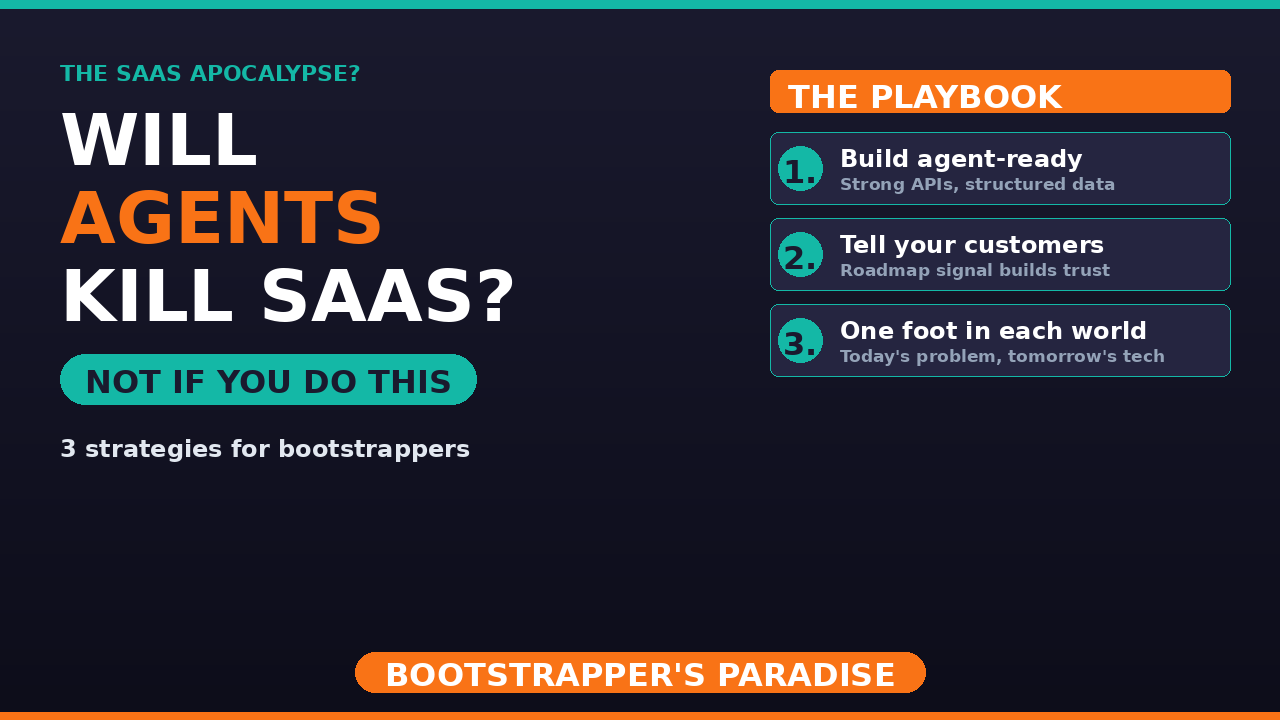
Strategy 1: Design for Agents From Day One
This is the most important one.
Build your product so that when the world is ready for agents, you can flip the switch and your customers get an agent experience through your platform.
Practically:
- Build strong APIs
- Structure your data so an agent can consume it
- Design workflows with clear inputs, outputs, and decision points (not just pretty UIs)
- Think about your product as a layer agents can operate on, not just a screen humans click through
When you do this, your customers won't churn when agents arrive. They'll upgrade. They'll have access to your agent instead of shopping for their own or spending a ton of time, effort, and money trying to build one.
You become the agent provider for your niche, not the software that gets replaced by one.
Strategy 2: Tell Your Customers What's Coming
This is about communication and timing. Letting your customers know what's coming so they stay with you instead of looking elsewhere.
Add agents to your product roadmap and let your customers know it's coming. Not next month — when they're ready for it. This does two things:
- It signals you're forward-thinking, which builds confidence
- It gives customers a reason to stay instead of shopping for standalone agent solutions
Start performing discovery as soon as customers show interest. Ask them:
- How are you using the product today?
- Which tasks would you hand off to an autonomous agent?
- What processes would need to change first?
Here's the critical part: be realistic about how ready they actually are. Too much tech too fast often backfires.
If a customer's processes aren't documented, their data isn't structured, and their team isn't trained on working alongside AI — deploying an agent will create more problems than it solves.
Be the trusted advisor who says let's get you ready first, rather than a vendor who oversells.
Strategy 3: One Foot in Each World
This is the most important mindset shift, and it's some of the best advice I've ever received as an entrepreneur.
You might want to live in the future. Right now, we all live in the present. And some of us live in the past. You need to keep a foot in both worlds simultaneously.
What that means in practice:
Today's world: Your product needs to solve today's problem with today's technology for today's customer. They want software that helps them do their job better. They're not ready for a fully autonomous agent. Serve them where they are.
Tomorrow's world: Be preparing for where the market is going. Learn about agent architectures. Build your APIs. Structure your data. Experiment with agent capabilities internally. Stay informed about what's becoming possible.
The founders who win will be the ones who are excellent at solving today's problem AND ready to evolve when the market shifts.
- Not the ones who bet everything on a future that hasn't arrived
- Not the ones who ignore the future and get caught flat-footed when it does
Keep one foot in each world. You'll know what works now, and you'll be ready for where the market is going tomorrow.
It's also a lot more exciting to build this way.
The Big Picture
This doesn't have to be one or the other. It's not SaaS versus agents.
It's SaaS evolving into agent-powered platforms.
The founders who treat this as a binary choice — either build SaaS or build agents — will lose. The founders who build SaaS designed to incorporate agents will thrive.
Your SaaS becomes the home for the agent. The domain expertise, the customer relationships, the workflow knowledge, the data — all of that lives in your product. The agent is how the value gets delivered in the future.
You're not being replaced. You're being upgraded.
Three Things to Do This Week
- Audit your product for agent readiness. Does it have an API? Is your data structured? Could an agent operate on your workflows, or are they UI-only? Identify the gaps.
- Add agent capabilities to your product roadmap. Even if it's 6-12 months out. Signal to customers that you're thinking ahead.
- Solve today's problem excellently while preparing for tomorrow. Keep one foot in each world. The present pays the bills. The future protects you from disruption.
Free Tools to Help
If you want the complete framework for building, pricing, and launching a SaaS product that's ready for where the market is heading, my free 5-day email course covers the whole process:
- Free 5-Day Email Course — bootstrappersparadise.com
- SaaS Idea Validator — pressure-test whether your problem is worth solving: tools.bootstrappersparadise.com/validator
- Problem Finder — discover real problems people will pay to solve: tools.bootstrappersparadise.com/problem-finder
- Pricing Calculator — figure out what to charge based on the value you create: tools.bootstrappersparadise.com/pricing
Build for today. Design for tomorrow.
Sean is building Clockless, a legal billing SaaS, in public at bootstrappersparadise.com. Join the free 5-day email course to learn the bootstrapper's approach to building SaaS with AI.
Ready to Build Your Own SaaS?
Learn how to go from idea to launch in my free 5-day email course — no coding or big budget required.
Start the Free Course