Is SaaS Dead? Here's Why SaaS Will Never Die
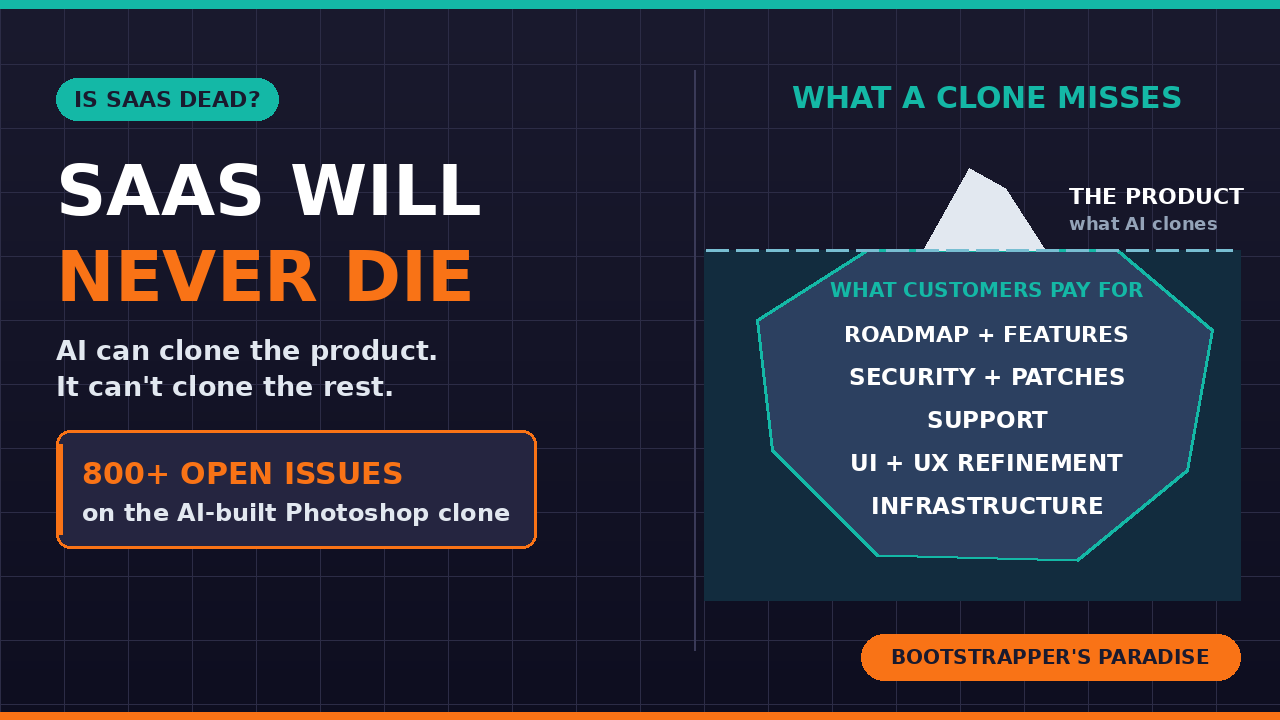
AI can clone a product, but it cannot clone the roadmap, security, support, patches, infrastructure, and commitment that customers actually pay a SaaS company for.
You've probably heard it by now. AI can build software in a weekend, so every company is going to build its own, and SaaS is finished.
I keep hearing about companies deciding to build their own software instead of licensing it, and honestly, I can't help but laugh a little every time. I've seen this exact story play out a hundred times, and it almost never ends the way people think.
So let me show you why SaaS isn't dying, and why I think it's going to come back stronger than ever, even though AI can build software faster than it ever could.
The SaaSpocalypse that wasn't
Let's start with the scare. Earlier this year the market convinced itself that AI was about to wipe out software companies, and SaaS stocks got hammered. People started calling it the SaaSpocalypse.
Then the companies that adapted kept right on growing. Salesforce was the poster child for "AI is going to kill this business." In August they reported $11.3 billion in quarterly revenue, up 11%. Their AI agent product passed $1.5 billion in annual recurring revenue, up more than 240%, and they raised their full-year outlook.
That's not what a dying business looks like. I've covered the SaaSpocalypse in more detail elsewhere, so check out Was The SaaSpocalpse Cancelled? if you want the full story.
So why are the companies that adapted doing so well? The best answer I've seen came from an experiment that was supposed to prove the opposite.
The Adobe clone test
You've probably heard about REA, short for Reverse Engineer Anything. It's an open-source project that lets an AI agent take apart an existing app and figure out how it works, and this month it blew past one hundred thousand stars on GitHub.
Around the same time, a developer used AI to publish open-source clones of seven Adobe apps, including Photoshop, Illustrator and Premiere Pro. Plenty of people cheered, and honestly, a lot of people have a valid complaint about Adobe's pricing. HSBC even downgraded Adobe's stock from Buy to Hold, citing the free AI-built alternatives. Interestingly, the same note also flagged the security and legal risks of AI-generated code, which is exactly the point I'm about to make.
So what actually happened? The Photoshop clone is labeled early alpha. Within about two weeks it had more than eight hundred open issues. Around a hundred of them mention Photoshop's own file format, and around fifty mention crashes.
It looks like Photoshop. It just doesn't work like Photoshop, and that gap is the whole point.
SaaS was never just the product
Here's what people aren't getting. SaaS was never just about building a product.
A prototype, or even a working product, is the tip of the iceberg. To make software work well for real customers over years, you need everything under the waterline too.
That means active development, a strong roadmap, and new features. It means constant refinement of the UI and the UX, security, patches, paying down tech debt, and performance upgrades. It means great support, and infrastructure that scales as customers grow.
None of that is a one-time job. It's every week, for as long as the product exists.
AI makes the tip of the iceberg faster to build. It doesn't make the rest of the iceberg go away. I'm sure by now you can see why "we cloned it in a weekend" and "we replaced it" are two very different things.
The "build it ourselves" story
Now let's talk about the companies deciding to build their own software, since I've watched this movie many times.
A big company looks at its software bill and asks, "Why don't we just build this ourselves?" A year or two later, they're no closer to a product that performs well or does anything close to what they wanted.
Why? They aren't a software company. They're an accounting firm, an insurance company, or a home builder. Their best people are great at accounting, insurance, or building homes, not at running software for years.
Just because AI can build fast doesn't mean these companies are going to consistently succeed at building their own products. It definitely doesn't mean it makes more sense for them to build than to license.
The research lines up with what I've seen:
- MIT found that AI tools companies bought from vendors succeeded about 67% of the time, while tools they built internally succeeded only about a third as often.
- S&P Global found 42% of companies scrapped most of their AI initiatives in 2025, up from 17% the year before.
- Menlo Ventures found that in 2024 companies built about 47% of their AI use cases in-house. In 2025 that dropped to about 24%. Everything else, they bought.
The realization is already happening.
Why SaaS comes back stronger
That's why I think SaaS is more likely to never die than it is to be dead.
When a company builds its own software, it owns every problem under that waterline forever, with a team that has other jobs. When it licenses SaaS, all of that becomes somebody else's full-time job.
That's the real product a SaaS company sells. Not the code, the commitment to keep it working.
As more companies try building it themselves and hit the same wall, I think they'll come back to SaaS with a much better appreciation for what they're actually paying for. The SaaS companies that adapt to the times, with AI doing real work inside the product, are going to be waiting for them.
What this means for bootstrappers
So what does this mean if you're a bootstrapper building a SaaS right now? It's good news, as long as you play it right.
First, pick a vertical. The accounting firm and the home builder aren't going to become software companies, and that's your opening. Be the software company they don't want to be.
Second, sell the whole iceberg. Your customers aren't just paying for features, they're paying for support, updates, security, and reliability. Make that visible, since it's the part a weekend clone can't match.
Third, use AI for speed, but treat your service as the moat. AI lets a team of one keep up with all of that work. That's exactly what makes it possible for a bootstrapper to compete in the first place.
Pro Tip – when a prospect says "we could just build this ourselves," don't argue about the code. Ask who on their team is going to maintain it for the next five years. That question usually ends the conversation.
Your playbook to follow
- Don't panic over "SaaS is dead" headlines. The companies that adapted are growing.
- Remember that a clone or a prototype is the tip of the iceberg, not the business.
- Pick a vertical full of companies that will never want to be software companies.
- Sell the whole iceberg: support, updates, security, and reliability, not just features.
- Use AI to keep up with all that work as a team of one.
- When a prospect wants to build it themselves, ask who maintains it for the next five years.
Sources
- Salesforce, Record Second Quarter Fiscal 2027 Results
- Akita on Rails, AI Reverse Engineering: Is Adobe Dead?
- Decrypt, the AI tool REA and the free Photoshop clone
- TIKR, HSBC downgrades Adobe on AI disruption risks
- Yahoo Finance, MIT report on generative AI pilots
- CIO Dive, S&P Global data on abandoned AI projects
- Beam, the great AI flip (Menlo Ventures build vs buy figures)
Where to go next
If you want to build a successful SaaS business, start with my free resources. The 5-day email course is the best place to start: bootstrappersparadise.com/#free-course
If you want to map out your own path with me directly, I take a small number of founders for private 1:1 coaching: bootstrappersparadise.com/#coaching
If you want to see where the biggest opportunity is for SaaS founders right now, watch Vertical AI vs Traditional SaaS | Game Over.
AI made building software faster than ever. It didn't make running software any easier, and that's why SaaS isn't going anywhere.
Ready to Build Your Own SaaS?
Learn how to go from idea to launch in my free 5-day email course — no coding or big budget required.
Start the Free Course