The Product Builder's Hardest Job: Deciding What To Build
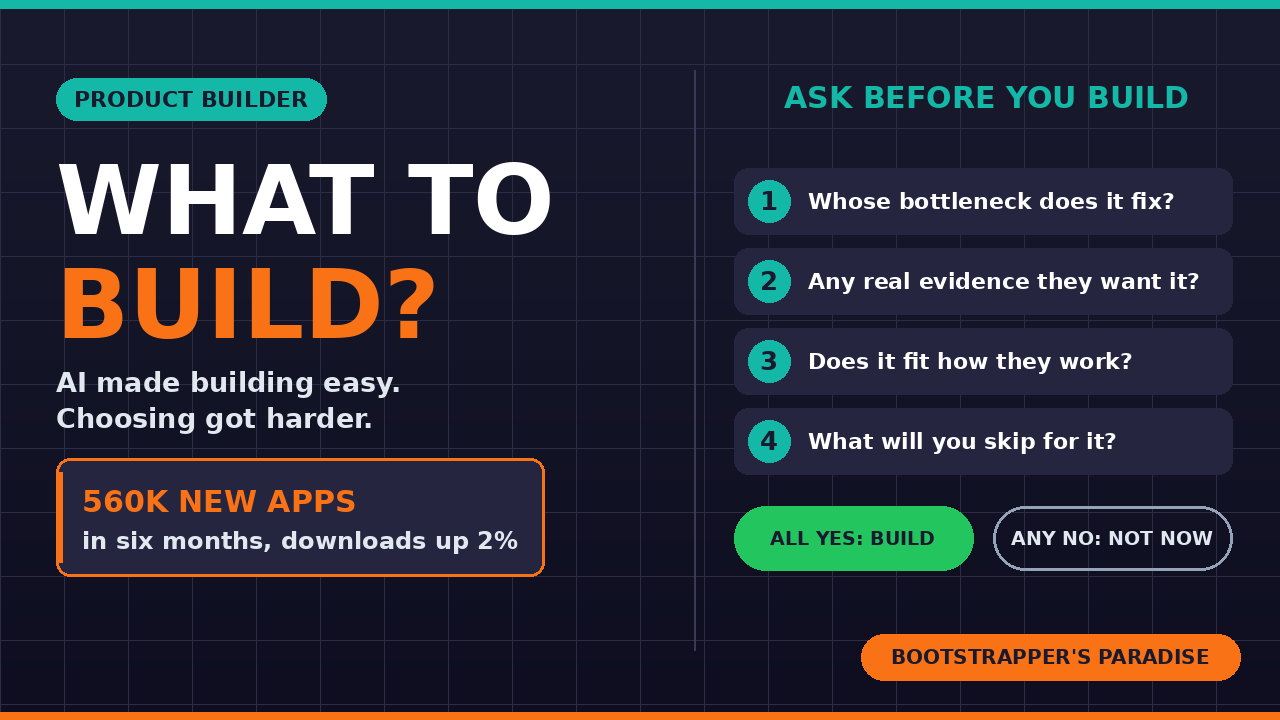
AI made building easy. Choosing what to build is now the job that matters most.
AI made building software faster, easier, and cheaper than it's ever been. You can go from an idea to a working product in a weekend now.
You'd think that would make it easier to build a successful product. It hasn't. In a lot of ways, it's made the hardest part of the job even harder, and that's knowing what to build in the first place.
Let me show you how to decide what's actually worth building, and how to stay close enough to your market that you keep getting it right, even when AI can build anything you want whenever you want it.
This is the follow-up to my Product Builder Masterclass, going deep on the product manager side of the role.
Why AI made this problem worse
Here's what's happening. AI indirectly made this problem worse, precisely because building got so easy.
When building something took months, you had to think hard before you started. Now it takes an afternoon, so a lot of people skip the thinking and go straight to building.
Instead of using AI to get ahead, most people are using it to build way more things that matter way less.
You can see it in the numbers. In the first half of this year, new apps on Apple's App Store doubled to about 560,000, according to Sensor Tower. That's nearly as many as all of last year. App Store downloads over the same stretch grew just 2%.
Way more apps, barely more demand. Meanwhile, the top reason startups fail hasn't changed. When CB Insights looked at 101 startup post-mortems, about 42% pointed to no market need.
More products, same old problem. Building faster doesn't help if you're building the wrong thing.
The job AI can't do for you
If you've seen my Product Builder Masterclass, you know a product builder wears three hats: product manager, designer, and engineer. This piece is all about the product manager hat, since that's the one that decides whether everything else matters.
AI can do a lot under that hat. It can research, summarize customer interviews, and draft specs.
What it can't do is decide what matters to your market, or say no to the ideas that don't. That judgment is still on you, and it's now the most valuable part of the job.
Validate first, build last
The best advice I give builders is simple. Validate first, build last.
Otherwise you just waste time and money on a business concept that was never going to work. This kills most ventures, and it's an easy trap to fall into.
I'll be honest with you. Every time I've tried to skip ahead, I've gotten burned. Every single time. I covered one of those stories in Don't Automate Everything, where I built bank connections into my software that customers were never going to be allowed to use.
So before you build, do the research. Talk to your target customers about their problem, not your idea, and look for real evidence that they actually need it solved. If you want a quick way to pressure test an idea first, my free SaaS Idea Validator is built for exactly that.
Iterate early and often
Research gets you started, but it's not a one-time step. The real trick is to put something in front of customers early, get their feedback, and iterate on it often.
That's where AI actually shines. Use it to put a prototype or a landing page in front of people in days instead of months. Then use their feedback to decide what to build next.
Each loop keeps you closer to your market. The closer you stay, the less likely you are to build something nobody needs.
Listen for patterns, not requests
One thing I'm constantly telling people is that you don't build everything customers ask for. People have a tendency to ask for way more than they can actually handle or need. Instead, you build around the patterns.
With my fintech software, I started with a version for the small end of the market. Then I reworked it to move upmarket. After that, I redesigned the whole experience around mid-market companies and up.
None of those changes came from one customer's wish list. They came from patterns I kept seeing across numerous prospective customers. When several people describe the same problem in different words, that's your signal.
Stagnation is death in the AI era
Here's the part a lot of founders miss. Once you find something that works, you can't stop.
Your competitors have AI too. If you stop iterating, someone else will take the feedback you ignored and build the better version.
So you need to keep iterating, even when things are going well. As I covered in The Only SaaS Moat That Ever Mattered, the speed at which you keep making your product better is the real moat. In the AI era, stagnation is death.
My filter for every idea
So how do you decide, idea by idea, what's worth building? Here's the filter I run every idea through.
- Whose bottleneck does this remove? If you can't name a specific customer and a specific painful step, stop there.
- What evidence do I have that they want it? Real conversations, not my own excitement.
- Does it fit how they already work, including what they're actually allowed to do?
- What am I not building to make room for this? Every yes has a cost.
Anything that fails one of these checks goes on a "not now" list, not in the trash. When several customers ask for the same thing on their own, it moves up.
Pro Tip – saying "not now" is a lot easier than saying "no," both for you and for your customer.
Your playbook to follow
- Don't let easy building replace real research and good judgment.
- Validate first, build last. Always.
- Use AI to get prototypes in front of customers early and often.
- Build around patterns across customers, never a one-off request.
- Run every idea through the filter, and keep a "not now" list.
- Never stop iterating. Stagnation is death in the AI era.
Sources
- 9to5Mac, App Store added nearly as many new apps in H1 2026 as in all of 2025 (Sensor Tower data via The New York Times), July 20, 2026
- Inc., 42 Percent of Startups That Fail Trip Over This One Critical Point (CB Insights, 101 post-mortems)
Where to go next
If you want to build a successful SaaS business, start with my free resources. The 5-day email course is the best place to start: bootstrappersparadise.com/#course
If you want to map out your own path with me directly, I take a small number of founders for private 1:1 coaching: bootstrappersparadise.com/#coaching
If you haven't seen it yet, watch the Product Builder Masterclass for the full skill set it takes to succeed in the AI era.
AI made building easy. Knowing what to build, and staying close enough to your market to keep getting it right, is what will set you apart.
Ready to Build Your Own SaaS?
Learn how to go from idea to launch in my free 5-day email course — no coding or big budget required.
Start the Free Course