What Is Product Market Fit, And How Do You Know If You Have It?
Product-market fit is not a milestone. It is a threshold to maintain. Use five observable gates to measure it from your first customer conversation.
Product market fit has been the standard for whether a software business is actually working for as long as I've been doing this.
It's also the thing almost nobody can define clearly, and even fewer people can measure. So let me explain what it is, and show you how to measure it even if you don't have any customers yet.
Everyone is building, nobody is selling
That was always a problem. It's a much bigger one now, and the reason is obvious once you see it.
AI made building fast and cheap. A quarter of one recent Y Combinator batch had codebases that were 95% AI-generated, according to the accelerator's own partners. Gartner projects that 60% of all new software code will be AI-generated by the end of this year, and roughly 63% of people using these tools aren't developers at all.
So everyone is building, but almost nobody is selling or checking whether the thing they're building is actually needed by anyone. I'm sure you see the problem here.
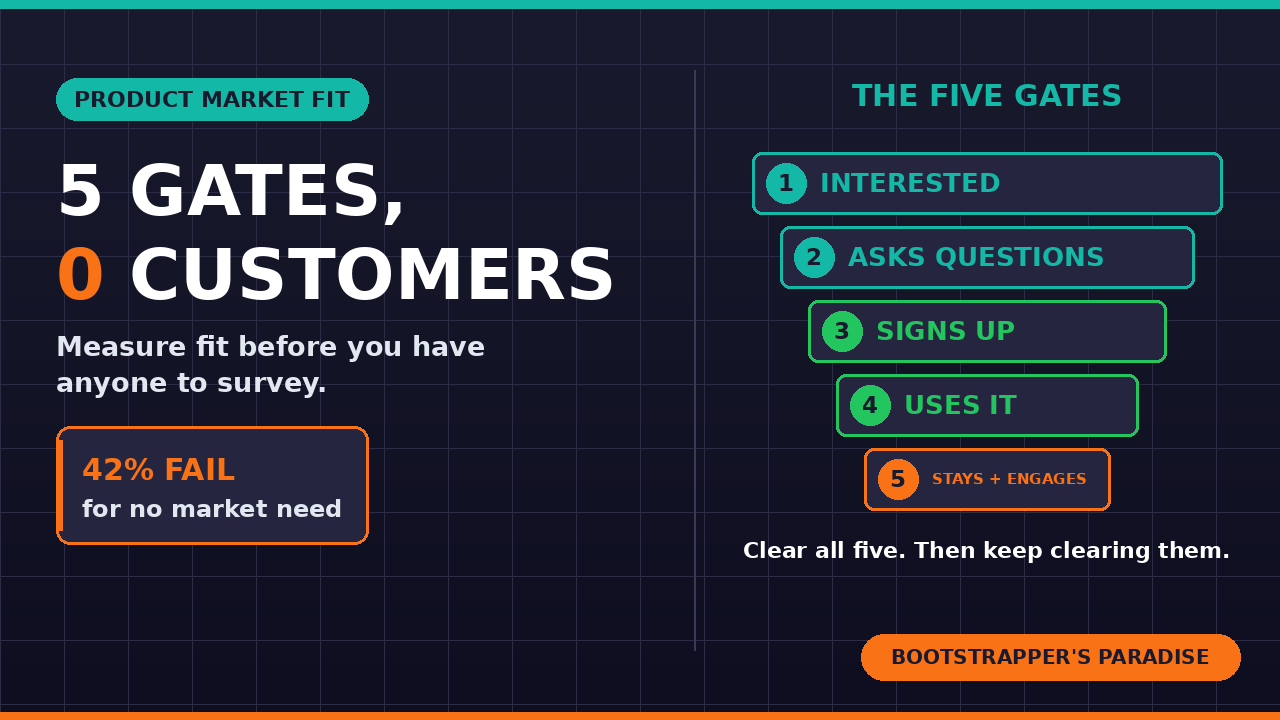
Here's the number that should worry you. Startup Genome's research across more than 3,200 high-growth startups found that 70% had scaled prematurely along some dimension, meaning they grew team, spend, or distribution before confirming the market actually wanted what they built. CB Insights has "no market need" as the single biggest reason startups fail, at around 42% of post-mortems. That's an insanely high number when you consider how much work goes into building a company.
So building has gotten at least ten times faster, but validating didn't. That gap is where most software products go to die. The good news is that it's completely avoidable.
Let me show you how to avoid all this nonsense, which should dramatically increase your chances of success, by learning to measure product market fit properly.
Why it's so hard to measure
First, why this is easier to understand than to actually measure.
Product market fit measures the fit between two things. Your product, which changes constantly. Your market, which also changes constantly.
You're not measuring something static. You're measuring a dynamic relationship at a point in time between two moving targets.
So the first problem is that people oversimplify the concept. That's why people struggle with it, and it's why so much advice about it feels slippery or ambiguous. Most metrics measure something that sits still. This one never does.
It also explains something most founders never consider until it happens to them. If the fit between two moving things can be found, it can also be lost. Your product ships a bad release. A competitor changes what your market expects. The problem you solved gets solved somewhere else, or stops mattering.
None of that requires you to do anything wrong. The fit can degrade while you aren't doing anything. I know this sounds scary, but hang in there. It gets better.
A threshold, not a switch
Which brings me to a clarification that should make all of this easier to understand.
Product market fit is not a line you cross or a milestone you hit.
It's a threshold you have to maintain.
That single reframe fixes the two most common mistakes I see.
The first is founders who think they haven't got it yet, so they keep building instead of selling, waiting for a moment of certainty that never arrives.
The second is founders who decided they had it eighteen months ago and stopped checking. Those are the ones who get genuinely blindsided, since the fit eroded quietly while they were busy shipping features that worked against them.
If it's a threshold, you need to measure it continuously. That's your job here. So let me show you how to measure it properly from zero, not after you have 100 or 1,000 customers like the other frameworks out there. That's not particularly helpful for those of us bootstrapping from 0 to 1.
The five gates
Five gates. You need to clear all of them, and you need to keep clearing all of them.
Here are the gates from start to finish.
Gate one. Are prospects interested? You reach out to people in your target market and they want to know more. They're not saying "cool, no thanks." They're not ignoring you every single time. They're engaging with you.
Gate two. Do they want a demo, and do they have questions? Questions are the signal here, not politeness. Someone asking how it handles their specific situation is what real interest looks like at this step.
Gate three. Do they sign up? Trial, pilot, or paid subscription. This is where the tire kickers separate out, since people don't typically buy things they don't want.
Gate four. Do they actually use it? People buy things they don't need all the time, and they likely won't use it if they don't really need it. If you sell a subscription, they have to buy it again and again, so usage tells you everything at this step.
Gate five. Do they keep using it, keep paying, and engage? Do they complain when something breaks? Do they send you ideas about what it should do next? Nobody tries to improve something they don't really care about.
That's it. That's the whole system, and you don't need a survey tool or fancy analytics software to run it. This is so easy to measure that you can probably do the basic math in your head or track it in a simple spreadsheet.
What each gate actually proves
Here's why these five qualifiers matter so much. Each gate is a behavior that's unlikely to be faked.
People don't ask questions about things they don't care about. People don't pay for things they don't want. People don't use things they don't need. People don't keep paying for things that don't provide regular value. People don't try to improve products they don't care about.
Every gate costs the customer something real: attention, money, time, or effort. That's what makes it evidence instead of an easily faked compliment.
One thing worth knowing: that last gate is recognized well beyond my system. There's a widely used signal in product circles that you've crossed into real fit when support tickets shift from "how do I do this?" to "can you also do this?" That's the same observation. The complaint changes shape when people have decided to stick with you.
One customer is not a pattern
Now the most important caveat in this whole piece.
One customer clearing all five gates is not product market fit. That's just your first indication that you might be on your way to product market fit.
What you really need is many customers doing this, repeatedly, over time. The signal isn't the individual journey, it's the pattern across many customer journeys.
This matters because a single enthusiastic early customer can be a very convincing but also misleading signal. They'll answer your calls, buy on the spot, use it daily, and send you a feature list. It feels exactly like fit, but it's a sample size of one. Don't get too excited until it becomes a pattern.
To level-set expectations: the median time from a working product to genuinely strong product market fit runs somewhere from nine to eighteen months for B2B, with some data putting the full journey from idea closer to two years. If you've been at it three months and don't have a pattern yet, that's normal. Keep measuring.
Is it getting stronger or weaker?
So how do you know whether your product market fit is getting stronger or weaker? This is the part almost nobody does, and it's easy.
Count the conversion rate between gates.
Of the prospects you reach out to, what percentage show real interest? Of those, what percentage take a demo? Of those, what percentage sign up? Then use it? Then stay and engage?
You now have five percentages. Keep measuring and track them monthly. This should basically become your sales pipeline. You can measure this in a spreadsheet or in a CRM like HubSpot, which offers new users a free account.
Those five numbers are your fit, expressed as a trend rather than a feeling. Rising means the fit is strengthening. Falling means it's weakening, and a nice bonus is that the gate where the drop-off is biggest tells you exactly where your biggest problem is.
- Stuck at gate two, you may be focused on the wrong problem, the wrong market, or both.
- Stuck at gate three, the value proposition likely isn't strong enough.
- Stuck at gate four, their experience didn't match your promise.
- Stuck at gate five, your product wasn't sticky enough.
The two numbers worth adding
Once you have real customers and some data, you should consider adding a couple of standard measures. Neither replaces the gates, and both need customers you don't have when you're just starting out.
The first is the 40% test. Survey your active users with one question: how would you feel if you could no longer use this product? If 40% or more say "very disappointed," that's a strong fit signal. Under 25% means you haven't found a market. Ask active users only, and you need at least forty responses for it to mean anything.
The second is your retention curve. Plot what percentage of each signup cohort is still active over time. A curve that flattens means a group of people built your product into how they work. A curve that keeps sliding toward zero means nobody did. First Round Capital calls curve shape the single most reliable quantitative signal, and for SaaS, flattening above roughly 35% at eight weeks puts you in strong company.
Notice both of these require customers. That's exactly why the five gates matter first. They work from your very first conversation, before you have anyone to survey. I encourage my coaching clients to start using this system immediately, and you should too.
Your playbook to follow
- Stop treating fit as a thing you'll recognize when you see it. It's five observable behaviors, and you can use this system right away even if you're just getting started.
- Write down your five conversion rates this week, even if the numbers are ugly. Ugly and known beats unknown.
- Track them monthly. The trend is the signal, not any single month.
- Diagnose by the gate where you're losing people. That tells you whether it's a market problem or a product problem.
- Don't call it a pattern from one customer. Wait for repetition.
- Once you have forty active users, add the 40% survey and start plotting your retention curve.
Sources
- CB Insights, The Top Reasons Startups Fail
- CB Insights findings summary, top 20 reasons from 101 post-mortems
- Startup Genome, a deep dive into the anatomy of premature scaling
- Startup Genome Report Extra on Premature Scaling, full report
- TechCrunch, a quarter of the Y Combinator W25 batch had codebases 95% AI-generated
- CNBC, Y Combinator on AI-written code and what it means for founders
- AI code generation statistics, including the Gartner 60% projection
- First Round Review, determining product market fit and retention curve analysis
Where to go next
If you want to build a successful SaaS business, start with my free resources. The SaaS Idea Validator is the right place to pressure test what you're building before you go further: tools.bootstrappersparadise.com/validator
If you want to map out your own path with me directly, I take a small number of founders for private 1:1 coaching: bootstrappersparadise.com/#coaching
Building has never been easier, which means a finished product proves almost nothing now. What it proves is that you can build.
Whether anyone wants it is a very different question, and it has an answer you can measure starting with your very next conversation.
Ready to Build Your Own SaaS?
Learn how to go from idea to launch in my free 5-day email course — no coding or big budget required.
Start the Free Course