What If AI Ships Your Feature Next Tuesday? The Bootstrapper Survival Framework
A practical framework for SaaS bootstrappers to build real moats, avoid thin AI wrappers, and turn fast-moving AI advances into an advantage.
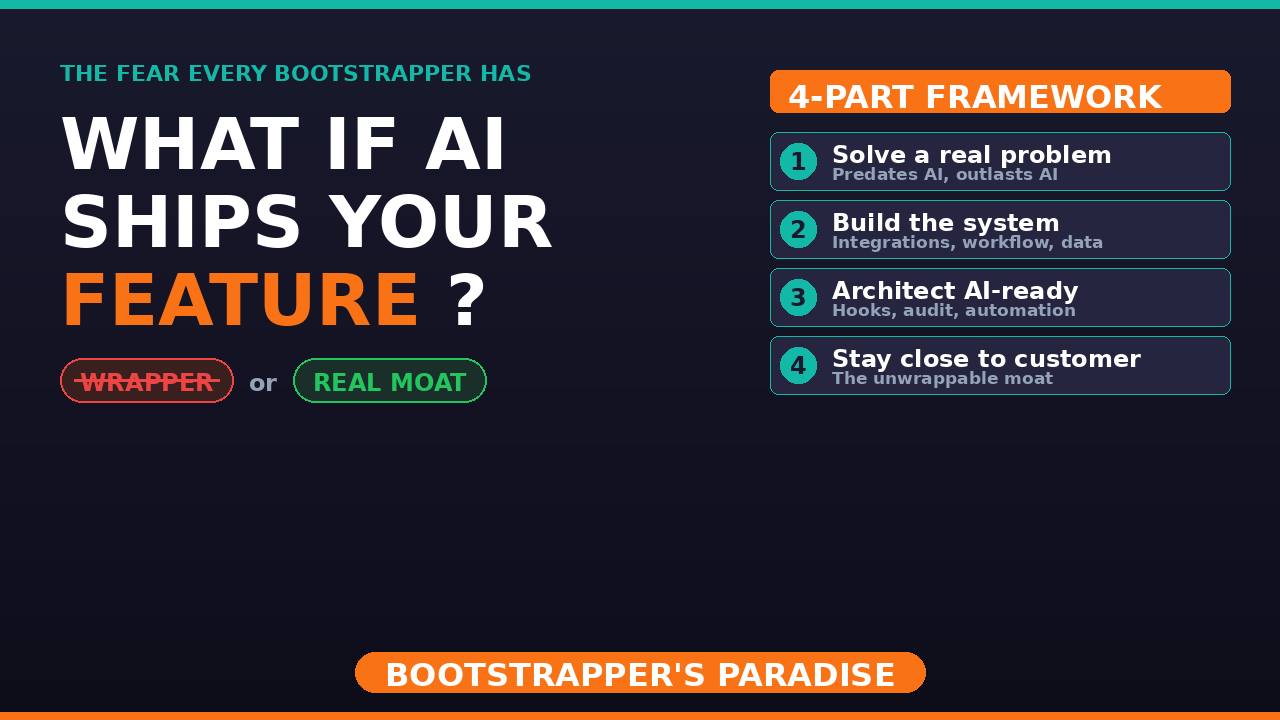
What if OpenAI ships a feature next Tuesday that kills your startup?
What if Anthropic releases an agent on Wednesday that does what your SaaS does — for free — in everyone's browser?
This is the fear keeping every SaaS bootstrapper awake at night. Today I'm going to give you the honest answer.
The threat is real. The threat is also wildly overstated. And the framework for not just surviving it but using it to accelerate your business is clearer than most people think.
Let's break it down.
The Fear Is Real
AI is moving faster than any technology shift I've ever seen, and I've been in tech a long time.
- New features ship daily
- Capabilities are basically doubling every few months
- The things that were impossible last quarter are commoditized this quarter
That pace is genuinely unprecedented.
But here's the part that should give you comfort. If you've been in tech long enough, you know the only constant is change — and that change accelerates. This is normal.
It happened with the internet. It happened with mobile. It happened with cloud computing.
Every wave brought the exact same panic from people building on top of it: what if the platform ships my feature?
That fear is the cost of admission to building on a moving foundation. The founders who win these waves aren't the ones who pick the safest rock. They're the ones who learn to ride the wave.
AI is not happening to you. AI is the river. Your job is to learn how to swim in it.
The Bombshell Nobody Wants to Say Out Loud
If your startup actually dies overnight because of a single new AI feature, then you probably didn't have a very strong value proposition to begin with.
That's hard to hear. Think about it.
A real value proposition is built on something that takes time to replicate:
- Customer relationships
- Workflow integration
- Domain expertise
- Data accumulated over time
- Nuanced understanding of the industry
Those things don't get nuked by a model release. They get nuked by competitors who slowly execute over years.
If a feature drop on a Tuesday wipes out your entire moat, what you built was a thin layer over someone else's tech. You built a wrapper. And the wrapper got wrapped.
That's not a tragedy. It's a signal. If you wanted better protection, you should have been building something deeper from the start.
The One Question That Sorts Wrappers From Real Businesses
When you're worried about AI disruption, ask yourself an honest question:
If a model gets twice as good tomorrow, does that make my product more valuable to my customer or less?
- If the answer is less — you have a wrapper
- If the answer is more — you have a real business
The rest of this post is about how to make sure the answer for you is more.
What Everyone's Forgetting in the Panic
Just because AI can do something today doesn't mean every business will adopt it tomorrow.
The business world is painfully slow to adopt new technology. There's a reason for that.
Real businesses have:
- Processes
- Compliance requirements
- Regulators
- Legal teams
- Boards
- Employees with muscle memory
- Data sitting in five different SaaS platforms that don't talk to each other
- A CFO who needs three quarters to approve a new line item
Big AI companies are learning this the hard way right now. Adoption curves for enterprise AI are way slower than the demos suggest. The models can write the email, sure — but rolling that out across a 5,000-person company means rewriting policies, retraining teams, and getting through three rounds of legal review.
That doesn't happen overnight.
The window between "AI can do it" and "businesses actually use it" is years, not weeks.
That window is your runway. That's where SaaS bootstrappers live. That's where you build your real product, get your customers entrenched, and become the trusted partner they call when they're finally ready to add AI into the mix.
Why Businesses Aren't Actually Ready
This matters for how you build. Four reasons businesses can't just flip the AI switch:
1. Hallucinations. AI is non-deterministic. The same input can produce different outputs. For most business workflows, that's a non-starter. Finance can't have AI guessing on a tax calculation. Healthcare can't have it inventing a dosage. Legal can't have it hallucinating a citation. Real businesses need predictable answers to the same question.
2. Data security and exposure. Businesses now more than ever need their customer data, internal data, and IP protected. Sending all that to a third-party model raises real risk. Most enterprise legal teams won't sign off without serious controls in place. The Vercel breach that just happened? That kind of incident makes every CISO think twice about AI integrations.
3. Process and data fragmentation. Even if a business wanted to deploy agents to automate everything, those agents would hit a wall. Their processes aren't documented. The documentation that exists is out of date. Their data is scattered across ten different systems. The agent can't act if it can't see.
4. Humans don't go away easily. Replacing a team with agents requires re-architecting how the company runs. That's realistically months or years of change management at minimum. Most companies aren't ready for the conversation, let alone the execution.
Add it all up and you get a market that needs structure, predictability, and security — not magic. That's where your SaaS should live.
The Playbook: Don't Build a Wrapper
The single biggest mistake I see solo founders make right now is building an AI wrapper.
ChatGPT for X. Claude for Y. A chat interface bolted onto a prompt.
That is the riskiest position in the entire market because the model is the product — and you don't own the model.
The opposite approach is the safe and powerful one: take an old, expensive, painful problem in a real industry and solve it with a multifaceted product.
Take law firms tracking time and billing — exactly what I'm building with Clockless. That's been a problem for decades. The actual product isn't "AI for legal billing." The actual product is:
- The workflow
- Integrations with their case management system
- Exception handling
- Reporting
- Compliance
- Audit trail
- Team permissions
- Data accumulated over time about how their firm bills and performs
That is the moat. A hundred small things stitched together that solve a real problem.
A new AI model can't disrupt that overnight because the AI model isn't the moat. The moat is the integration depth, the workflow knowledge, and the customer relationships built around it.
When you're picking what to build, pick something where AI is one ingredient in a multi-course meal — not the whole dish.
That's the difference between getting wrapped by the next model release and accelerating because of it.
Design for AI Readiness, Not AI Centrality
Here's the second piece of the playbook. Design your product to accommodate rich AI features when your customer is ready for them — not as the centerpiece, but as a layer that gets richer as the underlying tech improves.
What that looks like in practice:
- Your data model is structured so an AI agent could read it later
- Your workflows have clear automation hooks
- Your permissions are clean enough to let AI take certain actions on behalf of a user
- Your audit log is robust enough to track what humans did versus what AI did
- You build for a world where the customer might say okay, now I want AI to handle X — and you can flip it on or off for them
When you build that way, every advancement in AI makes your product more valuable to the customer, not less. Better models mean smarter automation inside your existing product. New capabilities slot into your existing surface area.
You become the place where they use the new AI. Not the thing that gets replaced by it.
This is the inverted strategy. AI advances aren't a threat. They're free fuel for your existing engine.
The Four-Part Strategy
If you do these four things, AI advancement stops being a threat and starts being an accelerator.
1. Solve a real age-old problem. Not a problem that exists because AI exists. A problem that existed before AI and will exist after AI. Industries with regulatory complexity, deep workflows, and fragmented data are gold.
2. Build the surrounding system, not just the AI features. Integrations, workflow, permissions, reporting, data accumulation over time, customer-specific configuration — the boring stuff that compounds. That's your moat.
3. Architect for AI ready. Clean data model. Clean automation hooks. Clean audit trail. When the customer is ready for more AI, you're already there waiting.
4. Stay close to your customer. Know what their business needs are. Know what AI can and can't do for that industry today. Be the trusted advisor who tells them when to add AI and when not to. That relationship is the one moat no AI feature can ever wrap.
Solve a real problem. Build the system. Architect for AI. Stay close to the customer.
Four boxes. If you can check all four, you can sleep at night even when Anthropic ships something brand new at 2 a.m.
Know What AI Is Actually Good At
You can't defend against something you don't understand. Spend real time learning what AI is actually good at and what it isn't.
What AI is great at right now:
- Pattern matching on huge amounts of unstructured text
- Drafting first versions
- Summarizing, translating, generating boilerplate
- Creative work that doesn't have to be perfect
What it struggles with:
- Deterministic outputs
- Complex multi-step workflows that require state
- Anything safety-critical
- Anything where the cost of being wrong is high
- Anything requiring deep context about a specific business it's never seen
- Anything where the user can't tell whether the answer is right
Map that against your customer's industry. The gaps are where you live. The places where AI can almost do something but not quite reliably enough for a real business.
Those gaps don't close fast. They take years. That's where your SaaS goes.
If you nail this map, AI advancement isn't a disruptor. It's an accelerator that quietly absorbs into the value you deliver.
Free Tools to Help
If you want help making sure your SaaS idea has a real moat and isn't just a wrapper, the SaaS Idea Validator is free at bootstrappersparadise.com in the free tools section. It'll score your idea against everything we just covered.
- SaaS Idea Validator — tools.bootstrappersparadise.com/validator
- Problem Finder — tools.bootstrappersparadise.com/problem-finder
- Pricing Calculator — tools.bootstrappersparadise.com/pricing
- Free 5-Day Email Course — bootstrappersparadise.com
And if you want to make progress on your SaaS business even faster, apply for private coaching at bootstrappersparadise.com so we can work one-on-one on wherever you're stuck.
Don't let AI fear stop you. Build deeper. Stay close. Keep shipping.
Sean is building Clockless, a legal billing SaaS, in public at bootstrappersparadise.com. Join the free 5-day email course to learn the bootstrapper's approach to building SaaS with AI.
Ready to Build Your Own SaaS?
Learn how to go from idea to launch in my free 5-day email course — no coding or big budget required.
Start the Free Course