Was The SaaSpocalypse Cancelled?
Six months after AI agents triggered a trillion-dollar software selloff, the index is green again and private equity is circling. But look one level down and it's not a recovery — it's a bifurcation. The crash is over. The verdict isn't.
About six months ago I made a video about the SaaSpocalypse. The market had just decided that AI agents were going to eat software as a service, and it repriced the entire sector in about two days.
Here's what's happened since. The index came back. It's green. Private equity is circling. Airtable just sold. Workday is in talks to go private in one of the biggest software buyouts ever.
So the obvious question is whether the whole thing was overblown, and whether we can go back to normal.
The answer is no, and the reason why is the most useful thing I can tell you this year.
The crash is over. The thing the crash was about is not over.
What actually happened
Quick recap for anyone who missed the first video on this.
Back in January, Anthropic shipped a tool called Claude Cowork, a desktop agent that reads your files, connects to your tools, and does multi-step work on its own. Two and a half weeks later they shipped a set of open-source plugins for it, including one aimed at legal workflows.
On February 3rd, the market did the math out loud. A basket of US software stocks dropped about 6%, the worst single day since the tariff selloff the year before. Roughly 285 billion dollars in market value gone in about 48 hours. Legal and data names got hit hardest, with one legal services company down almost 20% in a day and a major data provider posting its largest single-day decline on record.
That was the start, not the end. By the close of Q1, more than a trillion dollars had come out of enterprise software. The software ETF was down about 21% year to date. A broader index tracking more than 120 public software companies was down almost 26%.
The scariest number wasn't any of those. At the March bottom, forward software multiples hit about 22.7 times, which put software below the S&P 500 for the first time in the history of the cloud era.
Think about what that means. For twenty years, software got a premium just for being software. Recurring revenue, high margins, low marginal cost. At the bottom in March, the market said that premium is gone.
The logic was simple and it had a name: seat compression. Enterprise software was priced on human headcount. Agents don't need seats. If one agent does the work of five people, you don't need five licenses, and that's what started the selloff.
The recovery nobody expected
Here's what happened next, and this is the part people point at when they say the SaaSpocalypse has been cancelled.
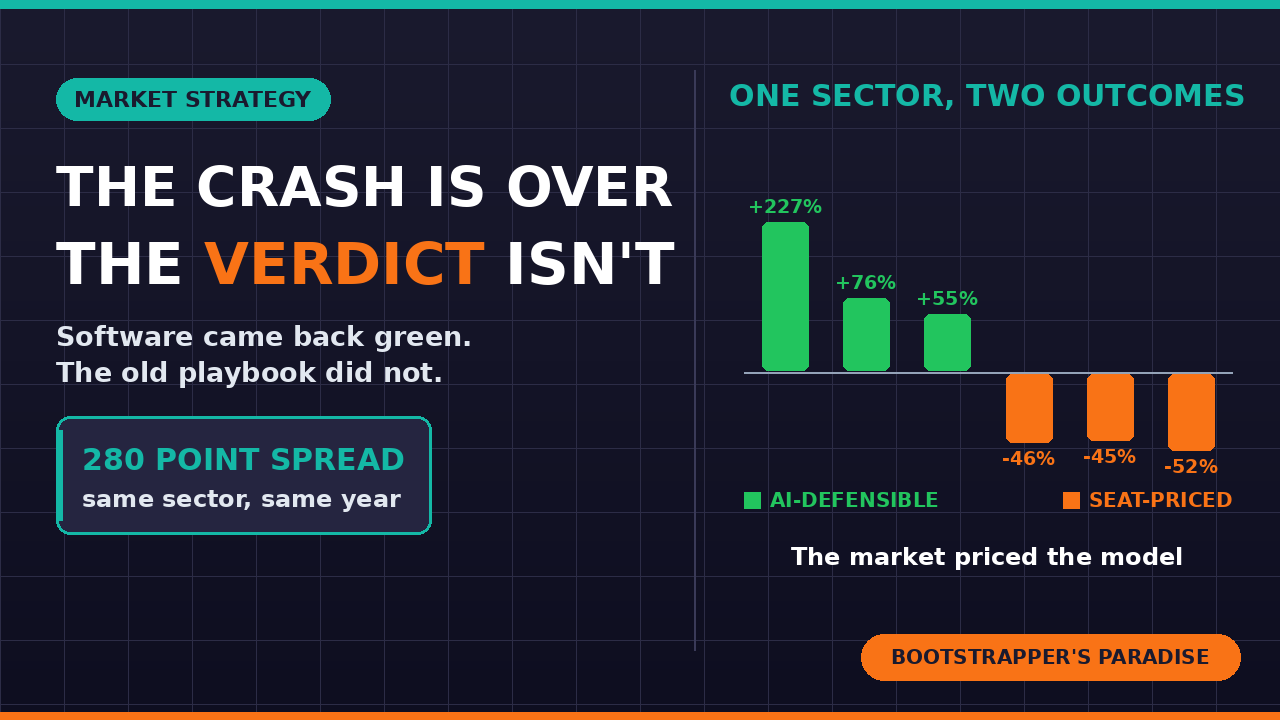
March was the bottom, but by late May the public software basket was back in the green for the year. Some names went on absolute tears. One cloud infrastructure company the market had written off as a commodity finished up more than 200% on the year. An observability company was up 76%. A security company up 55%.
The dealmaking came back too. Earlier this year a payroll and HR company got taken private in a multibillion dollar deal. Two weeks ago Airtable agreed to sell to an Italian software holding company for almost 1.3 billion dollars. Last week Reuters reported Workday was in talks to go private at roughly 43 billion dollars, which would be one of the largest software buyouts ever. Workday jumped 18% on the news and dragged a bunch of European software names up with it.
So on the surface, it looks like a full recovery. Crisis over, back to normal.
Look one level down and it's a completely different story.
It's a bifurcation, not a recovery
The index is green because the biggest infrastructure names carry it. The median software company is still climbing out of a deep hole.
Look at the spread. On the winning side that same year: one infrastructure name up 227%, observability up 76%, security up 55%. On the losing side, over the exact same period: a marketing automation company down 52%, one of the best-known CRM and marketing platforms down 46%, a work management platform down 45%, a collaboration giant down 36%.
That's a spread of nearly 280 points between the best and worst name in the same sector, in the same year.
Here's the detail that should stop you cold. That CRM and marketing platform down 46% grew revenue 23% with gross margins above 83%. The business is performing very well. The market cut it down anyway.
The market wasn't pricing the quarter. It was pricing the model.
That's the whole story of 2026 in one sentence. The index recovered, but the verdict did not change.
The part that's just the old cycle
Let's separate signal from noise, since a good chunk of what happened is the same movie we've seen three or four times by now.
Panics overshoot. When roughly three quarters of software stocks screen as oversold, the bounce is violent. One identity company was up 28% in a single session. The deepest cuts saw the sharpest snap-backs. That's mechanical, not insight.
Cheap attracts capital. Multiples got crushed to around three times revenue after sitting near seven a year earlier. That's exactly when private equity shows up. The Airtable deal and the Workday talks aren't a verdict that AI fear was wrong. They're a verdict that prices got low enough to be interesting.
The exit window follows the public bottom on a lag, usually two to four quarters. Same pattern as 2022, and 2008, and 2001.
If you only had those three, you'd conclude this was a normal cycle and go back to what you were doing.
Don't do that. Look at what didn't revert.
The part that's genuinely new
Four things changed permanently. These are the ones that matter to you.
One. The market now prices AI-defensibility separately from growth.
Two companies growing at the same rate can trade 200 points apart based purely on whether their product looks more valuable or less valuable as agents spread. That's a new axis. It didn't exist eighteen months ago, and it's now the first question every buyer, investor, and acquirer asks.
Two. The pricing model actually moved.
This isn't a forecast anymore, it's in the data. Pure per-seat pricing dropped from 21% of SaaS companies to 15% in about twelve months. Hybrid models, a base fee plus consumption, jumped from 27% to 41%. Gartner projects at least 40% of enterprise SaaS spend shifts to usage, agent, or outcome-based pricing by 2030.
Support tools now charge per resolved conversation, roughly a dollar or less each. That's not a pricing experiment. That's the unit of value moving from "who logged in" to "what got done."
Three. The efficiency bar reset, and it's not close.
Median annual recurring revenue per employee across a few hundred SaaS companies jumped 29% in one year, from about 150,000 dollars to 193,000. Public SaaS medians run near 395,000.
Then look at the AI-native cohort. Benchmarking puts the best AI-native companies averaging around 1.13 million dollars per employee, with individual companies well past 3 million. One AI app builder crossed 400 million dollars in recurring revenue with 146 full-time employees.
That's not 20% better. That's an order of magnitude, and it resets what investors and acquirers consider normal.
Four. The speed record broke.
That same app builder went from 1 million to 100 million in recurring revenue in about eight months, the fastest anybody has ever done it. It crossed 500 million in June, less than three years after being founded, and it's now seeing a million new projects a week.
Meanwhile the company that triggered the whole crash shipped the agent in mid-January, shipped eleven plugins for it before the month was out, and shipped a security product three weeks after that.
That's the real headline. The development velocity of the entire industry went up, and everybody's expectations went with it.
The three moves that are working
So what are the companies on the right side of that 280-point spread actually doing? Three things, and you can do all three at your scale.
Move one: ship AI where it beats the old way outright
Not AI sprinkled on top. AI where the new way is exponentially better than the old way.
Building a website used to mean picking a host, wrestling a content management system, hunting for a theme, fighting plugins, and losing a week or more. Now you describe what you want and iterate on the result in an hour. That's not a feature, that's a category being rebuilt, and it's why that company put up numbers nobody had seen before.
The test is simple. If your AI feature saves someone a click, that's a nice-to-have. If it removes a step from their process, or removes an entire tool from their stack, that's a real reason for customers to switch to you.
Move two: use AI on your own build velocity
The company at the center of this story ships at a pace that would have been impossible for a team that size three years ago. Agent in January, plugins two and a half weeks later, security product three weeks after that.
You don't have their resources, but you don't need them. What you need is the same operating principle: every release cycle you compress compounds, since faster cycles mean more shots on goal, which means more chances to find what your customers really need.
Move three: put agents to work at your company, not just on your product
This is the lever my coaching clients underuse, and I'm constantly on them about it. It's less obvious because it's internal, which doesn't make it any less powerful.
The reason revenue per employee jumped 29% in a single year is that companies stopped hiring for things agents now handle. One venture firm found its portfolio companies using AI for content and demand generation were running marketing teams 35% smaller than same-stage peers with the same pipeline. Another dataset showed finance teams covering 8 to 12 million dollars of recurring revenue per person, versus 4 to 6 million on traditional workflows.
As a solo founder, you don't have a marketing team to shrink. You have you. Which means the same leverage shows up as scope: the things you'd have hired for, or just never did, are now a keystroke away.
What this means at your scale
It's easy to read a section about 43 billion dollar buyouts and conclude none of it applies to you. Let me make the case that these strategies are more powerful in your hands than in any existing enterprise SaaS company's.
You have no installed base to protect. Every one of those companies down 40 or 50% has customers, contracts, and a revenue model built around seats they can't casually unwind. Repricing them takes years and a lot of angry renewals. You can pick the right model from the jump.
You have no committee. Their agent roadmap goes through a product council, a security review, and a board. Yours goes through you.
You're small enough for the gaps. The bifurcation is being decided at the category level for big companies. At your size you get to pick a specific workflow in a specific vertical, which is exactly where the AI-defensible answer is easiest to find.
The thing to take away is this. SaaS isn't dead. A trillion dollars came out and then a lot of it came back, and companies are getting bought at great prices right now. The opportunity is completely intact.
What died is the assumption that being software was enough. The old playbook, seats and logins and a premium for recurring revenue, is not coming back. The market already voted on that, and it didn't change its mind during the recovery.
The good news is that the new playbook is reasonable, it's short, and being small makes it easier to follow.
Your playbook to follow
- Answer the defensibility question in writing. Does your product get more valuable as agents spread, or less? One sentence. If you can't write it, that's your first project.
- Decouple your pricing from seats. Move toward the work getting done: per record, per resolution, per document, per outcome. Hybrid counts too, and it's where most of the market is landing so far. Bonus points for building your customer's ROI into your business model.
- Ship one AI feature that removes a step, not one that saves a click. Pick the ugliest part of your customer's workflow and take it out entirely.
- Compress your own build cycle. Measure how long an idea takes to reach a customer today, then figure out how to cut it in half with the tools you already have.
- Put agents on your own operations before you hire. Support triage, research, content, onboarding. Every function you don't have to staff is scope and margin you get back.
- Put your AI answer on your homepage and into your sales conversations in plain language, since customers, investors, and acquirers are all asking the same question now, and silence reads as "we don't have one."
Where to go next
Step two is the one people get stuck on, since moving off seats sounds great until you have to pick an actual number. That's what my free Pricing Calculator is for. It walks you through value metrics plus what and how to charge in the AI era: tools.bootstrappersparadise.com/pricing
If you want to work through your own pricing and AI strategy with me directly, I take a small number of founders for private 1:1 coaching: bootstrappersparadise.com/#coaching
So, was the SaaSpocalypse actually cancelled? The crash was. The verdict wasn't.
Software still works. It's just that the premium now goes to companies that can prove they get better as AI gets better, instead of companies holding on to the dying old model for dear life. The faster you adapt, the sooner you succeed.
Ready to Build Your Own SaaS?
Learn how to go from idea to launch in my free 5-day email course — no coding or big budget required.
Start the Free Course