Vibe Coding Won't Kill SaaS (Here's The Proof)
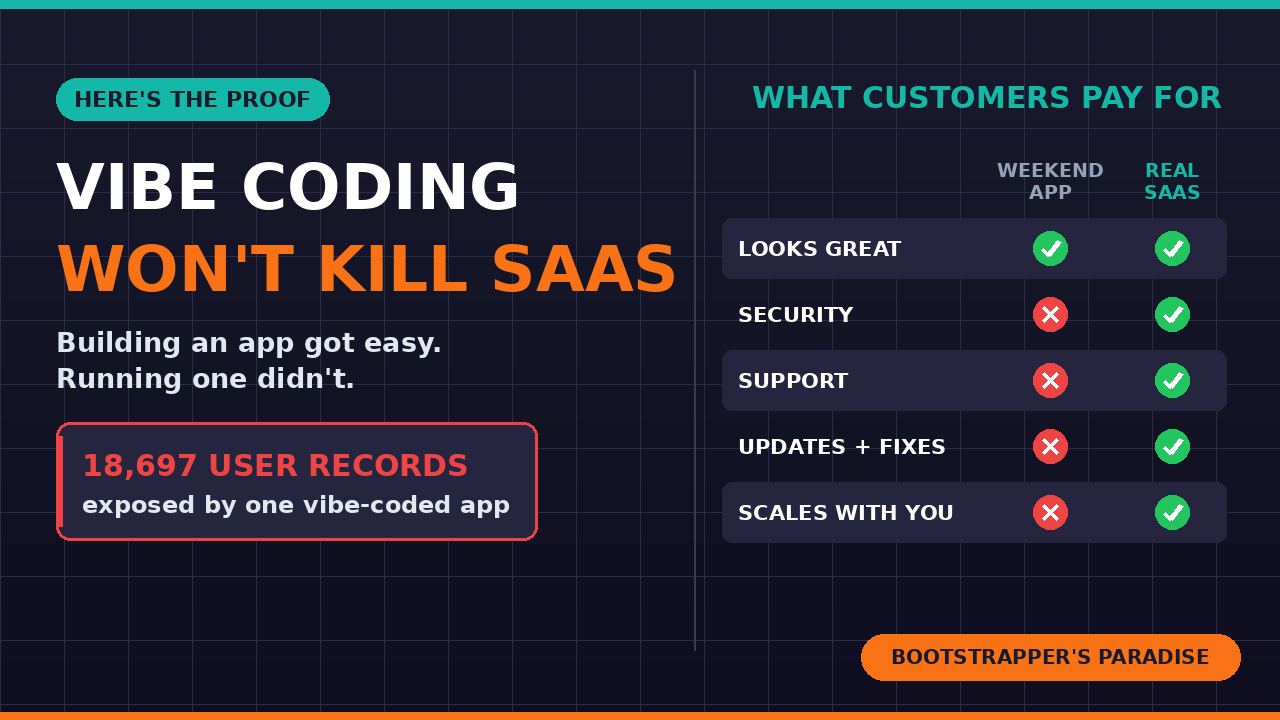
Vibe coding makes prototypes faster, but it does not replace security, support, updates, reliability, and infrastructure. Those are the parts customers pay SaaS companies for.
You've probably heard this one by now. Anyone can vibe code an app in an afternoon, so why would anyone keep paying for SaaS? Just describe what you want, let AI build it, and cancel your subscriptions.
It sounds convincing, and it's everywhere right now. I just don't think it's happening, and the evidence says it isn't either.
Let me show you why your customers aren't going to vibe code their way out of paying you, and why vibe coding is actually good news for SaaS founders, even if anyone can build an app in an afternoon now.
This picks up right where my last piece left off. If you missed it, start with The SaaS Death Trap: Why Everyone is Wrong About AI.
Most people will never build software
Let's start with something a viewer said on my last video, since it stuck with me.
He's been a developer for about thirty years, and his point was simple. Grandma isn't going to vibe code her own games. He also said he has clients who still think a USB thumb drive is the coolest tech there is, and there's no way they're ever building their own software.
I couldn't agree more, and I see the same thing with my own customers. Most people don't want to build anything. They want the problem to go away so they can get back to their actual job.
The people vibe coding their own tools are a tiny slice of the market, and plenty of them are builders like us, not the customers we're selling to.
The flood of apps is real
Now, to be fair, vibe coding is absolutely changing something. Apple's App Store got about 557,000 new app submissions in 2025, according to Appfigures. That's up 24% from the year before, and the first real jump in submissions in years.
So yes, a lot more software is getting built. Here's the part people miss, though. That's more products competing for the same customers. It's not customers building for themselves.
If anything, that flood makes it harder to stand out, which means the products that are actually better and actually reliable become even more valuable.
Where vibe-coded apps break
So what happens when vibe-coded apps meet real users and real data? This is where it gets interesting.
In February, a security researcher looked at an app built with AI and hosted on Lovable. It was featured on Lovable's own Discover page. He found sixteen vulnerabilities, six of them critical. Around 18,700 user records were exposed, and someone who wasn't even logged in could grade student tests or delete accounts.
That's not a one-off. In May, the security firm Red Access found about 380,000 publicly accessible apps built with AI coding tools like Lovable, Replit, Netlify and Base44. About 5,000 of them were exposing potentially sensitive information, including medical records, financial documents, and customer contact details.
To be fair to the platforms, they point out that security settings are up to the person building the app. That's exactly the point, though. The person vibe coding usually isn't thinking about row-level security or access controls. They just want the app to work.
I'm sure by now you can see why a business owner might think twice before trusting their customer data to something they whipped up over a weekend.
It's still the tip of the iceberg
If you read or watched The SaaS Death Trap, you already know where I'm going with this.
Vibe coding builds the tip of the iceberg. It gets you a demo that looks great. It doesn't give you security, support, updates, bug fixes, performance, or infrastructure that holds up as you grow.
That's the part customers are actually paying for when they pay for SaaS. It's someone else's full-time job to keep the thing working, so it doesn't have to be theirs.
Where vibe coding is genuinely great
Now, I don't want you to walk away thinking vibe coding is bad. It's genuinely great at a few things, and as a bootstrapper you should be using it.
- Prototypes, so you can show a customer an idea before you commit to building it.
- Landing pages and quick validation tests, so you can see if anyone actually wants the thing.
- Internal tools that only you will ever use.
Pro Tip – use vibe coding to answer the question "should I build this?" before you spend months answering "how do I build this?" That one shift will save you a lot of time and money. If you want to pressure test an idea right now, my free SaaS Idea Validator is built for exactly that.
What this means for you
So what does this mean if you're building a SaaS right now? It's good news, as long as you play it right.
First, stop worrying that your customers will build their own version. Most of them won't, and the few who try often come back once they hit the iceberg.
Second, use vibe coding to move faster on the front end of your process: prototypes, tests, and early versions.
Third, take the boring parts seriously. Security, reliability, support, and updates are exactly where a weekend app falls apart, and they're where you earn your customers' trust.
When you combine AI speed with real reliability, you get something a vibe coder can't match. Every little bit helps when you're a bootstrapped founder, and this is a big one.
Your playbook to follow
- Don't panic over "everyone will vibe code their own software." Most customers just want the problem gone.
- Remember that more apps means more competition, not fewer customers.
- Use vibe coding for prototypes, landing pages, and validation tests.
- Treat security, support, and reliability as part of the product, not an afterthought.
- Make your reliability visible, since it's what a weekend app can't match.
- Combine AI speed with real trust, and keep doing both.
Sources
- The Register, Lovable-hosted app littered with basic flaws exposed 18K users, February 27, 2026
- eWeek, Thousands of AI vibe coding apps may expose sensitive medical, business data, May 2026
- Appfigures, The App Store just logged its biggest release year in nearly a decade
Where to go next
If you want to build a successful SaaS business, start with my free resources. The 5-day email course is the best place to start: bootstrappersparadise.com/#course
If you want to map out your own path with me directly, I take a small number of founders for private 1:1 coaching: bootstrappersparadise.com/#coaching
Vibe coding made building an app easier than ever. It didn't make running one any easier, and that's why SaaS isn't going anywhere.
Ready to Build Your Own SaaS?
Learn how to go from idea to launch in my free 5-day email course — no coding or big budget required.
Start the Free Course