SaaS Is Dead, Part 2: How To Turn Your SaaS Into An AI-Native Company
Turn your SaaS into an AI-native company without forcing customers to start over: automate the bottleneck, retain their workflow, and increase automation as trust grows.
In my last piece I told you to start calling yourself an AI company instead of a SaaS company, but only if AI does real work for your customer. If you haven't read or watched that one yet, start there: Is SaaS Dead? Why Your Company Needs an AI Pivot.
Getting AI to do real work for your customer is where a lot of founders get stuck. If you haven't quite figured that part out yet, or you feel like you can do better, this is for you.
The SaaS label is working against you unless it's accompanied by AI as well. So let me show you how to get unstuck and turn your SaaS into an AI-native company, even if your customers hate change.
Expectations changed
Let's start with what's actually different now, because it's bigger than a label.
For decades, good software helped people do their work, and that was enough. It isn't anymore. Your customers have used AI tools by now, and they've seen software that does the work instead of just helping. Once someone has seen that, it's hard to go back to clicking through ten screens for the same result.
The growth bar moved too. Stripe looked at the top one hundred AI companies on its platform and found they reached five million dollars in annualized revenue in about twenty-four months. The top one hundred SaaS companies from a few years earlier took about thirty-seven months to get there.
So it's not enough to have an answer for AI when a customer asks about it. You need to lean into it. I know that sounds like a lot, but hang in there, it's simpler than it sounds.
A team of one with AI
First, what this means for you as the founder.
If you're anything like me, you're a team of one, or close to it, without a product, design, or support team behind you.
What you do have is AI. That means you should be able to build, ship, fix, and support everything about ten times faster than a founder could a few years ago. That's not a brag, it's the new baseline, and the market expects it.
Customers notice speed now. A bug that sits for two weeks used to be normal for a small company. Today it looks like an abandoned product.
Pro Tip – this actually works in your favor. A big company with a dozen approval meetings can't move this fast. You can, and that's one of the few unfair advantages a bootstrapper gets.
That's the operations side. Here's what changes inside the product itself.
Automate the bottleneck
Your product needs to automate your customer's biggest bottleneck, and it needs to do that better and faster than whatever they're doing today.
Notice I said bottleneck, not everything. Every customer has one or two steps in their work that eat up most of their time. That's where AI should go first, since that's where the time savings are big enough for someone to actually feel them.
If you're not sure where that bottleneck is, my free Problem Finder will help you figure it out for your market.
Now, this is where a lot of founders take a wrong turn, and there are two ways to get it wrong.
The magic box trap
The first wrong turn is building a magic box.
A magic box is software where data goes in, an answer comes out, and the customer has no idea what happened in between. It looks impressive in a demo, but in real life it confuses people, and people don't trust what they can't see.
Klarna is a good example of how this plays out at scale. They rolled out an AI assistant for customer service and said it could do the work of about seven hundred agents. A little over a year later, the company said quality had dropped and started hiring human agents again. The line from leadership was that "there will always be a human if you want."
If a company that size had to walk it back, you really don't want to learn this lesson the hard way as a bootstrapper.
Don't change everything at once
The second wrong turn is one I see a lot with bootstrappers specifically.
They decide to change how the whole job gets done, since AI can do it better now, and to be fair, it might.
The problem is that this assumes your market is ready for a big disruption, and most markets aren't. People adapt to new ways of working very slowly, even when the new way is clearly better.
MIT found that roughly ninety-five percent of enterprise generative AI pilots delivered little to no measurable impact on profit, and the main reason wasn't the technology. The tools just didn't fit how people actually work.
A buyer survey from INFUSE this past June found that fitting into the systems buyers already use is now the top thing they evaluate. Established vendors adding AI are also drawing about five times the interest of AI-native newcomers. That survey was of enterprise buyers, so treat it as a signal rather than a rule for every market, but the direction is hard to ignore.
So the problem usually isn't your AI. It's how much change you're asking your customer to adapt to at once.
Keep a foot in both worlds
So what should you do instead? Some great advice I heard a long time ago was to keep a foot in both worlds. Build a system that works well today and tomorrow, and your life will be much easier.
In practice, I've found the right balance is a hybrid approach. You follow your customer's old process, but you make it easier and faster for them.
Here's what that looks like in my own software. My fintech product produces due diligence reports, which are what accountants put together when a business is being bought or sold.
I built an AI agent that can do just about all of that work for them, but I also kept the old way. If an accountant wants to do everything themselves in a spreadsheet, the way they always have, the software supports that too.
The important part is that they can go back and forth. They can start in the spreadsheet, hand a section to the agent, check its work, and take it back. Then they move more of the work to the agent when they're ready.
Nobody has to start over, and nobody has to trust a magic box on day one.
You can see the same idea at a much bigger scale. When Microsoft added an AI agent to Excel, they put it right inside the spreadsheet people already use. They didn't ask anyone to learn a brand new tool.
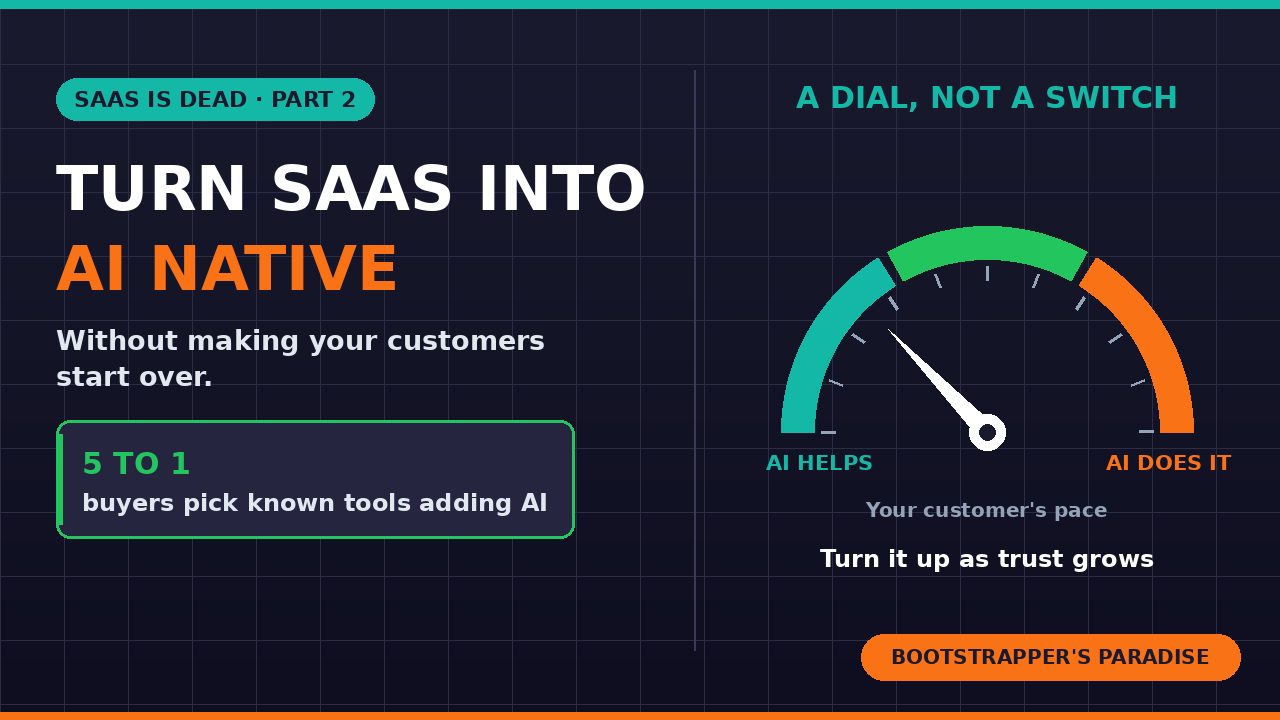
Think of it like a dial instead of a switch. You start with AI helping, then turn up the automation as your customers start to trust it. This sounds simple, but most people skip straight to the end.
My system for going AI native
So here's my system for converting a SaaS product without losing your customers along the way.
- Map your customer's current process step by step, the way they actually do it today.
- Mark the two or three steps that eat up the most time.
- Let AI do the work in those steps, but keep the output in the format your customer already uses. If they live in spreadsheets, give them a spreadsheet. If they send a certain report, give them that report.
- Keep a checkpoint where the customer reviews and approves what the AI did. That's what keeps you out of the magic box.
- Measure the time you're saving them and sell that, not the AI.
Your playbook to follow
- Be honest about where you are. If AI isn't doing real work in your product yet, that's your starting point.
- Use AI to run your own business faster, since the market expects it.
- Find your customer's biggest bottleneck and point AI there first.
- Keep their old process working while you add the AI version alongside it.
- Let customers move between the old way and the new way at their own pace.
- Sell the time you save them, then turn up the automation as their trust grows.
Sources
- TechCrunch, Stripe CEO says AI startups are growing faster than SaaS ever did
- Entrepreneur, Klarna hiring customer service agents again after AI couldn't cut it
- Fortune, MIT report finds most generative AI pilots at companies are failing
- INFUSE, Voice of the Buyer AI Research Reality Check, June 25, 2026
- GeekWire, Microsoft brings agent-powered AI to Excel, Word and PowerPoint
Where to go next
If you want to build a successful AI SaaS business, start with my free resources. The Problem Finder is the right first step here, since everything above starts with knowing your customer's biggest bottleneck: tools.bootstrappersparadise.com/problem-finder
If you want to map out your own path with me directly, I take a small number of founders for private 1:1 coaching: bootstrappersparadise.com/#coaching
Going AI native doesn't mean making your customers start over. It means doing more of their job for them, in a way they already understand, at a pace that's comfortable for them.
Ready to Build Your Own SaaS?
Learn how to go from idea to launch in my free 5-day email course — no coding or big budget required.
Start the Free Course