The Only SaaS Moat That Ever Mattered (Even More Relevant Now In The AI Era)
AI can copy a feature or even a whole product. It cannot copy the customer feedback loop that lets a focused SaaS business keep improving faster than competitors.
In my last piece we looked at how AI was used to clone the entire Adobe lineup, and how the Photoshop clone looked like Photoshop but didn't really work. If you missed it, start there: The SaaS Death Trap: Why Everyone is Wrong About AI.
In the AI era, it feels like everyone is hunting for a new moat. Data, distribution, labor budgets, agents. Every week there's a new theory about what's going to protect software companies now that AI can probably copy just about anything.
I think there's only ever been one moat that really mattered, with or without AI in the world. Let me show you what it is, and why AI makes it stronger for a team of as little as one, even if a competitor can copy your whole product in a week.
Why I switched budgeting apps
Let me start with a personal story. For a long time I used YNAB to manage my personal finances.
Over time I kept running into the same problem. The integrations with my accounts kept breaking, and I was constantly reconnecting them, or updating my brokerage balances by hand just to keep things current. It got old fast. I wrote to them constantly about it and even applied to be a product manager there so I could fix it myself. Unfortunately, none of that went anywhere.
So I switched to Monarch. Monarch automated the stuff I didn't want to touch anymore, the account balances updated on their own, and I could finally stop babysitting my budget app. The experience was so much better for me, and I'm very happy I switched.
Here's the thing. I didn't switch because of price, and I didn't switch because of the brand. Plenty of people love YNAB, and this isn't about it being a bad product. At the end of the day, Monarch's product experience was just better for me.
I'm sure you can see where this is going. This is the real reason most of the customers who churn will leave you. So now that we know why, we need to figure out how to fix it proactively, before it happens.
Every layer boils down to one question
There are layers to this beyond the product itself.
You can be better on price. You can be better on support, on flexibility, or on agility. You can have a bigger feature set, a better UI and UX, or more integrations.
All of those matter, but notice what they have in common. Each one is just a different way of being better in a specific way.
So when you strip it all down, it really boils down to one question: do you provide the best experience when it comes to what matters most to your customer? Is your product better?
If the answer is yes, and you keep it that way, you have a moat. If the answer is no, the clever stuff probably won't save you. There's also no single category to rule them all. It's the combination of factors that matters most to your market.
The 47th company to show up
This isn't a new idea, by the way. It's been true for as long as there's been software.
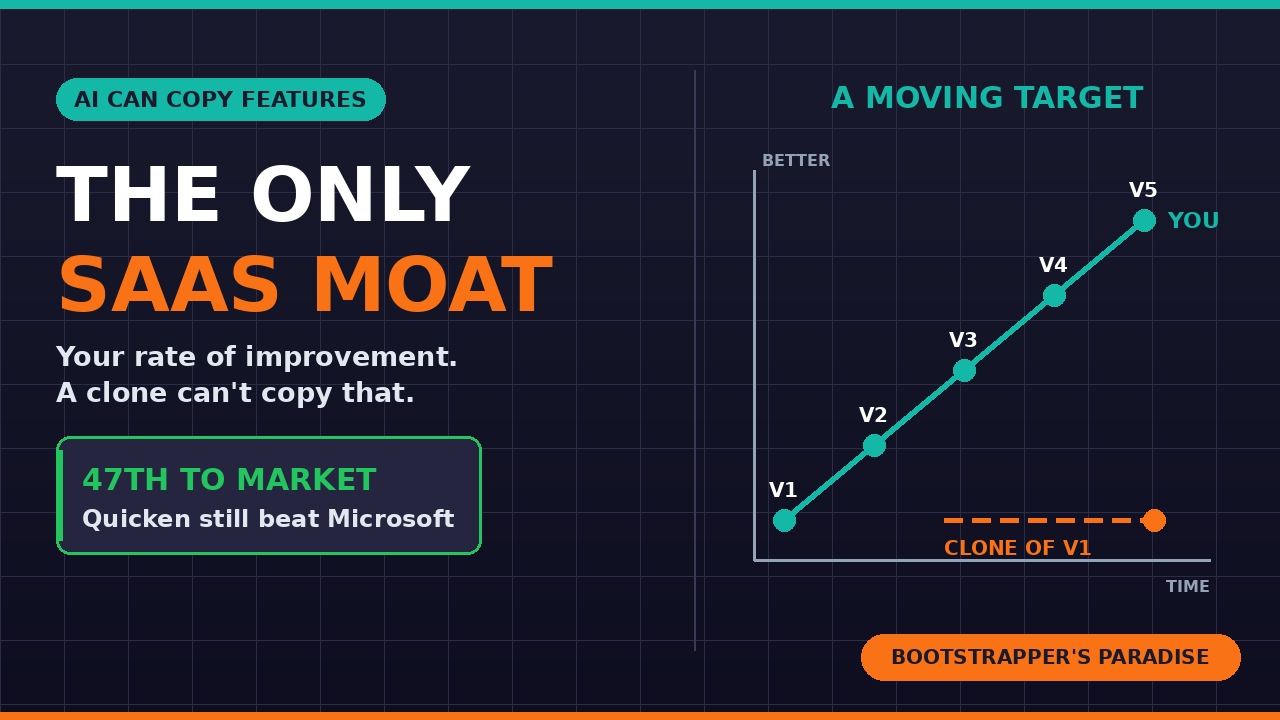
When Intuit launched Quicken, at least forty-six personal finance programs were already on the market. Quicken was number forty-seven, and it became the market leader anyway.
A lot went right for them, including some smart pricing and retail tactics. The thread running through all of it, though, was an obsession with making the product better. Intuit became known for its Follow Me Home practice, watching customers use the product in their own homes and offices, then fixing whatever tripped them up. They kept doing it even after they were in the lead.
When Microsoft came after them with Money in 1991, Quicken held on to the market. By the mid-nineties Quicken had around 70% of it, and Microsoft eventually stopped selling Money in 2009.
Being first didn't matter. Being better, and staying better, did. That's the real moat.
A feature isn't a moat, speed is
Here's where AI changes the picture, and it's not in the way most people think.
It's true that a competitor can copy any single feature now, sometimes in days. That's why a feature on its own isn't a moat anymore. What everyone is missing is that it never really was, so AI hasn't changed all that much here.
What they can't copy is your rate of improvement. That comes from your customers' feedback, and your competitor doesn't have your customers. Even if they did, there are plenty of reasons they'd likely fumble the chance to turn that feedback into the industry lead.
By the time a competitor has copied your version one, you're already shipping version five. They're chasing a moving target, and as long as you keep improving, they're always reacting to where you were.
Why AI makes this your ultimate moat
This is the part I really want you to take away. AI isn't a threat to a solo founder or a small team. It's actually the exact opposite, and you should consider it your secret weapon.
Small teams can move at light speed now. You can take customer feedback and turn it into a new UX in days, with no meetings and no approval chains.
Big companies have the same AI you do. Their speed is just throttled by process, so they can't use it nearly as well. Think of it like a cruise ship trying to catch a speed boat.
I've lived this with my own software. I built the first version of my fintech product for small-market buyers. Then I reworked it to move upmarket, since I saw the opportunity was much larger. After that, I redesigned it again for enterprise companies and the biggest firms, based on patterns I kept seeing across several prospective customers. My software is still in the early stages, but it's already been redesigned three times based on feedback from the market.
None of those changes came from guessing. They came from listening to the market and acting on it quickly, as a team of one. That's the superpower, and AI is what unlocks it for you.
My improvement loop
So here's my system for turning this into a real moat.
- Get initial feedback from your market. You need to validate your initial value proposition as soon as possible.
- Keep them. That means fixing whatever frustrates them first, since that's exactly what made me leave my old budgeting app.
- Capture their feedback everywhere it shows up: support tickets, calls, and how they actually use the product.
- Ship improvements in days, not quarters.
- Tell your customers what changed. It shows them their feedback led to the change they wanted, so it keeps coming.
Then rinse and repeat. As long as that loop keeps running, it's very hard for anyone to catch you.
Won't competitors just use AI too?
I know what you're probably thinking. Won't my competitors just use AI too?
Yes, they probably have access to the same AI you do. What they're unlikely to do is actually follow the process above, and it usually breaks down in one of two ways. I've been hired to fix these exact problems many times.
First, a lot of companies collect customer feedback and either ignore it or fail to process it. It sits in a support inbox or a sales call recording, and nothing ever changes in the product. That's a huge wasted opportunity.
Second, once a product starts to succeed, teams tend to get comfortable. Some decide they don't need to change anything anymore. Others get scared that any change might make the product worse, so they stop making them. That inaction is what eventually makes the product worse. They stop doing the thing that made them successful in the first place.
The key is to fight both. Get into a mode where you're continually making your product better no matter what, even when things are going well. As they say, the only constant is change, and the founders who embrace that are the ones nobody can catch.
Your playbook to follow
- Stop hunting for a clever moat. Ask one question: how can the product experience be better?
- Treat every layer, price, support, UX, integrations, as a way of being better.
- Land a wave of customers so you have real feedback to work with.
- Fix what frustrates them first, since that's why customers leave.
- Use AI to ship improvements in days, then tell customers what changed.
- Keep the loop running. Your rate of improvement is the moat.
Sources
- Knowledge at Wharton, How Intuit Found Fame and Fortune and Beat Out Microsoft
- Faster Than Normal, Intuit: The Forty-Seventh Mover
- Harvard Business Review, Intuit's CEO on Building a Design-Driven Company
- Consumer Reports, the demise of Microsoft Money
Where to go next
If you want to build a successful SaaS business, start with my free resources. The 5-day email course is the best place to start: bootstrappersparadise.com/#course
If you want to map out your own path with me directly, I take a small number of founders for private 1:1 coaching: bootstrappersparadise.com/#coaching
If you want to see how a team of one can run this whole loop, watch Product Builder Masterclass: PM, Designer, and Engineer Combined.
A clone can copy what you've built. What it can't copy is how fast you keep making it better.
Ready to Build Your Own SaaS?
Learn how to go from idea to launch in my free 5-day email course — no coding or big budget required.
Start the Free Course