How I Ship a Full Customer Roadmap in Hours, Not Months
The exact customer feedback loop I use to turn advisor and customer input into shipped, tested roadmap items with an agent doing the middle work.
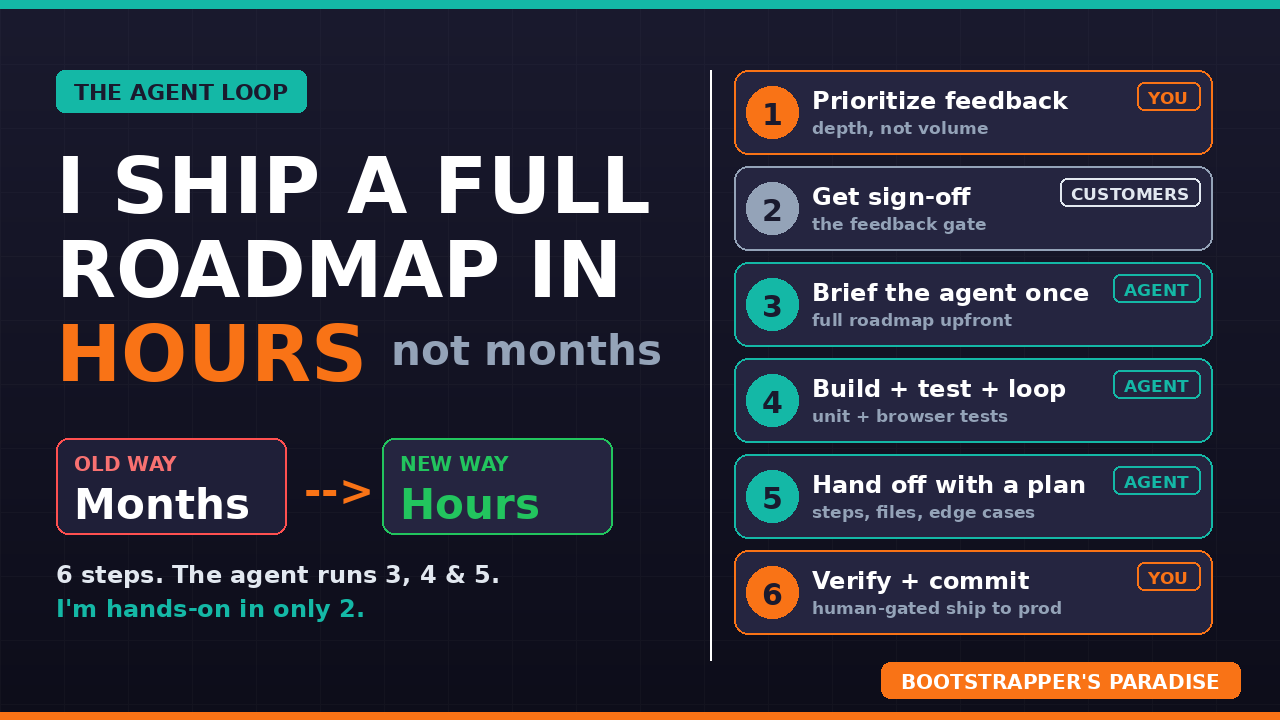
I can now ship an entire customer roadmap in the time it used to take me to ship a single feature.
That is not an exaggeration. It is measurable, week-over-week reality. A few months ago I shared the dev stack I switched to — the desktop coding agent, the rules file, the auto-commits, the browser-testing setup. That was infrastructure. It was about what tools I use and how they are wired together.
This is the part that sits on top of that infrastructure. It is the process. The exact loop I run every time a wave of customer feedback comes in, the one that turns that feedback into shipped, tested features in hours instead of months.
The principles here are transferable even if your stack looks nothing like mine. Let me break it down.
The whole loop in one picture
Six steps, and they form a cycle:
- Collect feedback and prioritize it into a roadmap.
- Send the roadmap back to advisers and customers for sign-off.
- Brief the agent once on the full roadmap.
- The agent builds, tests, and loops on each feature autonomously.
- The agent hands each feature off with testing instructions and sample files.
- I do manual verification, commit, and move to the next feature.
When the entire roadmap is built, I ship to production and run a smoke test to make sure nothing broke. That ships the wave. Then it is back to step one when the next wave of feedback arrives.
Here is the insight that makes the whole thing work: I am the bottleneck in only two places — prioritization at the start, and manual verification near the end. Everything in between is the agent. That is where the time math comes from.
Step 1: Collect feedback and prioritize by depth
I gather all the latest feedback from advisers and customers — emails, Slack threads, calls, notes, support tickets, anything that has come in since the last roadmap — and dump it into one document.
Then comes the critical part. Prioritization is depth-driven, not volume-driven.
The rule is simple. If multiple customers are asking for the same thing, that item bumps up. If one customer asks for something five times in five different ways, that is still one voice. If five different customers ask for the same thing once each, that is a strong signal. Depth of feedback equals priority.
I order the entire list this way. Top items get built first. Single-customer one-off requests go to a parking lot — not rejected, just deprioritized until they earn a second voice, or until that one customer is willing to pay for it as a custom build. A paid customization is its own validation signal: it tells you exactly how much that functionality is worth to them.
This is the same wait for the second voice principle I keep coming back to. It is the one discipline that protects you from building one customer's bespoke workflow while ignoring what the broader market is telling you.
What you end up with is a clean, ordered list, ready to brief into the agent. That is the input everything else follows from.
Step 2: The feedback gate I learned not to skip
Before I touch any code, I send the prioritized roadmap back to the customers and advisers who fed me those inputs. Not the full document — a brief summary, a couple of bullets per item, ordered, scannable in a few minutes.
The ask is simple: Here is what I heard. Here is the order I am planning to build it in. Approve it, adjust it, or flag anything I got wrong.
This single step does three things:
- It catches misinterpretations before they cost me a week of building the wrong thing.
- It makes customers feel heard, which deepens the relationship.
- It gives me an explicit, written green light. If they approved item three and I ship item three, nobody can later say "that is not what I meant." We agreed on the summary in writing.
This gate has saved me more rework than any other discipline I have added. Skipping it feels faster. It is not.
Step 3: Brief the agent once
I brief the agent on the entire roadmap once, upfront — not feature by feature.
That one brief contains the roadmap in order, the success criteria for each item, and standing instructions that apply to all of them. The standing instructions look like this:
- Use the existing patterns in the codebase, defined in the agent rules file.
- Run the test suite after each change.
- Run the browser-testing server to click through the feature like a real user.
- Fix anything those tests catch before flagging the feature as ready.
- Only flag a feature as ready when both the test suite and the browser tests have passed.
I also tell the agent to work the roadmap sequentially — one feature at a time, commit when done, then move on. That sequencing matters because it gives me clean review points and clean rollback boundaries. If feature three breaks something, I am not also unwinding features four and five, since those have not been built yet.
That one detailed brief is the only context dump I do. From there, the agent runs.
Step 4: Build, test, and loop — where the magic happens
For each item on the roadmap, the agent runs the same internal loop:
- Build the feature.
- Run the unit and integration tests. If anything fails, fix it, then run them again. Repeat until green.
- Run the browser-testing server. This is the part I want you to internalize — the agent opens a real browser and clicks through the feature like a real user. It verifies the UI actually does what it is supposed to.
- If the browser tests catch a layout break, a button that does nothing, a form that will not submit — the agent fixes that too, then loops until the browser tests pass.
Only when both the unit suite and the browser tests are green does the agent flag the feature as ready for my review. Not before.
The looping behavior is the unlock. The agent does the boring iteration on bugs that I used to do by hand. I never see the broken intermediate states. I only see the feature once it is already passing every automated check.
This is what people miss about agent coding done right. It is not just "the AI writes the code." It is that the AI writes the code, verifies it, fixes its own mistakes, and only bothers me when it is actually working. That is the leap.
Step 5: The handoff
When the agent declares a feature ready, it does not just say "done." It hands me a full test plan with a few specific pieces:
- A short description of what was built and what changed.
- Step-by-step instructions for me to manually test it. For Clockless, that reads like: log in as a test user, go to the billing page, click New Invoice, fill in these fields, click Save, then confirm the invoice appears in the list.
- Sample files, if my test needs them. A PDF to upload, a CSV to import, a sample image — the agent generates them for me. I no longer break my focus hunting down a test asset the agent could have just created.
- An edge-case list to specifically poke at, so I can confirm the agent did not miss anything obvious.
This turns my manual verification from "what should I even check?" into "follow these five steps." It probably cuts my testing time by two-thirds, sometimes more. I am still doing the manual test — no agent should ship a product without a human eye on it — but the agent has eliminated all the friction around figuring out how to test.
Step 6: Manual verification, then commit
This step is mine. I open the feature, run through the agent's test plan, and make sure it looks and acts the way it should.
This is the step I will never automate away. Even with great unit tests and great browser tests, I want to see the feature with my own eyes before it goes near production. There are aesthetic judgments, micro-UX decisions, and product-feel elements that no test suite is likely to catch. That is what the manual pass is for.
If it passes my review, I commit it. If something is off, I send it back with notes and we iterate. Once a feature is committed, the agent moves automatically onto the next item.
That sequencing is part of why velocity stays high. While I review feature one, the agent has not started feature two — it is waiting for my green light. That keeps the queue clean and prevents tangled changes. The reviews are fast and the agent is autonomous on everything else, so throughput is dramatically higher than the old days of writing every line and doing all the testing myself.
Shipping the wave
The loop continues until every item on the roadmap is built, tested, and committed. When the full roadmap is done in dev, I ship to production.
This is still a human-gated push. The agent does not push to production — I do. After deploy, I run a quick smoke test on the critical paths: login, billing, the core workflow, plus any high-traffic pages we just changed. If anything is broken, I roll back immediately. If everything is clean, I let the customers and advisers know their feedback is now live.
That message back to them matters, because it closes the loop. They gave the feedback. They approved the roadmap. Now they see the result in production. Their trust deepens, the relationship strengthens, and they start sending more feedback — because they know it actually leads somewhere.
Then the next wave comes in, and it is back to step one.
The payoff
The throughput this gives me as a solo bootstrapper is unreal compared to a year ago. I am shipping in days what used to take weeks, and in weeks what used to take months. The customer feedback loop has tightened from "we'll get to it next year" to "you'll see it on Tuesday."
That changes everything about how customers feel about your product.
To recap the whole thing: collect feedback, prioritize ruthlessly, brief the agent once and then let it loop, and verify yourself before anything ships.
Validate before you build the loop
This loop is brilliant for shipping fast — but only if you are shipping the right thing. The fastest way to waste a tight feedback loop is to point it at an idea nobody actually wants.
Before you run a single wave through this process, pressure-test the idea itself:
- SaaS Idea Validator — score your idea against real demand signals before you commit a single hour of building: tools.bootstrappersparadise.com/validator
- Problem Finder — surface the real, repeated problems worth solving in the first place: tools.bootstrappersparadise.com/problem-finder
- Pricing Calculator — figure out what the outcome is actually worth so you are not underpricing it: tools.bootstrappersparadise.com/pricing
For the complete, free playbook on launching a SaaS business as a solo founder, sign up for the free 5-day email course.
Collect feedback. Prioritize ruthlessly. Brief the agent once, then let it loop. Verify yourself.
Ready to Build Your Own SaaS?
Learn how to go from idea to launch in my free 5-day email course — no coding or big budget required.
Start the Free Course