The SaaS Renaissance: Why This Is the Best Time in History to Bootstrap
Everyone is calling it the SaaS Apocalypse. But if you are a bootstrapped founder, this is not an apocalypse — it is a renaissance. The cost to build has collapsed, the niches are wide open, and the incumbents are too distracted to compete.
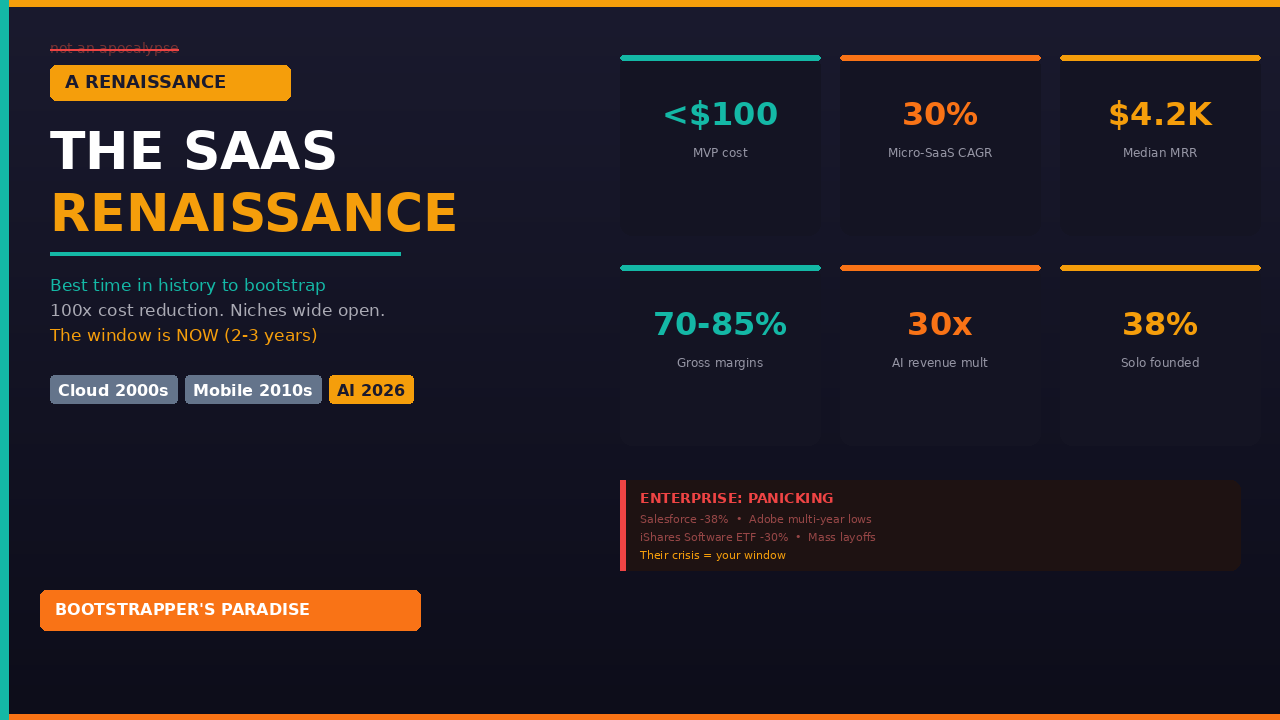
Everyone's calling it the SaaS Apocalypse. A trillion dollars wiped from software stocks. Per-seat pricing dying. Enterprise incumbents in freefall. But here's what nobody's talking about: if you're a bootstrapped founder, this isn't an apocalypse. This is a renaissance.
The cost to build has collapsed. The tools are nearly free. The niches are wide open. And those giant companies that used to be your competition? They're too busy trying to survive to even notice you.
This is the best time in the history of software to build a SaaS business with no investors, no team, and no permission.
Two Stories, One Market
The media is telling one story: SaaS is dying, software stocks are crashing, AI agents are replacing software. That story is somewhat true — but mostly for enterprise incumbents. For the Salesforces and ServiceNows charging $150 per seat to 50,000-person companies.
But there's a second story nobody's covering. While the giants are panicking, a new generation of solo founders is quietly building focused, profitable software businesses from their living rooms. The micro-SaaS segment is growing at 30% annually. Founders routinely hit $5K–$50K MRR with teams of 1–3 people. The median profitable micro-SaaS makes about $4,200 per month.
This isn't an apocalypse. It's a transfer of power from bloated incumbents to lean bootstrappers.
The 100x Cost Collapse
Five years ago, building a SaaS product required tens of thousands of dollars minimum. Developers, designers, infrastructure, months of time. The barrier to entry was high — only funded teams could play.
In 2026, you can go from idea to functional MVP for under $100 in two to four weeks. Lovable builds your landing page and prototype. Cursor and Claude Code write your application logic. Supabase gives you a free database. Vercel hosts for free. Stripe handles payments. Most founders spend well under $1,000 before earning their first dollar of revenue.
This isn't a marginal improvement. It's a 100x reduction in the cost and time of starting a software business. The barrier hasn't been lowered — it's been effectively eliminated.
The Solo Founder Stack
It's not just that building is cheaper. It's that you as a single person can now do the work that used to require an entire team. Need a coder? Cursor or Claude Code. Need a designer? Lovable, V0, or Magic Patterns. Need a marketer? Claude writes your copy, SEO content, and email sequences. Need customer support? Intercom's Fin. Need analytics? PostHog free tier. Need operations? Zapier and Make automate everything.
The share of solo-founded bootstrapped startups climbed from 22% in 2015 to 38% in 2024, and that trend is accelerating. Not because solo founders work harder — because AI has given them leverage that didn't exist two years ago.
I'm building Clockless as a solo founder. No co-founder, no employees. But I have AI tools that let me ship features, write content, manage a community, and produce a YouTube channel all in the same week. That's not hustle. That's leverage.
The Niche Gold Rush
Enterprise SaaS companies spent 20 years building horizontal platforms that try to serve everyone. Because those were so expensive to build, nobody could compete in narrow verticals. That equation has flipped.
Vertical SaaS is growing at 24% annually — nearly double the broader market. The niches are everywhere: legal billing, veterinary practice management, craft brewery operations, solar installation workflows, wedding planner coordination. Real markets with real pain and real willingness to pay. The incumbents are too big and too slow to serve them well.
When I looked at legal billing for Clockless, competitors had raised almost a billion dollars. But their pricing targets large firms. Small firms with 5–10 attorneys are underserved. That's not a small gap — it's an entire market segment the incumbents can't afford to focus on.
The riches are in the niches. And right now, most of those niches are unclaimed.
The Distraction Window
Right now, every enterprise company is in crisis mode. Salesforce has dropped 38% since the beginning of the year. Adobe has hit multi-year lows. The entire iShares Software ETF is down 30% from its peak.
These companies aren't thinking about how to serve a 10-person law firm. They're scrambling to figure out agentic licensing, outcome-based pricing, AI feature parity, and how to convince Wall Street they're not obsolete.
They're fighting for survival at the top while the bottom of the market — your market — is completely unattended. This is your window. While they rewrite their business models, you're building a product. While they debate pricing strategy in board meetings, you're shipping features. While they lay off thousands, you're a team of one with no overhead and no politics.
Every major disruption creates this window. Cloud computing in the 2000s. Mobile in 2010. AI now. The founders who move during the window — not after it closes — are the ones who build wildly successful businesses.
The SaaS Business Model Advantage
SaaS companies operate at 70–85% gross margins. For every dollar you earn, 70–85 cents is profit after hosting costs. Revenue is predictable and recurring — subscribers pay every month. The marginal cost of serving an additional customer is close to zero. And bootstrapped SaaS companies with clean financials are premium acquisition targets. AI-native startups command up to 30x revenue valuations versus 7x for traditional SaaS.
You don't need permission. You don't need a board. You don't need a billion-dollar market. You need 100 customers paying $99/month. That's $10K MRR. That could change your life.
Historical Context: The 2–3 Year Window
Every major technology shift creates a golden window for small operators. Cloud in the 2000s created Mailchimp, Basecamp, and hundreds of profitable bootstrapped companies still running today. Mobile created entire app categories built by solo developers.
Each wave had a window — usually 2–3 years — where tools were available but competition hadn't caught up. We're in that window right now with AI. The tools are mature enough for production software but new enough that the landscape isn't crowded. Incumbents are distracted, niches are unclaimed, cost is nearly zero.
This window will not stay open forever. As more people catch on, niches fill up, tools commoditize, and the advantage narrows. The founders who start now — not next quarter, not next year — are the ones who will own the verticals.
The Bottom Line
Call it what you want. The SaaS Apocalypse. The SaaSapocalypse. The Great Reset. I call it the SaaS Renaissance. And if you're a bootstrapper, you're living in the best moment in the history of software.
Don't waste it.
Got an idea? Validate it for free in 2 minutes with the SaaS Idea Validator — before you write a single line of code.
Ready to Build Your Own SaaS?
Learn how to go from idea to launch in my free 5-day email course — no coding or big budget required.
Start the Free Course