The SaaSpocalypse Was Wrong: The 2026 SaaS Playbook
The SaaSpocalypse was a repricing, not a prophecy. Learn the 2026 SaaS playbook: go vertical, put AI in your product, and open it to agents.
Earlier in the AI hype cycle, if you wanted one company to point at and say "this is what AI is going to kill," you probably picked Salesforce.
Think about how perfect a target it was. Enormous. Priced per seat. Full of exactly the data-entry work agents can now automate best.
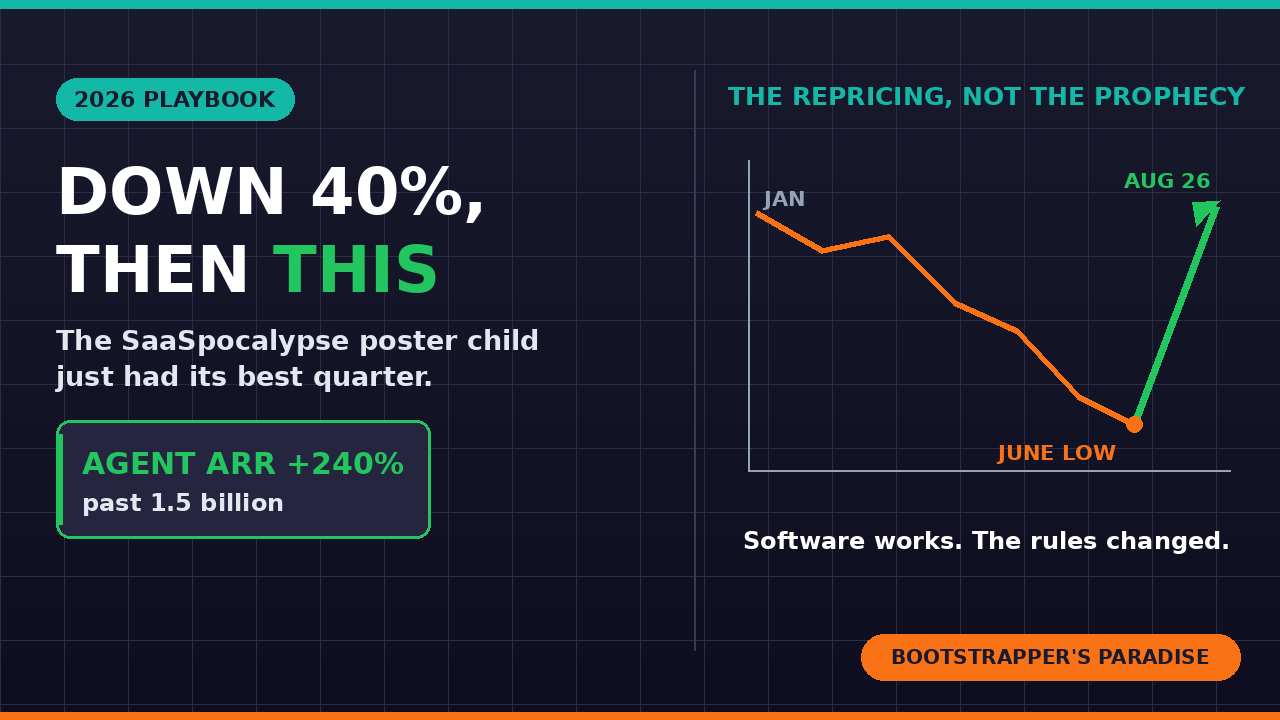
The market agreed. The stock was down 28% by February. It hit a multi-year low in June, down more than 40% on the year. Forward price-to-earnings crushed to about 11, from roughly 20 in January. Their CEO spent the year publicly arguing the software bears were dead wrong, and for eight months it looked like he was losing.
Then on August 26 they reported, and the stock had its best day in six years.
Here's what happened, plus the three lessons I think you should take from it as a solo founder.
Then Wednesday happened
Here's the report.
Revenue of 11.3 billion dollars, up 11%. Contracted revenue they haven't recognized yet, which tells you about the future rather than the past, up 14% to 33.5 billion. Their CFO called it the strongest quarter for net new order value in four years, which goes back to before the beginning of the AI era.
The AI numbers are the story. Agentforce recurring revenue passed 1.5 billion, up over 240%. Combined with their data platform, near 3.9 billion, up more than 210%. Customers ran 3.2 billion agent work units in the quarter, up 97% from the previous one.
Then they raised full-year guidance to a range of 46.1 to 46.4 billion.
One honest caveat, since I'd want somebody to tell me. A large part of the profit number came from investment gains rather than operations, roughly 2.6 billion tied in part to their stake in Anthropic. So look at the revenue, the contracted backlog, and the AI growth rates. Those are the real signal, and they're all strong.
Here's what it means for you. The company everybody said was most exposed just posted its best forward-looking quarter in years, and the entire software sector rallied behind it. The SaaSpocalypse wasn't a prophecy, it was a repricing. Software clearly still works. It's the rules that have changed.
So what are the new rules? Let's start with number one.
Lesson one: go vertical, not horizontal
Start with the thing that scared everybody in the first place.
The fear was simple. With AI, any company with budget and time can rebuild the software they're paying for. CRM, ERP, point of sale, pick your acronym. If they can just build it, why would they buy it?
They can. That part is still true, now more than ever. Starbucks has been building AI-assisted replacements for a Microsoft inventory system and an IBM maintenance system, aiming at the roughly 400 million dollars a year it spends on software.
However, here's what companies trying to go down that road are discovering, and it's the most important business lesson of this year.
Why nobody is rebuilding their CRM
Building it is the cheap part. It's the part after that should make you think twice.
Building it isn't all that's required. After you build it, you have to maintain it and keep developing it, forever. Security, compliance, uptime, support, a roadmap, and people who own all of it. Most companies aren't set up to run a software company inside their company, and they don't want to be. It would be a huge distraction from their core business.
So what these companies are realizing is this. Don't rebuild the system of record. Keep that budget on the books, since it's still cheaper and easier by comparison. Where the new budget is best spent is on the workflows and automations specific to how your company operates, since that's the part nobody can sell you off the shelf.
Buy the system of record. Build your specific workflows.
Now flip that around and look at it as a founder, since it tells you exactly where the opportunity went for us.
The horizontal play is out. A CRM for everyone, an ERP for everyone. Those markets are defended by incumbents who now have AI budgets and twenty years of data. It's too hard and expensive to compete with those monsters.
The opportunity moved to the vertical and the specific use case. Build the thing that feels custom-built for one market the moment they see it.
That's what I'm doing with Clockless. It isn't billing software for everyone, it's billing automation for lawyers. Everything in it assumes a law practice. That specificity is the moat, since the horizontal players won't go that narrow and my customer feels like it's been customized for them.
Lesson one: go vertical, or go use-case specific. Ideally both. That's your sweet spot for the foreseeable future.
Lesson two: put AI in your product
Lesson two is probably the easiest one to understand, though no less impactful than the first.
A key thing Salesforce did right was that they didn't fight AI. They pulled the best models into the product experience and made it the center of their story. The numbers say customers are actually using it, not just buying it. Billions of agent actions a quarter is a crazy amount of real engagement.
Your customer expects AI in your product. Maybe yesterday, maybe next quarter, but that expectation is coming either way and it's not going back.
I've written a whole separate piece on where AI belongs and where it will hurt you, so I won't repeat it here. The short version: use it where variance is fine or valuable, keep it away from anything that has to be consistently reproducible, and never ship it just to have it. It's a tool like any other. Use it for the right job.
Lesson two: get started integrating AI into your product right away. The sooner you start, the sooner you learn what actually works for your market.
Lesson three: open your product to AI
Lesson three is simultaneously the most powerful recent update to SaaS strategy anywhere and the one that might make you the most uncomfortable. Allow me to explain why it shouldn't. This strategy is the whole reason the Salesforce outlook is so strong.
They're not only putting AI in the product. They're opening the product to AI.
Alongside the earnings report they announced a partnership with Anthropic called Claudeforce. It ships a plugin with 37 prebuilt sales skills covering things like meeting prep, deal health review, and pipeline review, and it makes Claude the reasoning model across their agent products and Slack. That's not a chatbot in a sidebar. That's an outside agent being handed the keys to operate the platform.
This is what I've been telling my coaching clients for months, so let me make the case to you as well.
The 150 billion dollar clue
Salesforce is famously hard to use. Powerful, but big, complex, and genuinely difficult to get value out of without a huge investment in time, money, and resources.
Look at what that created. The partner ecosystem around Salesforce is estimated at five to six times the size of Salesforce itself, north of 150 billion dollars. Partners earn about six dollars for every dollar Salesforce makes. Roughly 90% of customers hire a certified partner to implement it.
An entire economy exists basically because the software is really complex.
Now here's the change. You used to need a human with years of experience to figure out how to make that software do the thing you wanted. An agent can now do the same thing better in minutes, sometimes seconds, and then go complete the task for the user as well.
Think about what that unlocks. Every capability buried three menus deep that nobody could ever find. Every workflow that needed a consultant. An agent finds it, figures out the best path, and executes it in seconds to minutes.
That's a huge change. When you open your product to agents, your customer stops being limited by what they know how to do in your interface. They're limited only by what they can describe.
So this means you must build for agents. Clean API, an MCP server, real documentation, permissions that make sense for a non-human operator. Then let your customers run wild with it and unlock enormous value from your software.
Watch what they build. The patterns that show up over and over are pre-validated features, and you can roll those into the platform as first-class functionality. The ones that don't catch on, you skip, and it cost you nothing since you didn't build them. That's how I'm building my products now. I'm letting agent usage dictate the future roadmap, which has been crazy helpful.
Lesson three: open your product up to AI agents, observe, then absorb what works.
Your playbook to follow
- Pick a vertical or a specific use case and commit. If your positioning would make sense to more than one industry, it's probably still too broad.
- Make it feel custom on day one. Their vocabulary, their workflow, their edge cases, right out of the box.
- Ship AI where it genuinely helps, and stop waiting for a perfect plan. Your customers already expect it.
- Open your product to agents. API, MCP server, docs, permissions. Treat that as a feature, not plumbing.
- Watch what your customers build on top of your product, then absorb the winners into the platform.
- Stop pricing purely by seat. When agents do the work, the seat stops being the unit of value. Price relative to their ROI.
Sources
- Salesforce Q2 FY2027 results, August 26, 2026
- Salesforce Q2 FY2027 results, investor relations
- Salesforce Q2 FY2027 Form 8-K exhibit, SEC
- CNBC coverage of the Q2 report
- Salesforce and Anthropic announce Claudeforce
- Claudeforce announcement, investor relations
- CNBC on the Claudeforce partnership
- Claudeforce and the two-directional integration, The Next Web
- Salesforce stock reaction, August 27, 2026, Motley Fool
- Salesforce Q1 FY2027 results, for the prior-quarter Agentforce comparison
Where to go next
Lesson one is where most founders get stuck, since going narrow means committing to a market before you know it will work. That's what my free SaaS Idea Validator is for. Use it to pressure test your vertical before you build: tools.bootstrappersparadise.com/validator
If you want to work through your own vertical and your agent strategy with me directly, I take a small number of founders for private 1:1 coaching: bootstrappersparadise.com/#coaching
The company everybody said was dead just had its best forward quarter in four years, by going all in on the thing that was supposed to kill it.
SaaS isn't over. The generic version is. If you go narrow, build with AI, and open your product to agents, there has never been a better time to be a solo founder in this space. The people playing by the new rules are going to absolutely crush it over the next two years, and I want one of those people to be you.
Ready to Build Your Own SaaS?
Learn how to go from idea to launch in my free 5-day email course — no coding or big budget required.
Start the Free Course