The Product Builder: PM + Designer + Engineer in One Person
AI collapsed the old three-person SaaS team into one Product Builder: a founder who can think like a PM, design the experience, and ship the product.
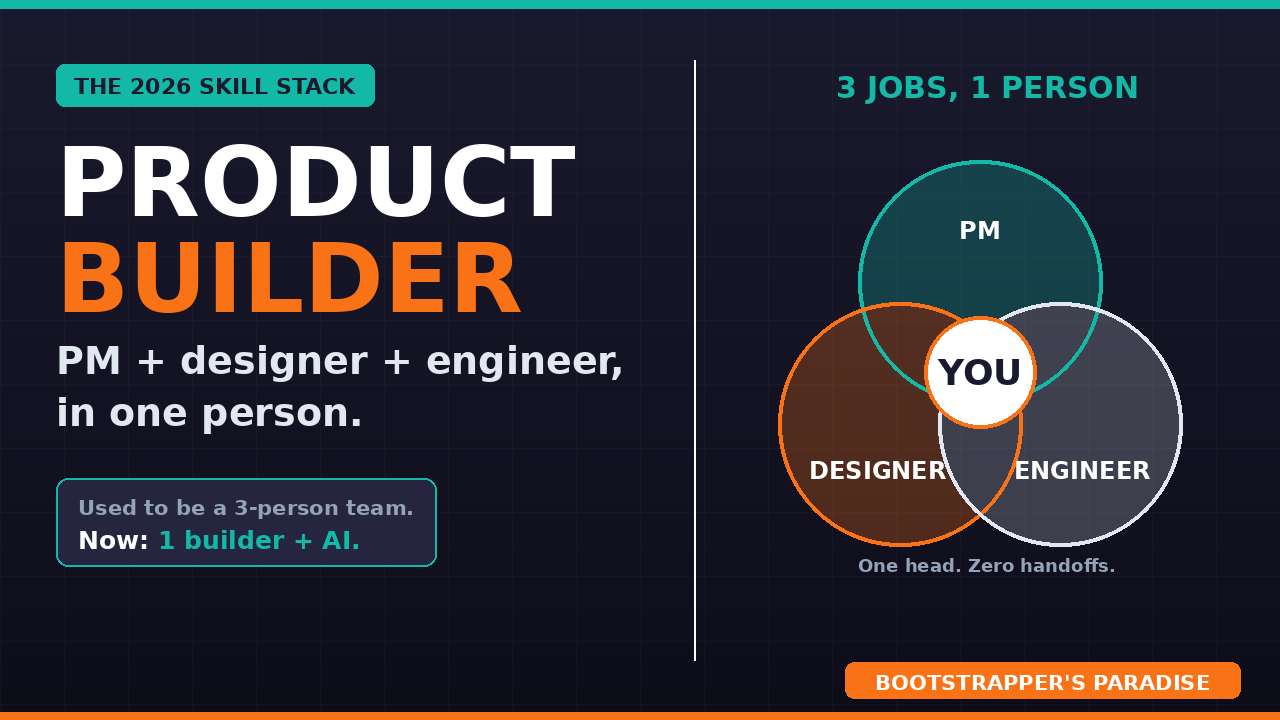
To succeed at building a bootstrapped SaaS business, you first need to become what everyone is now calling a Product Builder: a PM plus a designer plus an engineer, all in one person. Three roles, one person. That used to take a team. In 2026, with AI, it is one bootstrapper.
I used to tell you to become a Product Engineer. I was thinking too small. The Product Builder is the fuller picture, and it is the skill stack that will build the most successful SaaS companies of the next decade. LinkedIn renamed their entire PM training program around it. The biggest tech companies in the world are restructuring around it. Here is the toolkit and the skills you need to become one.
The old team of 3
The traditional way to build software has always required at least three distinct roles. A product manager who figures out what to build. A designer who figures out how it should look and feel. An engineer who figures out how to make it real. Three separate skill sets, three separate hires, three separate paychecks, and three separate sets of meetings, handoffs, and inevitable miscommunications.
The PM writes specs and hands them to the designer. The designer makes mockups and hands them to the engineer. The engineer builds and ships back to the PM for review. Each handoff is a loss in translation, each role waits on the previous one, and the whole pipeline moves at the speed of the slowest seat.
This is how SaaS was built for two decades, and it worked if you had VC money to fund a team. If you did not, you were stuck. You had to be one of those three and find or hire the other two. That team math is a big part of why most bootstrapped solo founders historically failed before they even got a product out the door. In 2026 that whole model is obsolete. AI changed the math.
Enter the Product Builder
The Product Builder is one person carrying all three of those skill sets in one head. The same person who interviews the customer also sketches the screens, and the same person who sketches the screens also writes the code. The handoff distance is zero. There is no waiting, no miscommunication, no "the engineer did not understand the spec." You are the spec, the mockup, and the code, all at once.
What is different in 2026 is that AI now does a huge percentage of the technical execution under each of those three hats. AI helps you research and prioritize like a PM. AI helps you mock up, polish, and iterate like a designer. AI helps you ship working code like an engineer. You do not have to be world-class at any one role. You have to be good enough at all three to know what to ask for, evaluate what comes back, and make decisions across the stack.
That is the unlock, and it is not theoretical. LinkedIn renamed its Associate Product Manager program to Product Builder because they see it as the future. Google is moving product managers into technical staff groups. Open product engineering roles are up over 50%. The biggest tech companies in the world have already pivoted toward this. The only question is whether you are ready for the shift.
Why this is possible now
Let me be specific about why this is possible now and was not two years ago. Three things converged.
First, AI coding tools got real. Codex 5.5, Claude Code, agentic coding workflows, MCP integrations. The technical execution barrier has fallen through the floor. You can ship production code on day one without a CS degree.
Second, AI design tools got real. Lovable, v0, Figma's AI features, Claude Design. You can go from a napkin sketch to a polished UI prototype in an afternoon. Designers used to be a hard hire for bootstrappers. Now you have an entire design studio in your browser.
Third, AI research and writing tools got real. Claude and ChatGPT can compress hours of competitive research into minutes, help you synthesize customer interviews, draft your roadmap, and write your pricing page. The PM-style strategic thinking is augmented.
When all three of those collapse, you get a moment where one person, with the right toolkit and the right mindset, can do what used to take a small startup team. That moment is right now. Two years from now everyone will be doing this. The bootstrappers who start today get a massive head start.
The PM hat
What you have to be able to do: find a real problem worth solving, talk to customers and extract signal from the noise, prioritize the right things, write clear specs that you and your AI can both work from, and hold the whole roadmap in your head while making trade-offs.
What AI does for you: synthesize hours of customer interview transcripts into themes in minutes, draft PRDs from your raw notes, stress-test your prioritization by playing devil's advocate, and pull competitive research that used to take a week into a usable summary in twenty minutes.
What you still own: the customer relationships, the judgment calls about what matters, and the willingness to say no to features. AI cannot say no for you. The skills to focus on are customer interviewing, problem framing, prioritization frameworks, and writing clear specs an AI can act on, which is a real skill now, separate from writing specs for human engineers.
The designer hat
This is the role bootstrappers most underestimate. What you have to be able to do: think about user experience, not just user interface. Understand information hierarchy. Know when a layout feels right and when it does not. Have taste, which is the unsexy word for knowing what looks professional and what looks like a junior side project.
What AI does for you: Lovable, v0, and Claude Design let you describe a screen in words and get a working, styled prototype back. Figma's AI features let you generate variations and iterate faster than any human designer could. You can A/B test mockups with customers in the time it used to take to brief a designer.
What you still own: taste, judgment, and the customer empathy that drives design decisions. AI can produce a hundred mockups. You have to know which one is right. The skills to focus on are information hierarchy, layout fundamentals, basic color theory, progressive disclosure, and writing UI copy. Most importantly, the ability to look at AI-generated UI and immediately spot what is off about it. That last one is hard to teach, and it is what separates a Product Builder from someone who just ships AI slop.
The engineer hat
What you have to be able to do: ship working code to production, pick the right stack, understand enough system design to not paint yourself into corners, debug your own mistakes when the AI gets it wrong, and know when to trust the agent and when to take the keyboard back.
What AI does for you: Codex, Claude Code, agentic workflows, MCP servers, automated testing, context engineering. The agent writes the code, runs the tests, loops until green, and only bothers you when the feature is working.
What you still own: architecture decisions, code review, security judgment, and the discipline to keep the AI inside good guardrails through AGENTS.md or CLAUDE.md policy files. Vibe coding gets you a demo. Context engineering gets you a real product. The skills to focus on are stack literacy, policy file authoring, reading code even when AI writes most of it, debugging, production deployment basics, database fundamentals, and the discipline of testing, both the agent's automated tests and your own manual verification.
The Product Builder toolkit
Here is what I run as a Product Builder right now. Each tool does the job of what used to be a full role.
For the PM side: Claude or ChatGPT for research, synthesis, and writing, a simple markdown doc for the roadmap, and a spreadsheet for prioritization scoring if you want to be formal about it.
For the designer side: Lovable or v0 for going from idea to working prototype fast, and Claude Design for quick UI experiments or when I need to iterate on real design with team or advisor feedback.
For the engineer side: Codex or Claude Code for the heavy build work, Playwright MCP for automated browser testing, Supabase, Railway, and Vercel for database and hosting, and AGENTS.md or CLAUDE.md to keep the agent inside guardrails.
For the connective tissue across all three: a clean local dev environment, a context file any AI can read to onboard to the project instantly, a regular customer feedback loop, and the discipline to switch hats deliberately rather than defaulting to the one you are most comfortable with. This is not an expensive toolkit. Most of it is free or under fifty dollars a month. Compare that to hiring a PM, a designer, and an engineer.
The 5 skills to master
Tools are easy. Skills are what compound. If you want to become a Product Builder this year, focus on these five.
- Customer interviewing. Without it, you build the wrong thing no matter how fast your AI is. This is the foundation.
- AI prompting and context engineering. Treat your prompts like code and your context files, CLAUDE.md and AGENTS.md, like your operating system. The Product Builders who win at scale are the ones whose AI orchestration is structured, not vibe-coded.
- Design taste. You do not have to be an artist. You have to be able to look at a UI and know whether it is good. Study screenshots of great products and use them as the standard.
- Architecture awareness. You do not have to be a software engineering expert, but know enough to spot when the AI is about to paint you into a corner. The difference between code that lasts six months and code that lasts six years lives here.
- Switching hats deliberately. The single failure mode of Product Builders is retreating to the hat they are most comfortable with. If you came from design, you over-design and under-ship. From engineering, you under-research and over-build. From PM, you spec endlessly and never code. Notice your retreat and force the discipline.
Master those five. The tools change every quarter. The skills compound for a career.
Why Product Builders win
Zero handoffs is faster than the most efficient team. One head holding the full picture beats three heads each holding a third. The most successful software companies of the next decade are going to be built by people who can think in customer outcomes, design experiences, and ship working software, all without a translator in between.
VC-backed startups can throw a team at it, and they still will. But the Product Builder, armed with AI, can match or exceed that team's output as a solo founder. That is the most asymmetric advantage in software right now. Use it.
What to do next
If you want help getting your SaaS off the ground, I built a set of free tools: a Problem Finder, a SaaS Idea Validator, and a Pricing Calculator. For the full path from zero, the free 5-day email course walks you through it.
If you want my help with your project, my private coaching program is open to a small number of founders.
The best way to increase your chances of SaaS success as a bootstrapped founder is to become an effective Product Builder.
Ready to Build Your Own SaaS?
Learn how to go from idea to launch in my free 5-day email course — no coding or big budget required.
Start the Free Course