The New SaaS Playbook: 7 Rules for Bootstrappers in 2026
Every rule that defined SaaS for 20 years has changed. Here are the 7 new rules — and why every one favors bootstrapped founders.
In February 2026, a trillion dollars was wiped from software stocks in a single week. Not because of recession. Not because of inflation. Because investors realized that AI agents don't need software seats. The per-seat pricing model that built the entire SaaS industry is collapsing in real time.
And if you're a bootstrapped founder, this is the best news you've ever heard.
I'm Sean. I've spent 15 years bootstrapping SaaS businesses, including Clockless, the legal billing SaaS I'm building in public right now. And I can tell you — I've never seen a market shift like this. Every single rule that defined the SaaS playbook for the last 20 years has changed. Here are the 7 new rules, and why every one of them favors you.
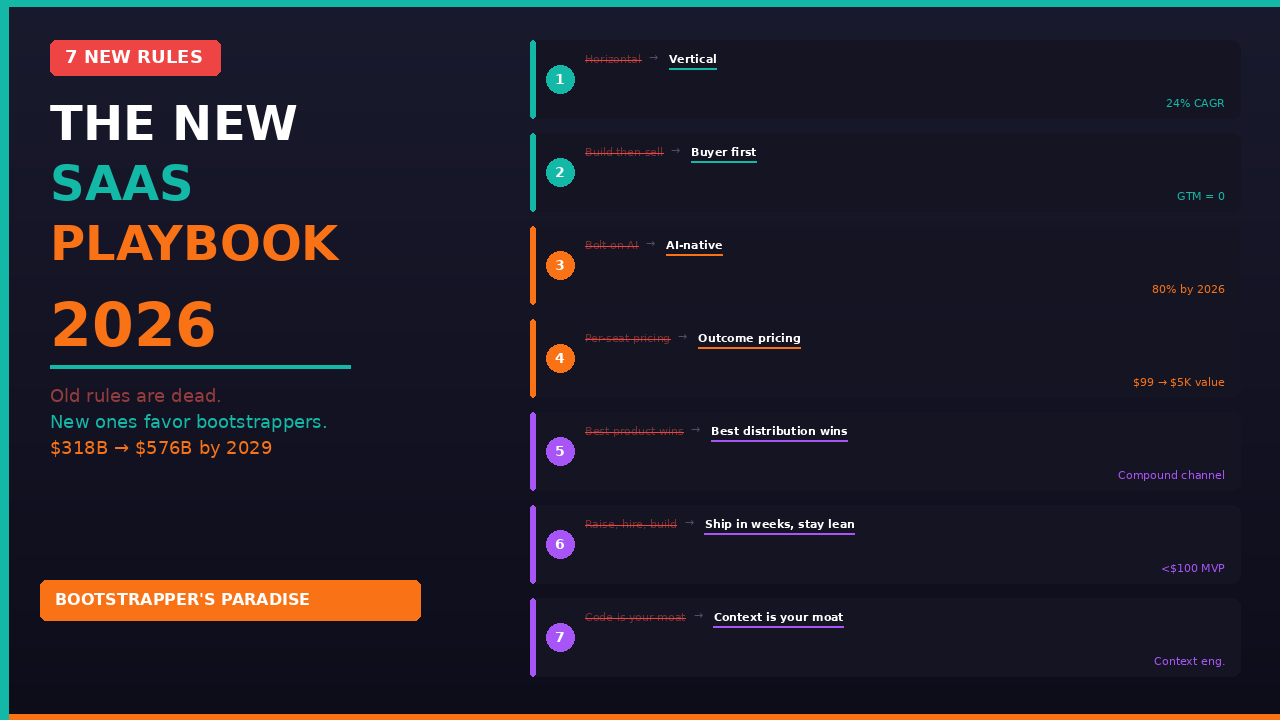
Rule 1: Vertical > Horizontal
Old rule: Build for everyone. Go wide. New rule: Build for one industry specifically.
The vertical SaaS market is growing at nearly 24% annually — almost double the broader SaaS market. A generalist CRM that serves everyone serves no one particularly well. But a billing automation tool built specifically for small law firms understands the domain, speaks the language, and solves the exact problem.
Enterprise giants can't go this deep into every niche. They're too big, too slow, and too distracted by the AI transition. That's your opening. Pick a vertical, become the expert, own the space.
Rule 2: Find the Buyer First
Old rule: Build the product, then find customers. New rule: Find the buyer, then build around their needs.
If you're building in 2026 and you don't have a real human waiting for your product, you're doing it wrong. One conversation with a real buyer saves you months of building the wrong thing. Your go-to-market timeline should be zero — not short, zero — because someone is already waiting for what you're building.
Rule 3: AI-Native From Day One
Old rule: Build the product and bolt on AI later. New rule: AI is the foundation of your product, not a feature.
This is the difference between AI-enabled SaaS and AI-native SaaS. An AI-enabled product is a traditional tool with a chatbot slapped on. An AI-native product was designed from the ground up to use intelligence as its core infrastructure.
For Clockless, AI isn't a premium add-on. It IS the engine. The entire product is built around the idea that AI reads your meetings, extracts billable time, and calculates lost revenue. Without AI, there is no product. Gartner expects 80% of enterprises will deploy GenAI-enabled apps in 2026. The bar has moved. AI is expected, not optional.
Rule 4: Price for Outcomes, Not Seats
Old rule: Charge per seat per month. New rule: Charge for the outcome your software delivers.
This is the single biggest shift in SaaS history. Per-seat pricing assumes humans are the users. When AI agents do the work, nobody's sitting in a seat. A Fortune 50 company leaked a memo planning to cut their Salesforce and ServiceNow spend by 60% — not because the software is bad, but because they need fewer human users.
As a bootstrapper, you've never been locked into per-seat pricing. You can design outcome-based pricing from the start. If Clockless recovers $5,000 in lost billable time and charges $99, that's a no-brainer. I'm not selling a seat. I'm selling recovered revenue.
Rule 5: Distribution > Product
Old rule: The best product with the deepest pockets wins. New rule: The best product with the best distribution wins.
When AI can build an MVP in weeks and replicate features in days, product quality alone isn't a moat. What IS a moat is owning the channel that connects you to your customers: founder-led content, an email list, a YouTube channel, a community, SEO authority in your niche. These compound over time and can't be replicated quickly.
The biggest SaaS exits in 2026 aren't happening because of superior technology. They're happening because founders cracked a repeatable acquisition channel.
Rule 6: Ship in Weeks, Stay Lean
Old rule: Raise money, hire a team, build for a year. New rule: Ship in weeks, iterate from feedback, stay profitable.
AI development tools have collapsed the cost of building to near zero. Idea to functional MVP in a week for under $100. You don't need permission. You don't need investors. You don't need a team. You need a validated problem, a focused product, and discipline to ship.
Bootstrapped SaaS companies with clean financials and strong retention are now premium acquisition targets. The goal: build a business that CAN raise but doesn't need to.
Rule 7: Context Is Your Moat
Old rule: Your codebase was your moat. New rule: Your accumulated project intelligence is your moat.
When AI writes the code, the code itself isn't the differentiator. What's unique is the accumulated context you've built: your CLAUDE.md file with project-specific guidelines, your domain expertise encoded as requirements, your test suites that define exactly what "working" means in your niche.
A competitor can clone your features. They can't clone six months of iterative context engineering. They'd have to make every mistake you already made and learn every lesson you already learned. Time is the one thing nobody can shortcut.
The Numbers
The market isn't shrinking — it's restructuring. Global SaaS spending is projected to rise from $318 billion to $576 billion by 2029. The money is moving from bloated horizontal incumbents to focused vertical tools built by small teams.
Micro-SaaS founders routinely hit $5K–$50K MRR. The median profitable micro-SaaS makes about $4,200/month. The top 1% exceed $50K/month with teams of 1–3 people. AI startups command up to 30x revenue valuations versus 7x for traditional SaaS.
The old guard has thousands of employees, legacy pricing, and investors demanding answers. You have none of that baggage. You can move faster, price smarter, go deeper, and ship a product this month that solves a problem better than anything a billion-dollar company offers.
The New SaaS Playbook
The 7 new rules of SaaS in 2026 — with checklists for vertical focus, buyer-first strategy, AI-native building, outcome pricing, and more.
The old rules are dead. The new ones favor you.
Ready to Build Your Own SaaS?
Learn how to go from idea to launch in my free 5-day email course — no coding or big budget required.
Start the Free Course