The Micro-SaaS AI Advantage: Why Solo Founders Are Winning
A freelance developer built a $9K/month SaaS in two weeks. The micro-SaaS segment is growing 30% annually and solo founders are hitting $5K-$50K MRR. Here are the three advantages driving it and a 5-step playbook to get started.
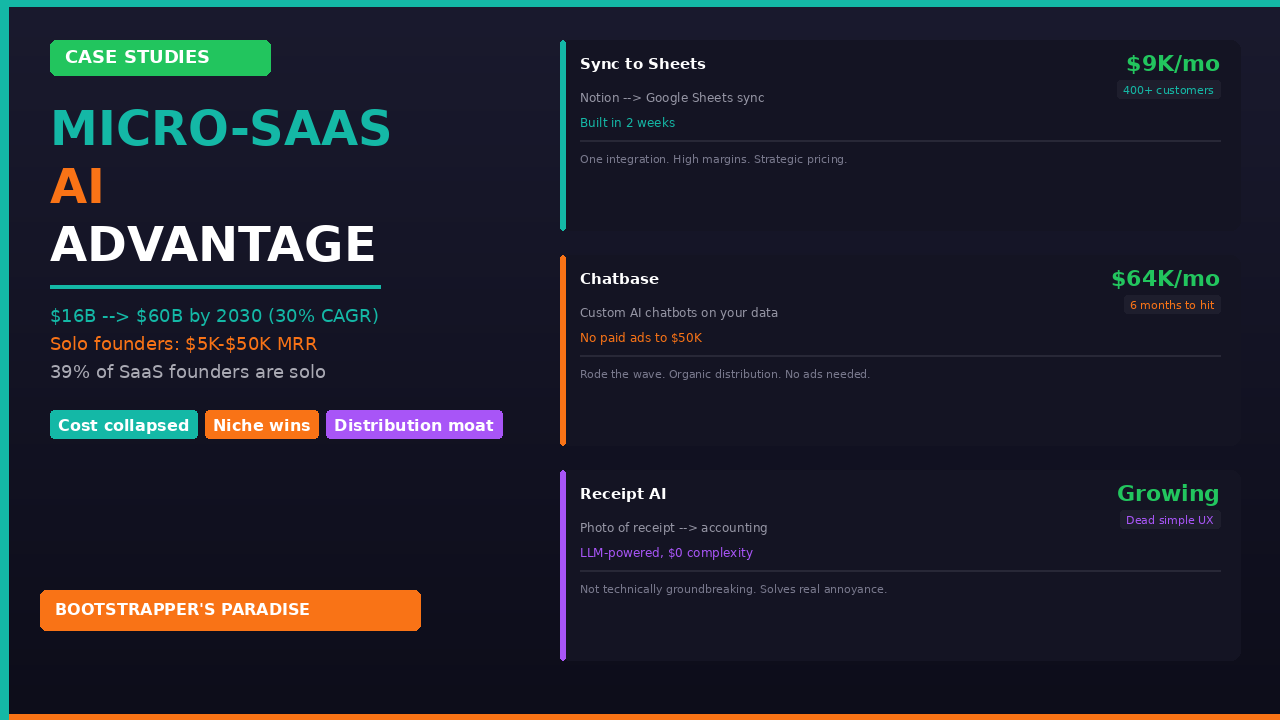
A freelance developer built a micro-SaaS called Sync to Sheets in two weeks. It does one thing: syncs Notion databases to Google Sheets. It now makes $9,000 a month with over 400 paying customers. Meanwhile, enterprise SaaS companies with hundreds of employees are watching hundreds of billions evaporate from their market cap.
Something fundamental has changed. And if you're a bootstrapper, this change benefits you.
What the Data Says
The micro-SaaS segment is projected to grow from about $16 billion in 2024 to nearly $60 billion by 2030 — roughly a 30% annual growth rate. Solo founders routinely hit $5K–$50K MRR by targeting niche pain points. The Micro Conf 2025 report showed 39% of independent SaaS founders are solo operators.
The median profitable micro-SaaS makes about $4,200 per month in MRR. The top 1% exceed $50,000 per month, often run by teams of 1–3 people.
This isn't a side hustle fantasy. This is a real business model.
The Three Advantages
Why are small teams winning against companies with hundreds of millions in funding?
1. AI collapsed the cost of building. What used to take five engineers three months, a solo founder can now ship in two to four weeks using tools like Lovable and Claude Code. The MVP isn't "minimum" anymore — it's opinionated. You can build something genuinely good, incredibly fast.
2. Niche beats horizontal. The enterprise giants built horizontal platforms trying to serve everyone. That worked when software was expensive to build. Now, a solo founder can build a vertical tool for wedding planners, law firms, or podcast editors that's 10x better at that one thing than anything Salesforce offers. And charge $30–$100/month for it.
3. Distribution is the new moat. The founders winning right now aren't the best engineers. They're the ones who cracked one repeatable acquisition channel: SEO/AEO blog posts, Reddit threads, Product Hunt launches, YouTube content. The product gets built in weeks. Distribution is the hard part — and the part that can't be automated.
Case Study 1: Sync to Sheets — $9K/month
A Google Workspace add-on that syncs Notion databases with Google Sheets. That's it. One focused integration. MVP built in two weeks using the Notion API and Google Sheets API. Now has over 40,000 installs and 400+ paying customers at around $9,000/month.
The founder is a freelance developer who works in focus bursts around family time. Most expensive monthly bill: under $90 for email infrastructure. When free plan limits were tightened, revenue grew from $5K to over $8K. Small strategic decisions on a small product.
Lesson: One integration, high margins, strategic pricing moves on a tiny product.
Case Study 2: Chatbase — $64K/month in 6 Months
Custom AI chatbots trained on your own data, URLs, and documents. Rode the ChatGPT wave and grew through organic traffic, Product Hunt, and community engagement. No paid ads until after hitting $50K MRR. Reached $64K MRR within six months.
Lesson: Pick a use case that's exploding in demand, build fast, and distribute through channels where your audience already lives.
Case Study 3: Receipt AI — Simplicity Wins
Take a photo of a receipt, text it to the app, it asks which folder, and it's uploaded to your accounting software in seconds. Dead simple. Not technically groundbreaking — most heavy lifting is done by third-party LLMs. But it solves a real annoying problem, and that's the whole game.
Lesson: You don't need to build something technically impressive. You need to solve a real problem more conveniently than the alternatives.
Bonus: The $400/Month App Nobody Touches
One founder built an AI reading and note-taking app that makes $400/month. They haven't touched it in six months. People still pay. Users still sign up. $400/month won't replace your salary, but it proves the model. Build a few of these and you start stacking real income.
The 5-Step Playbook
Step 1: Find a pain point, not an idea. Check Reddit. Check Upwork. See what people pay others to build manually. Look for repeated complaints and workarounds. If people are duct-taping spreadsheets and Zapier together, that's your opportunity. Use the Problem Finder to generate a complete research framework for your market.
Step 2: Solve one thing exceptionally well. Not five things adequately. Receipt AI takes a photo and syncs it. Sync to Sheets syncs two apps. Clockless recovers lost billable time. One core action, done better than anything else.
Step 3: Build the MVP in weeks, not months. Use Lovable for the landing page and prototype. Use Claude Code for the product. Your first version should get a user to value in under 10 minutes.
Step 4: Price for value, not for competition. Solo founders consistently underprice. If your tool saves someone 5 hours/month and their time is worth $50/hour, charging $29/month is a no-brainer. Don't race to the bottom. Use the Pricing Calculator to model your pricing strategy.
Step 5: Pick one distribution channel and go deep. SEO/AEO blog posts, Reddit communities, YouTube content, Product Hunt. Pick one, master it, then add a second.
The Window
Right now, tools are cheap, cost to build is near zero, and enterprise SaaS is distracted. AI startups command up to 30x revenue valuations versus 7x for traditional SaaS. A micro-SaaS doing $100K/year could be valued at close to $3 million.
The founders who move now — while the big players scramble with agentic licensing and outcome-based pricing — are the ones who will own the niches. Once claimed, the barrier goes up significantly.
Got an idea? Validate it for free in 2 minutes before you write a single line of code.
Ready to Build Your Own SaaS?
Learn how to go from idea to launch in my free 5-day email course — no coding or big budget required.
Start the Free Course