Meet Your Customer's CURRENT Needs (Build for Today, Not the Future You Imagine)
Build for what your customer needs today, not the future you imagine for them. Adoption is the bottleneck, so start with the smallest useful improvement.
I just made a mistake I watch bootstrappers make all the time, and I want to save you from it, because it quietly slows your growth.
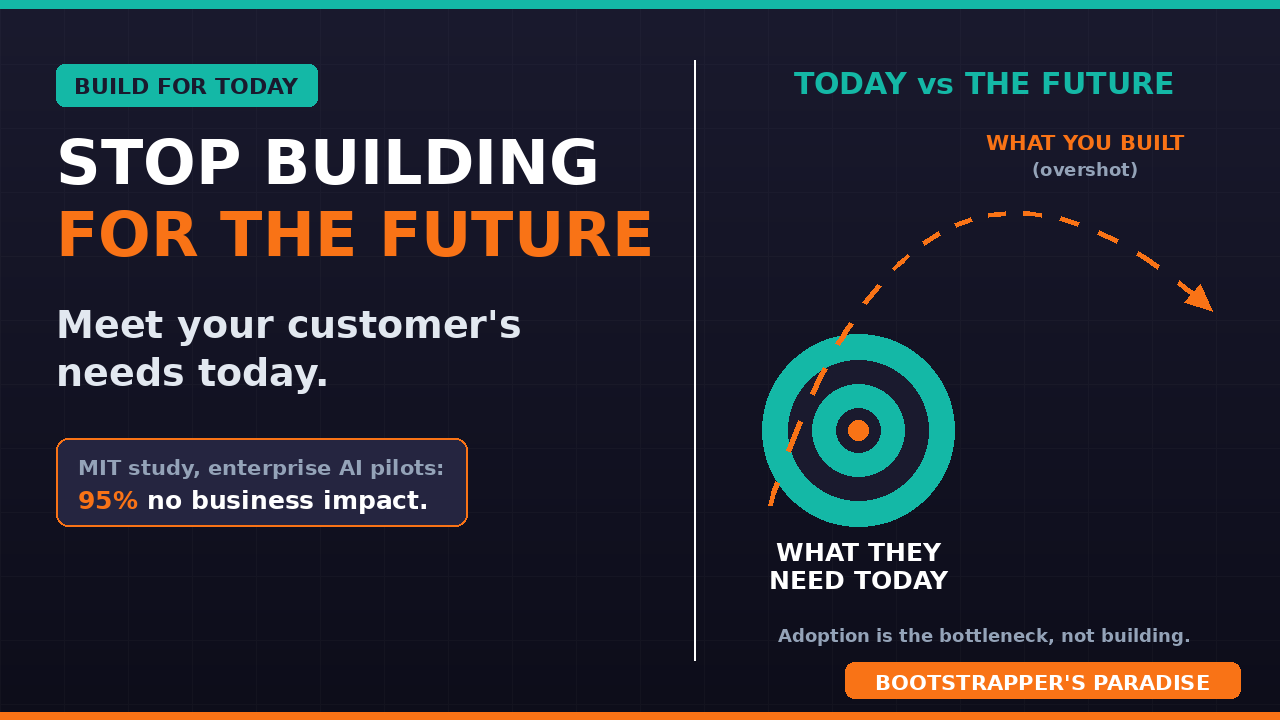
I built too far into my customer's future. I gave them something powerful, but it was so far ahead of where they actually are today that it started to feel less relevant, not more. What I should have done was make what they already do just a little bit faster and easier.
That is the whole lesson: build for your customer's current needs, not the future you imagine for them. Let me show you the three mistakes underneath this, and how to avoid them so you grow faster.
My expensive mistake
Here is exactly what happened, so you can spot it in yourself.
One of the products I am building helps accounting firms run due diligence on M&A transactions. I loaded it with powerful features. I nearly automated every single step of their process. My intent was good. I was not trying to replace them, I wanted to augment them, to automate away the boring, time-consuming stuff so they could focus on what matters most.
The problem? I overshot it. I focused too far into their future, and that made it feel less relevant to them today. What I should have done, and what I am working on now, is simpler: take everything they already do and make it just a little bit faster and easier. That is the classic mistake, and it comes from three places.
Mistake 1: We want to live in the future
Trust me, I get it. What if everything was automated? How great would that be? We convince ourselves it is the obvious choice, and in a perfect world we would probably be right. We just do not live in that world, and we likely never will, at least not anytime soon.
I am not telling you to drop the vision. I am telling you to be ready to take a phased approach to reaching it, and you must start with today to get to tomorrow. Have the big picture, absolutely, but do not take your eyes off the ball that is right in front of you.
Mistake 2: We overestimate what customers can handle
Most of your customers are buried in the day-to-day. They barely have time to think about the future, because they are too busy executing. Even in a world full of AI, that is still true.
That is why you keep hearing that real AI adoption, especially inside big companies, is relatively low. Change takes a long time. So even though building is much faster with AI now, and that is a real advantage for us, building was never the bottleneck in the first place. The real bottleneck was always change management and getting your customer to actually onboard and adopt your platform.
Mistake 3: We overthink it
Here is the truth. Your customer is going to be happy with a process that is a bit easier, a bit faster, or ideally both. That is it. You really do not have to reinvent the wheel.
In fact, because change is genuinely hard, the further you push them away from their current process, the bigger the uphill battle you will face getting them to adopt anything at all. So focus on what sucks for them today, and start by making that one thing a little bit better. If you want help finding exactly where that is, go watch my video on bottlenecks. That is the perfect place to start.
The real bottleneck isn't building
Let me put a number on why this is so important.
A big MIT study last year, their State of AI in Business report, found that 95% of enterprise AI pilots delivered no measurable business impact. Ninety-five percent. Not because the technology failed, but because it did not fit how people actually work day to day. That is the entire lesson in one statistic.
Building got faster. Adoption did not. So the constraint on your growth is not how much you can build, it is how much change your customer can handle. Once you internalize that, you stop overshooting, because you are no longer optimizing for the wrong thing.
Netflix: the phased approach that worked
The best example of success following the pattern I am recommending is Netflix.
From the very beginning, Netflix wanted to stream shows and movies over the internet. That was always the vision. The problem was that the technology of the time could not support it, so they did not force it. Instead, they started by just making it easier to watch movies at home.
Think about the alternative back then. It was Blockbuster, which meant driving to a store, hunting for a copy, and paying late fees. So what did Netflix do to make that one thing a little easier and faster? They mailed the DVDs to your home. That is it. That one small change to the existing process is what enabled them to take off. They still realized the streaming vision, but years later, once the technology and their customers were ready. The phased approach worked.
The fix: today first, vision in phases
Here is the fix, and it is refreshingly simple.
Start with today. Take the thing your customer already does and make it a little faster or a little easier. That is your entry point, because that is the change they can actually absorb right now. Then phase toward your bigger vision from there, one step at a time.
Do not give up on the vision. You should absolutely have one for the future. Just be ready to modify it along the way, and do not start there. Meet your customer where they are today, earn the adoption, and let that pull you both forward.
Your playbook to follow
- Build for what your customer needs today, not the future you imagine for them.
- Make their current process a little faster or easier first.
- Remember that adoption, not building, is your real bottleneck.
- Keep your vision, but reach it in phases and modify it as you go.
- Start with what sucks most for them today, their biggest bottleneck.
Start with today
Keep these three mistakes in mind, stay focused on today, and your path as a bootstrapper gets a whole lot smoother. You should not have to learn this one the hard way over and over again.
If you want help pinpointing the exact thing to make better first, I built a free Problem Finder that walks you through it. If you want to work with me one on one directly, I coach a small number of founders through my private coaching program.
Build for today, phase toward tomorrow, and I will see you in the next video.
Ready to Build Your Own SaaS?
Learn how to go from idea to launch in my free 5-day email course — no coding or big budget required.
Start the Free Course