How I Book B2B SaaS Demos In 2026
Cold email is dying. Learn the 2026 B2B SaaS sales playbook: split your motion by company size, build relationships, and earn a place on the AI shortlist.
This is exactly what I'm doing right now to book demos for my B2B SaaS.
Not theory, not what worked years ago. What's working now, across everything from small companies to mid-market and enterprise.
I'll also tell you which channel I've stopped using entirely, because it no longer works, and the shift in how buyers find software that almost nobody has adjusted for yet in the AI era.
B2B vs B2C: fewer combinations to manage
Quick framing, since these are different games and I've built and coached founders in both.
B2B and B2C are unique, but in my experience B2B is easier and more lucrative. When you focus on an industry vertical, the problems customers need solved are real and consistent. Most law firms of a similar size have similar problems and want similar solutions. That consistency is a gift, since it means fewer combinations for you to manage.
B2B selling comes down to getting right to the problem you solve and figuring out fast whether this prospect wants a better solution. Beyond that it's relationship driven. You need to talk to people. Not necessarily in person, but you do have to talk to them.
B2C is a different world. There's often no company involved, so you're dealing with individuals, and people are all over the place. More combinations. A business gives people shared context and shared goals, which is exactly what makes B2B easier to manage.
That doesn't mean you can't win in B2C. I've done it. Growth comes mostly from advertising and marketing, and since B2C products are priced lower, your acquisition cost must stay reasonable. Spending a few hundred dollars to land a customer worth fifty obviously isn't economical, so B2C must be scalable from day one.
I consistently recommend founders start with B2B, so that's where I'm spending the rest of this piece.
Draw the line at 100 employees
Inside B2B there are two markets, and they buy differently, so you need separate playbooks.
To keep things simple, I'm drawing the line at 100 employees. Anything under that is small market, over that is mid-market and up. It's more complicated than one number, but this is a clean place to start.
Here's what actually separates them, and it isn't just budget.
Belkins analyzed 1,871 real customer profiles and found the number of contacts goes up as your company target gets bigger: 4.6 for small companies, 5.6 mid-market, 6.0 enterprise. So enterprise doesn't just add more people, it adds a specific kind of person. Legal, procurement, and IT security. Gatekeepers who can kill your deal but will rarely ever champion it.
That shows up in the timeline too. Two to four weeks to close small market. Four to eight weeks mid-market. Three to nine months or more for enterprise. The timeframe varies wildly relative to prospect size.
Small market: let the product sell
Small market first.
Your constraint is budget. Smaller buyers mean smaller deals, which means less money to spend acquiring each one. Everything hinges on cost-effective channels and a motion that doesn't slow you down, since volume is the name of the game.
That's product-led growth. Skip most of the expensive conversations, get them into the product fast, let the product do the selling. The data backs this up: self-serve and product-led purchases involve just one to three people, the lowest of any B2B motion. Under 200 employees, the CEO often is the buying process. One decision maker, which is a huge advantage.
Alongside that, advertising and marketing. Search ads, AI ads, and content channels. All still work, and they scale without clogging up your calendar.
Small market decision makers are fewer and faster, which is good. However, that low barrier cuts both ways, so expect more competition. Your positioning has to be sharp enough that they know in thirty seconds whether your software is for them.
Large market: more people, more process
You might think B2B would be similar regardless of size. In reality, mid-market and up flips almost everything.
Budget stops being the limiting factor. Larger companies are comfortable paying more and often expect to. What slows you down is people and process: bigger teams, sometimes multiple decision makers, and three functions that will stop you cold if you're not ready. Legal, procurement, and security.
Account for all three before they show up. Security certifications in hand and questionnaires answered in advance, terms you can agree to, a procurement path you understand.
This market is the most relationship-driven of anything covered here. You'll be talking to people, so you need a reliable way to get in front of them and tell them what they want to hear.
Build your committee playbook
Step one is managing your combinations. Build a playbook laying out who you'll need to convince at a company like this, what each of them cares about, and the message that lands with each one.
Why it matters: 86% of B2B purchases stall at some point, and the primary cause is complexity on the buyer's side, not anything you did. Deals with four or more relationships close at roughly twice the rate of deals riding on one champion. The more relationships you build inside the prospect, the more likely they are to close.
Pro tip on messaging, and this is something I work on a lot with my coaching clients. Keep it simple. Skip the jargon. Respect their time, keep it short, and drive to a yes or no fast. You get no credit for making your solution sound complicated.
Cold email is dying
So how do you line up those conversations?
Historically cold email was very popular. I'll be direct with you: that channel is mostly dead, and the numbers are ugly.
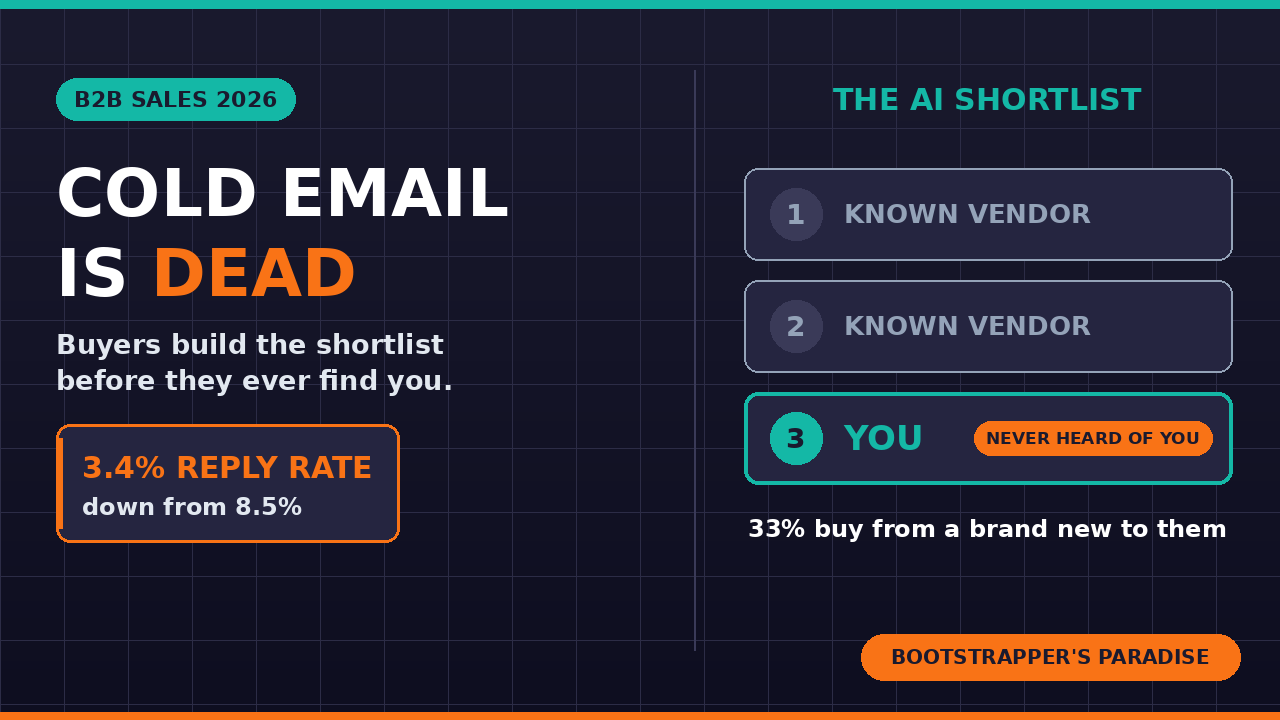
Average reply rates fell from about 8.5% in 2019 to 7% in 2023, 5% in 2025, and roughly 3.4% now. Average conversion sits around 0.2%, which is one deal per 500 emails. Roughly one in five emails gets filtered to spam before anyone sees it.
Two things did this. Google, Yahoo and Microsoft rolled out bulk sender rules between 2024 and 2025, so non-compliant mail now gets rejected outright rather than filtered. Then AI-generated outreach flooded every inbox and buyers stopped reading. For the most part this channel is a waste of your time, so skip it.
Deliverability is an engineering problem now, not a copywriting problem. As a solo founder you have better places to spend your time. Whatever you do, don't spam people. It's counterproductive, damages your domain authority, and is bad for your company's reputation.
What's actually booking me demos
Here's what is working these days.
Two channels. In-person networking, and highly specific LinkedIn outreach. Emphasis on specific.
The method: build a tight list where every prospect is nearly identical. Exact department, exact title, exact industry, exact company size. Not a big list, a tight one. Then write messaging that's relevant to that precise person and timely, meaning it's about something they're thinking about right now.
That's a tricky balance. Get it right and you don't just get replies, you get people asking you for a demo.
Notice why this works when cold email doesn't. The hyper-targeted version was always the part that worked. Volume was hiding it. Once volume stopped working, all that's left is precision.
The AI shortlist is the new front door
Here's another important shift you need to be aware of.
Your buyers are actively building their vendor shortlists inside AI chatbots before they ever contact you.
G2 found 51% of B2B software buyers now start research with an AI chatbot more often than Google, up from 29% a year earlier. Forrester puts ChatGPT usage in vendor evaluation at 72% of software buyers.
Here's the number that should get your attention. In that same G2 research, 69% of buyers chose a different vendor than they expected to, and 33% bought from a brand they had never heard of, because an AI chatbot recommended it. That's not just a big change, it's a huge opportunity for you.
Brand recognition used to be the chasm you couldn't cross as an unknown solo founder. AI just built you a bridge over it.
The catch: these tools cite only three or four brands per answer, and roughly half of tech companies have zero citations at all. This is winnable right now, and it won't stay that way.
The work is unglamorous. Clear public content about the problem you solve, in your buyer's language. Real case studies with real numbers. Presence where your industry actually consumes information. Then check it yourself. Ask ChatGPT or Claude what the best tool is for your exact use case and see whether you come up. That answer is the new SEO.
Your playbook to follow
- If you're just starting out, go B2B and focus on one vertical, so the problems stay consistent and your combinations stay small.
- Decide which side of the 100-employee line you're selling to, then build the matching motion. Product-led below it, relationship-led above it.
- For large market, write the committee playbook before you start outreach. Who you need, what they care about, and what kills the deal.
- Stop cold emailing. Put that time into in-person networking and hyper-specific LinkedIn outreach.
- Get your security and procurement answers ready before anybody asks for them.
- Audit your AI visibility this week. Ask the chatbots what they'd recommend for your use case and fix what you find.
Sources
- G2, The Answer Economy: 2026 AI Search Insight Report
- G2 report announcement, April 15, 2026
- G2 on what buyers trust in AI search
- G2 findings coverage, Demand Gen Report
- Cold email reply rate decline, 8.5% in 2019 to 3.43% in 2026, Reachoutly
- Cold email benchmarks and reply distribution, Growth Engineer
- State of Cold Email 2026 benchmark data, SmartReach
- Cold email response rate benchmarks, Cleanlist
- Reply rate expectations for well-run campaigns, Apollo
- Measuring cold email effectiveness, SalesHive
Where to go next
All of this depends on naming a problem sharp enough that a prospect takes a meeting about it. That's what the free Problem Finder is for, so start there: tools.bootstrappersparadise.com/problem-finder
If you want to build your GTM with me directly, I take a small number of founders for private 1:1 coaching: bootstrappersparadise.com/#coaching
The channel that stopped working relied on volume. Everything replacing it rewards being specific, which is the one thing a solo founder focused on a single vertical is naturally better at than a big company.
You're not disadvantaged here. You're built for it.
Ready to Build Your Own SaaS?
Learn how to go from idea to launch in my free 5-day email course — no coding or big budget required.
Start the Free Course