Get Customers To Actually Use Your Software (The Adoption Loop)
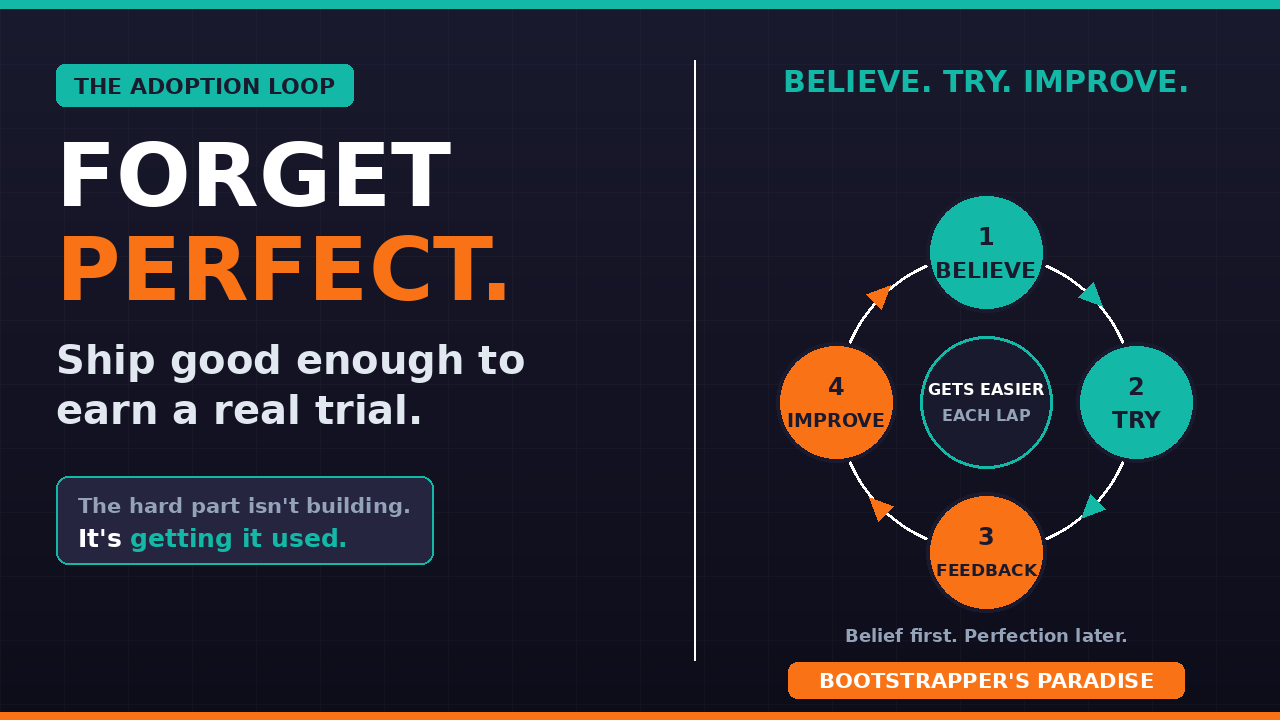
Forget perfect. Build software good enough to earn a real trial, get real feedback, and improve from actual usage instead of guessing.
The hardest part of building a SaaS is not the building. It is getting people to actually use your product once it exists.
I have talked before about how this is one of the biggest challenges you will face: change management. People naturally resist change, and here is the cruel twist. The more capable and complex your software is, the harder it is to get anyone to adopt it, because you are asking them to change even more.
So what do you do? I want to reshape the way you think about this problem, because once you see it the way I am about to show you, it gets a whole lot easier to solve.
The real challenge is change management
Let me define the biggest problem clearly first.
Adoption, not building, is the hard part. People resist change by default, even when the new thing is objectively better. It is not logical, but it is human.
Now stack complexity on top of that. The more powerful and feature-rich your software is, the bigger the change you are asking your customer to make, and the more they will naturally resist. So the very thing you are proud of, all that capability, is often what makes adoption harder. That is the trap we need to escape.
The reframe: don't build it perfect
Here is the reframe that changes everything.
You do not have to build functionality that works perfectly right away. You just need to build functionality that makes your customer believe it is what they need. Sit with that for a second, because it is the whole move.
If they believe, they will try it. If they try it, you finally get some real feedback. Once you have that feedback, that context, then you can go make the functionality genuinely great. I shifted your focus from perfecting the feature up front to making it good enough to motivate a real trial, so you can learn how it actually performs, and then improve it. Belief comes first. Perfection comes way later.
The adoption loop
Let me give you the adoption loop, because this is the engine.
It is all about belief. Build something good enough that they believe it can solve their problem. Next comes a trial or pilot, because that belief earns you a real trial. Then you get real feedback, since actual usage gives you honest input from your target market. Now you can really improve, making it much better using their context instead of your best guess.
Then it repeats, and here is the beautiful part. Each time around the loop it gets easier, because your software is closer to what they actually need, which means they will naturally trust it more. That is momentum, and momentum is what you are really after.
Perfection is a trap
Let me warn you about the trap that keeps most bootstrappers from making real progress: the obsession with perfect.
If you focus obsessively on perfection, two bad things happen. First, you might never even ship, and software that never ships helps nobody. Second, it is a myth, because perfect is not really possible. Chasing it is like wanting to find a real unicorn.
What you actually need is not a perfect product. It is enough people trying your software and handing you real feedback so you can make it better. Shipping something good enough today beats spending forever trying to perfect something. Every single time.
Reworking blind makes it worse
Here is another huge time sink that gets bootstrappers stuck in a loop.
Constantly reworking your feature without real feedback can actually make it worse. Think about why. If you are changing how it works without context from someone in your actual target market, you are not improving it, you are just layering on your own assumptions. You might be polishing your ideas, not theirs.
That is the difference between spinning your wheels and making progress. Real usage from real customers is the only thing that tells you the truth about what to change. Without it, you are just guessing, and that is a dangerous place to build from.
Let AI build the good-enough version fast
This is where you, as a bootstrapper, should leverage AI to give you an unfair advantage.
AI builds fast. So take whatever little context you can gather up front, a few prospective customer interviews, a demo or two, some honest conversations, and use it to build the feature you think they want as fast as you possibly can. It does not need to be perfect, remember. It needs to be good enough for them to believe they might need it.
Then you put that in front of them to motivate them to give it a shot. Speed is the whole point here, because the faster you can put something real in their hands, the faster you get to the only thing that actually matters: real feedback.
Then it snowballs
Once you can get them to try it, everything rolls forward from there.
Now you have real feedback to workshop the feature further and make it much better. From there, it snowballs. Better software earns more trust, more trust earns more usage, more usage earns more feedback, and everything gets easier.
I am living this right now. I am running demos for one of my platforms as we speak, and the feedback I am getting is steering me in a much better direction than I ever would have found on my own, sitting in a room guessing. That is the power of getting to real usage fast.
Your playbook to follow
- Forget perfect. Aim for good enough to earn a real trial.
- Build it functional, so they will actually test it.
- Use AI to build it fast from whatever little context you have.
- Get them using it, and collect real feedback.
- Workshop it with that feedback and make it way better.
Forget perfect, earn the try
Change is hard, so forget perfect. Make it good enough to get real usage, then leverage that to make your product much better. That is what gets you unstuck and building real momentum.
If you want the full framework for building, shipping, and growing a SaaS this way, my free 5-day email course lays it all out. If you want me working through your specific adoption problem with you, I coach a small number of founders through my private coaching program.
Ship it, earn real feedback, make it better, and I will see you in the next video.
Ready to Build Your Own SaaS?
Learn how to go from idea to launch in my free 5-day email course — no coding or big budget required.
Start the Free Course