Find Your Customers First: The Bootstrapper Playbook That Compresses Years Into Weeks
Find your customers first, build around what they actually need, and turn your earliest buyers into advisors who help you grow.
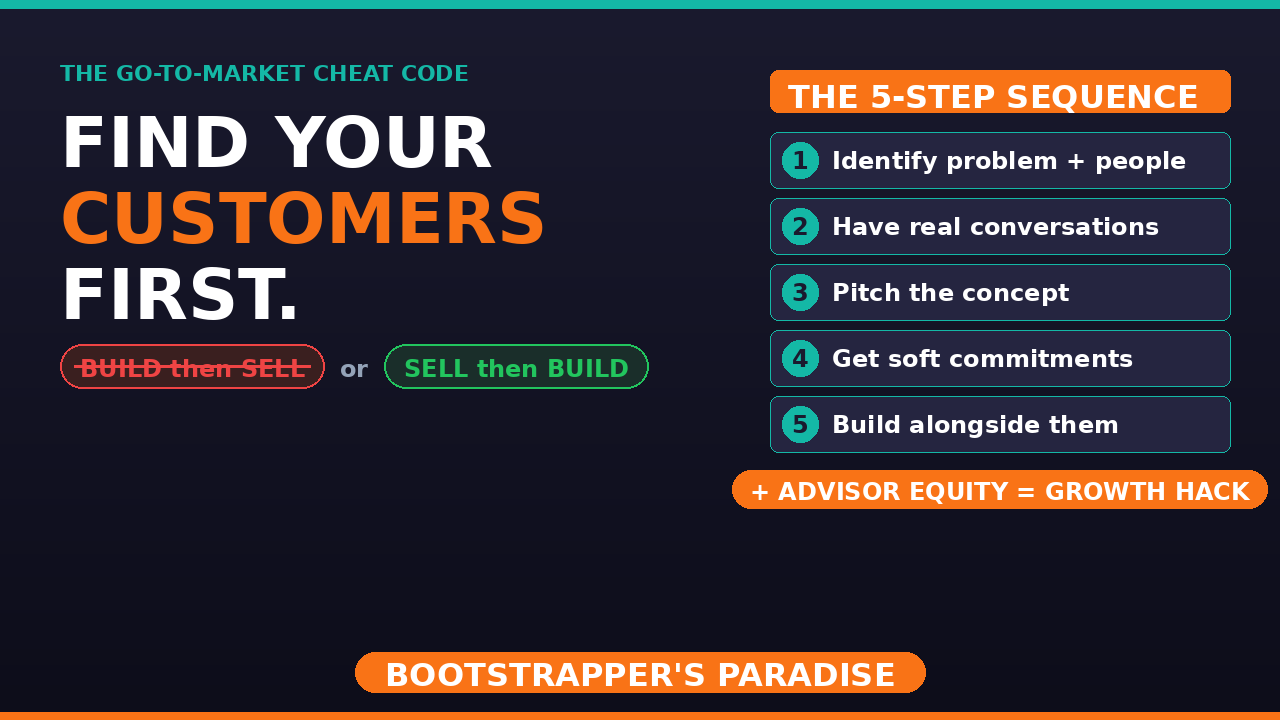
Most bootstrap SaaS founders build a product first and try to find customers second.
That's why a lot of them fail.
In this post I want to walk you through the opposite strategy. Find your customers first. Build a product around what they actually need. Then cut them in on the action by giving a few advisors a couple of equity points.
This compresses your go-to-market timeline, dramatically increases your odds of success, and turns your first customers into the people most motivated to help you grow.
Let's break it down.
The Two Hard Things
I've been saying this for years and it only gets more accurate over time.
There are really only two hard things when building a bootstrap SaaS business:
- Finding a problem worth solving
- Going to market successfully
That's it. Building the software is the easy part.
AI tools have collapsed the build cycle from months to weeks, sometimes days. Codex, Cursor, Claude Code, Lovable — you can ship a real working product faster than ever.
If building isn't the bottleneck anymore, what is?
Go-to-market. Getting the product into the hands of paying customers. That's the part that breaks bootstrappers.
You can have the cleanest, fastest, best-engineered SaaS in your category and watch it sit there with three signups for six months. Because nobody knows it exists. Nobody trusts you. You don't have a distribution channel yet.
If go-to-market is the hard part, the smartest move you can make as a bootstrapper is to attack go-to-market first. Before you write a single line of code.
The Mindset Flip
The traditional bootstrapper build order looks like this:
Idea → build → launch → market → maybe customers
Almost all products die at that "maybe."
Flip the order and your odds improve dramatically:
Idea → customers → build → ship → customers help you market
The first customer conversation comes before your first commit.
Go find five to ten people who clearly have the problem you want to solve. Ask them about it. Describe what you're thinking of building. See if it might solve their actual problem.
- If their eyes light up — great
- If they shrug — you just saved yourself six months of building something nobody wants
This isn't a new idea. It's classic problem discovery. But the AI era makes it more powerful than ever, because once the customers say yes, your build phase is short enough that you can deliver what you promised inside the same business cycle. They still remember the conversation.
You don't have to wait twelve months. You can come back to them in a few weeks with a real, functional version one. That speed advantage is what makes this strategy obvious for bootstrappers in 2026.
The Five-Step Sequence
Step 1: Identify the problem and the people. Pick a problem you actually understand in a market you can reach. Make a list of ten to fifteen real humans who deal with this problem regularly.
Step 2: Have the conversation. Not a survey. A real conversation. Twenty to thirty minutes. Ask about their current workflow, where it's painful, what they've tried, what they would pay to make the pain go away.
Step 3: Pitch your concept. Tell them what you're thinking of building. Be specific. Don't ask "would you use this?" Ask: what would have to be true for you to switch to this from what you're doing today?
Step 4: Get a soft commitment. If their answer is yes, get this on the table: if I built this for you over the next few weeks, would you be one of my first paying customers? This is your gate. If three to five people say yes, green light. If nobody says yes, rethink.
Step 5: Build it for them. Build with their workflow front and center. Let them see early versions. Let them yell about what's wrong so you can fix it.
That's the sequence. Notice you have paying customers lined up before you've written a single line of code. That flips everything in your favor.
The Growth Hack: Make Your Favorite Customers Advisors
Once you have those first customers locked in, you go a step further. You make your favorites official advisors.
What does this mean?
You offer them a slice of equity — maybe a point or two — in exchange for being formally part of your newly formed board of advisors. They sign a simple advisor agreement. They commit to a couple of hours a month. They get vested equity over a year or two.
In return, they get a tangible reason to want your company to win.
This single move changes everything:
- When they hit a problem in your product, they don't churn quietly — they make sure you fix it
- When their friend complains about the same workflow problem, they don't shrug — they refer them
- When you launch a new feature, they don't ignore it — they tell their network, because their upside is now tied to yours
You just turned your favorite paying customers into your most motivated salespeople.
That's a go-to-market cheat code.
Not a lot of bootstrappers do this. The ones who do tend to compound their success much faster than the ones who don't.
The Legal Side (It's Simpler Than You Think)
This is where a lot of bootstrappers get tripped up. It doesn't have to slow you down.
The Founder Institute has free templates. Their FAST Agreement (Founder/Advisor Standard Template) is a single page that's been used by tens of thousands of startups. It doesn't cost you anything. You don't necessarily need a lawyer to execute it for early advisors — though having one review it is a smart idea if you can swing it.
Standard terms typically look like this:
- Equity grant of 0.5% to 1% per advisor, depending on involvement
- Two-year vesting schedule, monthly or quarterly vesting, sometimes a three-to-six-month cliff
- Time commitment of a couple hours per month — answering questions, making intro calls, feedback on the roadmap
- 30-day termination notice either side, unvested equity forfeited
Cap your total advisory pool to about 5% across everyone. You don't have to give the same percentage to everyone — scale it to actual involvement. Document everything. Keep records of meetings and intros so you can justify the equity later if someone asks.
It's simple. It's standardized. It's been done a million times. Don't overthink it.
Why This Compresses Your Timeline
Three reasons:
1. You skip the cold start. Most bootstrappers spend six to twelve months trying to get the first paying customer. With this approach, you start with three to five paying customers on day one of launch. That's not a month saved — that's upwards of a year saved.
2. You skip the "build a solution to a problem that doesn't exist" trap. The single biggest waste in early SaaS is building features nobody wants. When you build alongside actual customers, that waste plummets. You're not guessing. You're literally watching them use it and adjusting in real time.
3. Your advisors do heavy lifting on marketing. Cold outbound is brutal. Warm intros from a customer-advisor with equity convert dramatically better. The trust is borrowed from someone in the buyer's network, not bought from an ad platform. Every advisor becomes a multiplier for your reach.
Skip the cold start. Skip the wrong build. Skip cold outreach.
Your timeline collapses from years to weeks.
The Trap: Don't Build a Custom App for One Customer
Now let me help you avoid the one pitfall that can doom this entire strategy.
The single biggest risk of customer-led development is accidentally building a product that solves exactly one company's workflow. Not one of many. One of one. The first company you talked to.
Every time they ask for a feature, you build it because they're paying. Every quirk in their workflow gets accommodated because they're your customer. Six months in, you have a piece of bespoke software that works beautifully for that one customer and is unsellable to anyone else.
That's not a SaaS product. That's a consulting engagement with extra steps.
I have watched bootstrappers walk into this trap over and over because the customer is right there asking for things and it feels productive to keep saying yes. But the whole point of SaaS is that it scales. One codebase serves many customers. The moment you customize the product to one customer's specific workflow, you've broken that.
You now have a custom dev shop, not a SaaS business.
The Four Rules That Keep You SaaS
Here are the four rules I use to keep customer feedback from turning my product into custom software for one buyer.
1. Wait for the second voice. If one customer asks for a feature, that's an anecdote. If two unrelated customers ask for the same feature in the same month, that's a signal. Don't build for one. Build when it's a pattern.
2. Translate workflow to outcome. When a customer says I need a button that does X, ask what outcome they're trying to achieve. The outcome is usually general. The button is specific to their team. Build for the outcome, not the button.
3. Keep a parking lot. Every one-customer-specific request goes into a parking lot. Don't say no. Say noted. Revisit the lot every month. Watch for items that get a second voice. Promote them when they do.
4. When in doubt, charge for it. If a single customer wants a feature only they'll use, offer to build it as a paid customization separate from the core product roadmap. Feature-flag it. You're not corrupting the product and you're covering your dev time. Win-win.
These four rules are how you stay customer-aware without becoming customer-controlled. Huge difference.
The Whole Playbook on One Page
- Find the customers first
- Have real conversations to validate the problem
- Get soft commitments before you build
- Cut your earliest customers in as advisors with a small equity slice and a simple agreement
- Build a generalized product, not one company's bespoke tool
- Use your advisors as a go-to-market multiplier from day one
That's it. It compresses years into months — sometimes weeks — and dramatically raises your odds of getting to product-market fit before runway runs out.
Free Tools to Help
If you want help finding the right idea to apply this to, my SaaS Idea Validator is free at bootstrappersparadise.com. Validate the problem first, then go find your customers.
- SaaS Idea Validator — tools.bootstrappersparadise.com/validator
- Problem Finder — tools.bootstrappersparadise.com/problem-finder
- Pricing Calculator — tools.bootstrappersparadise.com/pricing
- Free 5-Day Email Course — bootstrappersparadise.com
And if you want personalized one-on-one help building your SaaS company, check out my private coaching program.
Find your customer first. Cut them in. Build the right product. Keep shipping.
Sean is building Clockless, a legal billing SaaS, in public at bootstrappersparadise.com. Join the free 5-day email course to learn the bootstrapper's approach to building SaaS with AI.
Ready to Build Your Own SaaS?
Learn how to go from idea to launch in my free 5-day email course — no coding or big budget required.
Start the Free Course