Find Your Community Before You Build Your Product
The fastest way to solve the 2026 SaaS bottleneck is to find where your target buyers already gather, listen first, and build from real community demand.
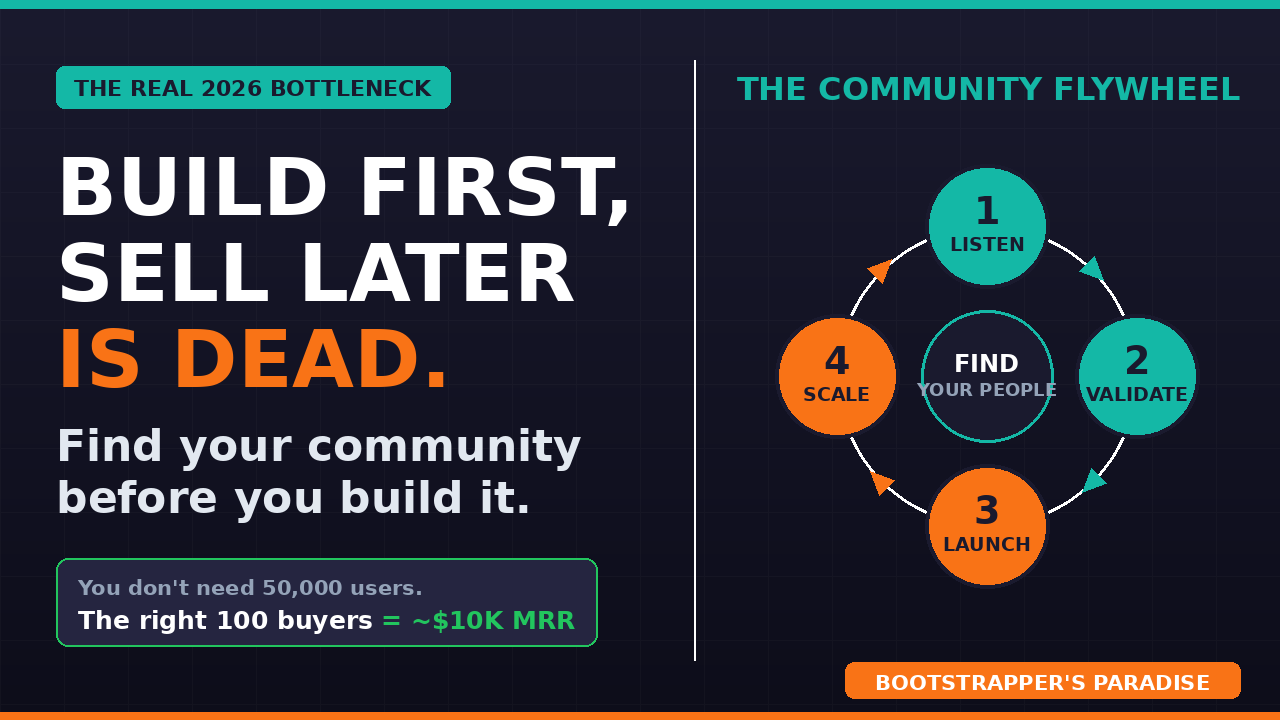
The biggest bottleneck for SaaS companies in 2026 is not development. AI solved that. You can build an MVP in a week for under $100.
The bottleneck is go-to-market — finding customers. The founders who keep building first and selling later are falling into the same trap that has been killing startups for over 20 years.
There is one move that solves it: finding your community before you build your product. Let me show you how it works.
The trap founders keep falling into
Here is the pattern I see over and over. A founder comes to me and says, "I built this amazing product, but I can't find customers." They spent three months building. They spent zero minutes talking to buyers. The product is polished, the go-to-market is an afterthought, and they are surprised nobody is buying.
In 2026, development is the easy part. You have Lovable, Cursor, Claude Code, Codex — the list goes on. You can build almost anything in days to weeks.
What you cannot automate is trust. You cannot automate relationships. You cannot automate the deep understanding of a customer's pain that only comes from being embedded in their world.
That is why the bottleneck has shifted. The question is no longer "can I build this?" It is "does anyone want this, and do they know I exist?" The fastest way to solve both of those at once is to find a community of your target buyers and go live among them.
Find your community — do not build one
When I say find your community, I do not mean stand up a Discord server and hope people show up. I mean find where your target buyers already gather, complain, help each other, and discuss their work. Then go be a genuine participant.
For Clockless, my community is lawyers — more specifically, small law firm owners and solo practitioners. They hang out in subreddits, LinkedIn groups, and the online forums of local bar associations. They are already there, already talking about and complaining about their problems.
I did not create those communities. I found them. That distinction is crucial: a community you found is full of people who were already motivated to be there. A community you build from scratch starts at zero and can take months or years to grow.
Your job is to find where your people already are, embed yourself, listen, and become the person they trust when the problem your product solves inevitably comes up.
The Community Flywheel
Here is the framework. I call it the Community Flywheel because once you start it, each phase feeds the next and it accelerates over time.
- Listen — discover problems worth solving.
- Validate — confirm the pain is real and widespread.
- Launch — to an audience that is already waiting.
- Scale — the community gives you feedback and distribution at the same time.
Most founders start at phase three. They launch into the void. The flywheel starts at phase one. You listen first, and everything after that gets easier.
Phase 1: Listen
Phase one is pure listening. No pitching. No mentioning your product. No "hey, I'm building something, what do you think?" Just reading, absorbing, and understanding what people are frustrated about.
This is exactly what I did for Clockless. I found the lawyer subreddits and asked Claude to research the top five problems — without telling it about billing. I did not want confirmation bias. I wanted to see if the problem would surface organically. It did. Billing landed in the top three.
The listening phase gives you more than problem validation, though. It gives you the language your customers use. When a lawyer says, "billing can kiss my entire ass," that tells me the exact tone and vocabulary I can use on my landing page. That is copy you cannot get from a focus group.
Here is the rule: spend at least two weeks as a silent observer before you ever post or comment. Read everything. Screenshot the posts that make you think "I could solve that." Build a folder of complaints, workarounds, and emotional quotes. That folder is your product spec and your marketing copy rolled into one.
Phase 2: Validate
After you have listened, phase two is about participating — still without pitching. You are validating now.
Start answering questions. Share your expertise on the topic. Help people with the problem you are thinking about solving. When someone posts about their frustrations, do not say "hey, I'm building a tool for that." Say "I've been researching this — here's what I found works for small firms." Be helpful first. The product pitch comes much later, so do not jump the gun.
You are doing two things at once. First, you are confirming the problem is frequent and painful enough to build for. If you see the same complaint five times in a week, that is a signal. If you see it once in three months, probably not.
Second, you are building credibility. When you eventually share your product, you are not a stranger dropping a link — you are the person who has been helping the community for weeks. That trust converts at a completely different rate than cold outreach.
Phase 3: Launch
This is where the magic happens. After you have listened and participated for weeks, you have something most founders would kill for at launch: an audience that already knows you, trusts you, and understands the problem you are solving.
Your launch is not a cold post into the void. It is a message to people you have already been helping: "I've been working on something that addresses the billing problem we've all been talking about. Here's an early look, and I'd love your feedback."
That is a fundamentally different motion than "I built a product, now how do I find customers?" You already found the customers. They were there the whole time. You spent the weeks earning the right to sell to them.
This is what I mean when I say your go-to-market timeline should be zero — not because you skip go-to-market, but because you did it first. The community is the go-to-market strategy.
You don't need the whole community
Here is what most people miss. You do not need everyone to buy.
If there are 50,000 lawyers in those subreddits and 100 of them become customers at $99 a month, that is nearly $10K MRR. You do not need scale. You need the right 100 people to launch with.
Phase 4: Scale
Phase four is where the flywheel really gets moving. Now you have customers from the community. Those customers give you feedback that makes the product better. You ship improvements, and the improved product generates more word of mouth in the community. New members see the discussions, try the product, and some of them become customers too.
This is the compound effect that enterprise SaaS companies spend millions trying to manufacture with sales teams and marketing departments. You create it for free by being genuinely embedded in the community you serve.
The feedback loop is especially powerful because your customers are also product advisers. They tell you what to build next, what is broken, and what competitors are getting wrong — and they do it publicly, where other potential customers can see the founder actually listening.
The other thing that happens at scale: your participation becomes content. Every helpful answer is a micro piece of marketing. Every product update you share is a touchpoint. Every public thank-you is social proof. You build marketing by being helpful, not by running ads.
The 5-step playbook to find your community this week
- Define your buyer. Not "small businesses." Be specific. For me it is owners of law firms with 5 to 25 attorneys who handle their own operations. The more specific you get, the easier they are to find.
- Search where that person hangs out. Reddit, LinkedIn groups, Facebook groups, Slack communities, niche forums. Use searches like your-industry plus "frustrated," "wish there was," or "does anyone struggle with."
- Join three to five of the most active communities and lurk. Read everything. Screenshot complaints. Build your pain-point folder.
- Start participating. Answer questions, share insights, be helpful. Do not pitch. Do this for two to four weeks.
- Share what you're building. Once you have earned trust, show your work and ask for feedback. Your first customers are in that room.
Total investment: about four to six weeks, and zero dollars. What you get in return is a validated problem, the exact language for your marketing, a trusted relationship with your target buyers, and a built-in launch audience. That is the best ROI of any activity in bootstrapped SaaS.
Start with the problem
The flywheel only works if you point it at a real, repeated problem. The fastest way to waste those four to six weeks is to embed in a community and then build something nobody actually wants.
Before you start, surface the problems worth solving:
- Problem Finder — find the real, repeated problems in your market so you build something people already want: tools.bootstrappersparadise.com/problem-finder
For the full playbook on going from zero to a launched SaaS — validation, building, and getting your first customers — grab the free 5-day email course.
If you want personalized, one-on-one help running this in your own market, my private coaching program is open.
Find the community. Listen. Participate. Then build. Find your community first, and everything else gets easier.
Ready to Build Your Own SaaS?
Learn how to go from idea to launch in my free 5-day email course — no coding or big budget required.
Start the Free Course