Find Your Buyer First: Why Your Go-To-Market Timeline Should Be Zero
Most founders build first and sell later. Here's why finding your buyer before writing a single line of code collapses your go-to-market timeline to zero — and how I did it with Clockless.
Most founders spend months building their product, then months more trying to find someone to buy it. But what if your go-to-market timeline was zero? Not days. Not weeks. Zero. Because by the time your product is ready, someone is already waiting to pay for it.
That's exactly what I did with Clockless, the legal billing SaaS I'm building in public. And after 15 years of building SaaS products, this is the single greatest lesson I've learned.
The #1 Mistake
The number one mistake founders make is building in isolation. They have an idea, they get excited, they disappear into a code editor for weeks or months, and when they emerge, they have something nobody actually asked for.
I used to do this too. But now I flip the entire process. I find the buyer first, understand their pain deeply, and build exactly what they need. When I do this, the go-to-market timeline collapses to zero because someone is literally waiting for the product the day it ships.
How It Worked With Clockless
It started with a single conversation.
I was talking to a friend who owns a small law firm, and he said something that stuck with me. He told me his attorneys were losing 10 to 50 percent of their billable revenue because they simply couldn't track their time accurately.
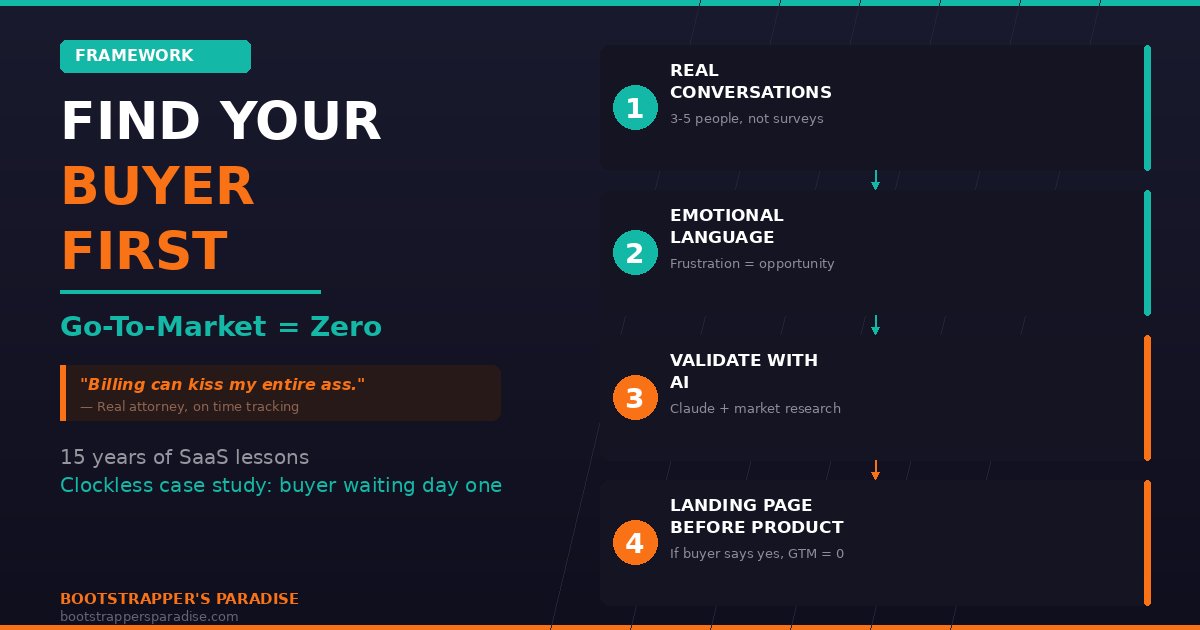
The quotes I uncovered from real attorneys about billing were very telling. One said, and I quote: "Billing can kiss my entire ass."
That's the level of frustration you're looking for. That's not mild inconvenience. That's intense pain worth putting real dollars into solving.
But here's the key: I didn't go build an app. I didn't even sketch a wireframe. I went and validated that this was a widespread problem first.
I used Claude to research legal forums, Reddit, Quora — everywhere attorneys talk about their problems. Billing and time tracking consistently ranked as a top-three operational pain point across the industry. Firms using competitors like Clio, who've raised nearly a billion dollars, were still complaining about billing.
That told me two things. The market is massive, and the existing solutions aren't solving the problem well enough.
So now I had a real person with a real problem, backed by market-wide validation. I knew the buyer. I knew the pain. I knew the price point the market would support. Everything I build with Clockless works backwards from that one attorney, that one firm. He's not a hypothetical persona. He's a real business person who's waiting for this product.
The Buyer-First Framework
Here's the four-step framework you can start using this week.
Step 1: Have real conversations.
Not surveys. Not Reddit polls. Actual conversations with actual humans who have the problem you think you want to solve. Three to five conversations is enough to start. Use an AI notetaker like Fathom so you can be fully present instead of scribbling notes.
Step 2: Listen for emotional language.
When someone says "billing can kiss my entire ass," that's not calm indifference — that's pain worth paying to fix. If people describe their problem with a shrug, it's probably not a business. If they get emotional or frustrated, you're on to something.
Step 3: Validate the market with AI.
Take your interview transcripts, paste them into Claude, and ask it to research the broader market. Is this problem in the top five for your target audience? Is there quantifiable impact? Are competitors raising money to solve it? If yes to all three, you likely have a validated idea.
Step 4: Build a landing page before you build a product.
Use a tool like Lovable to spin up a landing page in hours. Put it in front of your interview subjects. If your buyer — the real person you talked to — says they'd sign up, you've just collapsed your go-to-market timeline to zero.
Traditional vs. Buyer-First
The traditional approach goes like this: idea, build for three months, launch, try to find customers, struggle for six months, probably give up.
The Buyer-First approach: conversation, validate, build, buyer ready on day one.
The go-to-market timeline isn't short. It's literally zero because the customer exists before the product does.
Clockless in Practice
I'm building Clockless entirely in public. I'm using Lovable for the landing page and prototyping, Cursor and Claude Code for development, and documenting every step on the channel.
The attorney I talked to has seen the landing page. He's given feedback on the feature set. He knows the pricing. When this product ships, I'm not launching into the void hoping someone finds it. I'm handing it to someone who's been waiting for it.
That's the power of finding your buyer first.
The Snowball
Here's the beautiful thing about doing this as a bootstrapper: you don't need thousands of customers on day one. You need one, then five, then ten.
Each of those early customers becomes a reference, a case study, and a source of feedback that makes your product better for the next ten. Before you know it, your real business is off and running.
Your Homework
Pick one person in the market you want to serve. Not a friend. Not your mom. An actual potential customer. Have a 20-minute conversation with them about their biggest pain points.
Don't pitch. Don't mention your idea. Just listen.
Record it with Fathom, then take the transcript and run it through Claude. If you do this once, you'll learn more about your market in 20 minutes than most founders learn in three months of building alone.
If the pain is real, you just found your first buyer.
The Buyer First Playbook
Framework and prompts to find your buyer before writing a single line of code and collapse your go-to-market timeline to zero.
Ready to Build Your Own SaaS?
Learn how to go from idea to launch in my free 5-day email course — no coding or big budget required.
Start the Free Course