Find Problems Worth Solving: The Free Reddit Research Framework
Most founders skip problem discovery and go straight to building. I built a free tool that generates a complete Reddit research framework for your market in 2 minutes — subreddit hit lists, search queries, signal taxonomy, and a research roadmap.
Every successful SaaS product starts with a problem worth solving. Not an idea you had in the shower. Not a feature you think would be cool. A real, painful problem that real people are already complaining about.
The question is: how do you find those problems?
Reddit is a gold mine of unfiltered frustration. But most founders have no idea where to look, what to search for, or how to separate real pain from noise. So I built a free tool that does the research planning for you. It generates a complete Reddit research framework for your specific market in about two minutes.
The Step Most Founders Skip
Most founders jump straight to the solution. They have an idea, start building, and hope customers show up. But there's a step before validation that most people miss entirely: problem discovery.
Problem discovery isn't brainstorming. It's going to the places where your target market hangs out and listening to what they're already complaining about. The best SaaS ideas don't come from your imagination — they come from someone else's frustration.
For Clockless, I didn't invent the billing problem. A law firm owner told me about it. Then I went to Reddit and found hundreds of lawyers complaining about the same thing. The problem was already there. I just needed a systematic way to find it and verify it.
Why Reddit (And Why You Need a Framework)
Reddit captures raw, unfiltered frustration that formal channels miss. Nobody writes a 500-word rant on the lawyer subreddit because they're mildly annoyed. They write it because they're in pain. The anonymous element removes the filter — people say things on Reddit they'd never say in a LinkedIn post or a survey.
But there are millions of subreddits, millions of posts, and most are irrelevant to your market. Without a framework, you waste hours scrolling through noise trying to find signal. That's why the Problem Finder exists. It's not a scraper — it doesn't pull live data. It's a research methodology generator. You tell it your market and it builds you a custom playbook.
What the Problem Finder Generates
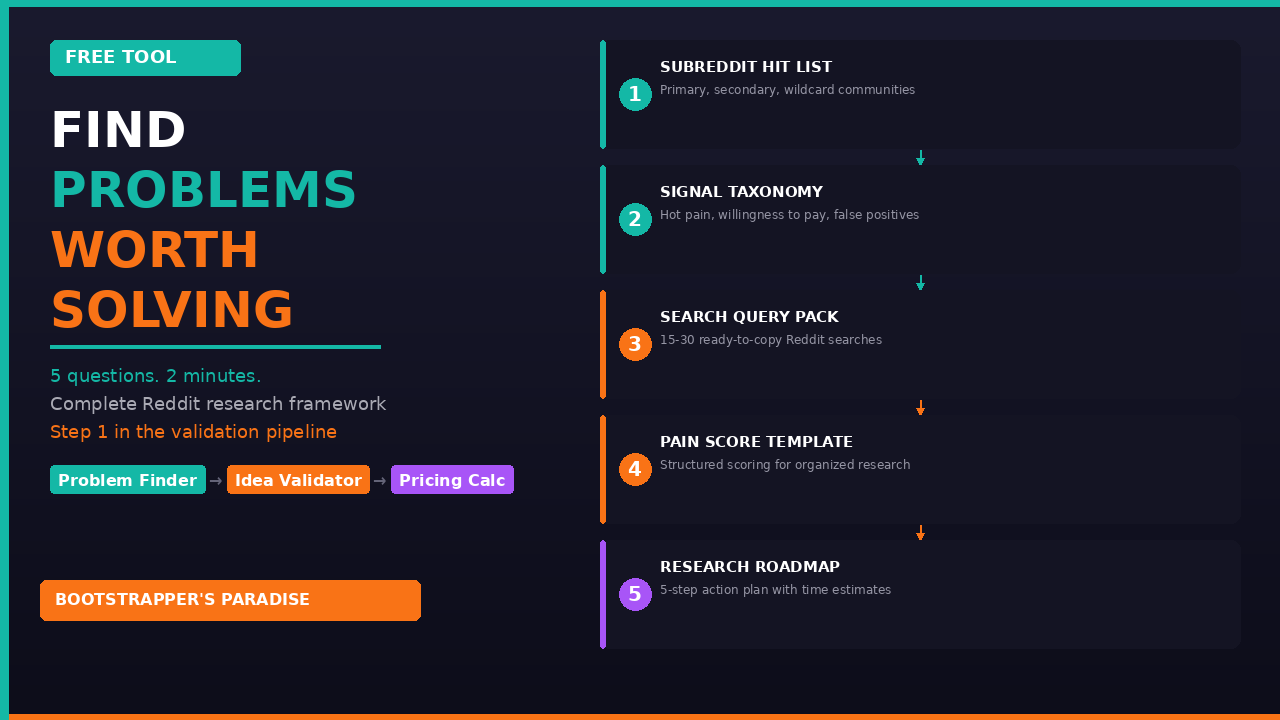
The tool produces five outputs from five questions:
1. Subreddit Hit List. Primary, secondary, and wildcard communities ranked by relevance. For small law firms, it identified r/lawyers (180K members) and r/lawfirm (25K) as primary, r/soloattorney and r/paralegal as secondary, and r/smallbusiness and r/accounting as wildcard subs for cross-industry patterns.
2. Signal Taxonomy. What hot pain sounds like in your specific market ("billing nightmare," "drowning in time sheets"), willingness-to-pay signals ("worth every penny," "would pay anything to automate"), frequency signals ("every month," "end of month hell"), and critically — false positives to avoid. For legal billing, it flagged complaints about clients not paying as a false positive that looks like billing pain but isn't. That distinction saves hours of wasted research.
3. Search Query Pack. 15–30 ready-to-copy search queries organized by intent. Problem discovery queries ("billing software lawyers hate"), tool queries ("best billing software small law firm," "alternatives to Clio"), and workflow queries ("how do you handle client billing"). Copy-paste directly into Reddit search.
4. Pain Score Template. A structured way to log and score what you find. Your research stays organized instead of becoming a pile of screenshots.
5. Personalized Research Roadmap. A five-step action plan based on your experience level with estimated time for each step. Total: about 10 hours across one week. Your entire week of research, planned for you.
How to Actually Use the Framework
Block two hours a day for five days. Follow the roadmap in order — each step builds on the previous one.
Day 1: Search primary subreddits using the problem discovery queries. Read posts. Screenshot complaints. Start building your pain-point folder.
Day 2: Go deeper. Read comment threads on posts with the most engagement. Look for specific workflow breakdowns — not just "billing is hard," but "I spend three hours every Friday reconstructing what I did all week." Those details are where product ideas live.
Day 3: Search the tool and solution queries. Find what people already pay for and where those tools fall short. Every complaint about an existing tool is a potential opportunity.
Day 4: Explore secondary and wildcard subreddits. Different perspectives reveal different angles on the same problem.
Day 5: Organize everything using the pain score template. Which problems are most frequent? Most painful? Most monetizable? The answers tell you what to build.
The Validation Pipeline
The Problem Finder is step one in the validation process. It gives you the research methodology to discover problems worth solving. Once you've found a promising problem, run it through the Idea Validator to score the opportunity. Then use the Pricing Calculator to figure out what to charge.
Problem Finder discovers. Idea Validator scores. Pricing Calculator monetizes. Three free tools, one validation pipeline.
The Bottom Line
The founders who skip problem discovery and go straight to building are the ones who end up with products nobody wants. The founders who follow a systematic process end up building something people actively need.
Five questions. Two minutes. A complete methodology for finding problems worth solving.
Try the Problem Finder for free — and start your validation pipeline today.
Ready to Build Your Own SaaS?
Learn how to go from idea to launch in my free 5-day email course — no coding or big budget required.
Start the Free Course