Just Because You Can Automate It Doesn't Mean You Should
The best automation targets a customer's bottleneck, not every task around it.
AI and modern software tools can automate almost anything now. Data entry, integrations, reports, emails, whole workflows. If you can describe it, there's a good chance you can automate it.
You'd think that would make building the right product easier. In my experience, it's actually made it harder, since when everything can be automated, it gets really easy to automate the wrong things.
Let me show you how to decide what's actually worth automating, and why automating the wrong thing can cost you customers, even if your demo looks amazing.
My demo dazzled, and nobody could use it
Let me start with a mistake I made myself.
My fintech software helps with the financial due diligence that happens when a business is being bought or sold. Early on, I got a little carried away. I automated all the things: connections to accounting systems, and even direct connections to bank accounts.
In theory it was a great idea, and it dazzled in my demos. You could watch the data just flow in.
Then the feedback started coming in, and it was almost always some version of the same thing. "We'd love to, but we'll likely never get access to banking credentials. Even if we did, we'd never get permission to automate that kind of data pull."
When you think about it, that makes total sense. An outside advisor isn't going to get the seller's bank logins. I'd built an impressive feature that most of my market could never actually use.
The hidden cost of over-automating
Here's the part I didn't see coming. Over-automating doesn't just waste your build time.
To the buyer, it can make it look like you don't really know their market. If you build something they could never use, they may quietly wonder what else you don't understand about how they work.
That stung a little, but honestly, it was some of the most valuable feedback I've ever gotten. It told me exactly where my product and my market didn't line up, so I could fix it.
Build around how the process actually works
So I changed it. I redesigned my product around how the process actually works for my customers, which is processing the files and statements they already have.
It's less flashy in a demo, for sure. It's also far more valuable in real life, since it fits the way they actually do the work.
So how do you spot this before you build it, instead of after? It starts with understanding what's really slowing your customer down.
Why automating the wrong step doesn't help
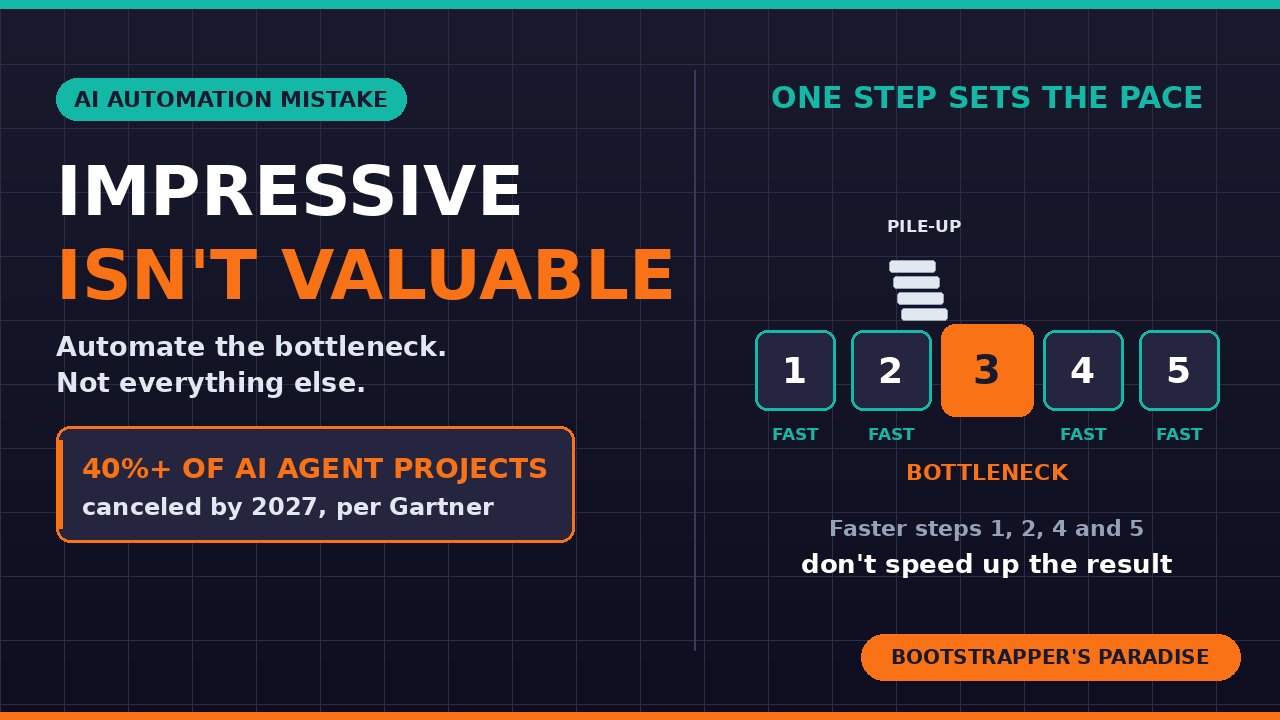
Picture your customer's process as five steps in a row, and step three is the slow one. That's the bottleneck.
Now say you automate steps one, two, four, and five. They're all lightning fast. Does your customer get their result any sooner?
Not really. Steps one and two just pile up more work in front of step three, and steps four and five sit there waiting for it. The whole process still moves at the speed of the slowest step.
The only automation that speeds up the whole thing is automation at the bottleneck. Everything else might be impressive, but it's not where the value is. That's the difference between building the most impressive tool and building the most valuable one.
It's not just bootstrappers
This isn't just a small-founder problem, by the way. Big companies are falling into the same trap.
Gartner predicts that more than 40% of agentic AI projects will be canceled by the end of 2027, mostly because of escalating costs and unclear business value. Their analysts also estimate that of the thousands of vendors selling agentic AI, only about 130 are actually delivering on what they promise. A lot of the rest are relabeling chatbots and assistants as agents.
That's a lot of impressive capability without a clear reason for anyone to pay for it. The good news is that as a bootstrapper, you can avoid this a lot more easily than a big company can, as long as you stay close to your customers.
My system for deciding what to automate
So here's my system for deciding what's actually worth automating.
- Map your customer's critical path. That's the steps they actually take to get the result they care about, the way they do it today.
- Find the one step that holds everything else up. My free Problem Finder can help you figure that out for your market.
- Check the constraints before you build anything. Permissions, compliance, access, and who's allowed to do what. This is the step I accidentally skipped, and it's the one most automation advice never mentions.
- Automate only that bottleneck step, inside those constraints.
- Measure whether your customer actually gets their result faster. If they don't, it wasn't the right thing to automate.
Pro Tip – when a prospect says "we'd love to, but," don't treat it as an objection to argue with. Treat it as free research. It's telling you exactly where your product doesn't match how they work.
Your playbook to follow
- Don't automate something just because you can.
- Map your customer's critical path the way they actually do it today.
- Find the one step that holds everything up.
- Check permissions, compliance, and access before you build.
- Automate only the bottleneck, then measure whether results come faster.
- Treat every "we'd love to, but" as feedback, not an objection.
Sources
- SD Times, Gartner: More than 40% of agentic AI projects will be canceled in the next few years
- The Star (Reuters), Over 40% of agentic AI projects will be scrapped by 2027, Gartner says, June 25, 2025
Where to go next
If you want to build a successful SaaS business, start with my free resources. The 5-day email course is the best place to start: bootstrappersparadise.com/#course
If you want to map out your own path with me directly, I take a small number of founders for private 1:1 coaching: bootstrappersparadise.com/#coaching
If you want to see why building fast isn't the same as building a business, read or watch Vibe Coding Won't Kill SaaS (Here's The Proof).
When you strip it all down, the goal isn't to build the most impressive tool. It's to build the most valuable tool for your target market, and those are rarely the same thing.
Ready to Build Your Own SaaS?
Learn how to go from idea to launch in my free 5-day email course — no coding or big budget required.
Start the Free Course