When And Why To Brand As An AI Company Instead Of SaaS
The AI label can open doors with investors and acquirers, but customers buy outcomes. Learn how to position your company honestly for both audiences.
Somewhere in the last eighteen months, "SaaS" became a word founders started avoiding.
Watch how people introduce their companies now. They'll say platform, they'll say tool, they'll say AI company. Almost nobody leads with "we're a SaaS business" anymore, and that's a change from what was a perfectly good label for twenty years.
Let me show you why that happened, what the AI label is actually worth in real numbers, and the best way to position your company in the AI era.
Why the label got re-rated
Here's what happened to the word.
The market spent most of this year convinced that AI was about to let every company build its own software. If a business can just build it, the thinking went, why would anyone license anything ever again?
That belief hammered the sector, and the term "SaaS" went along with it, since the label was attached to the business model under attack.
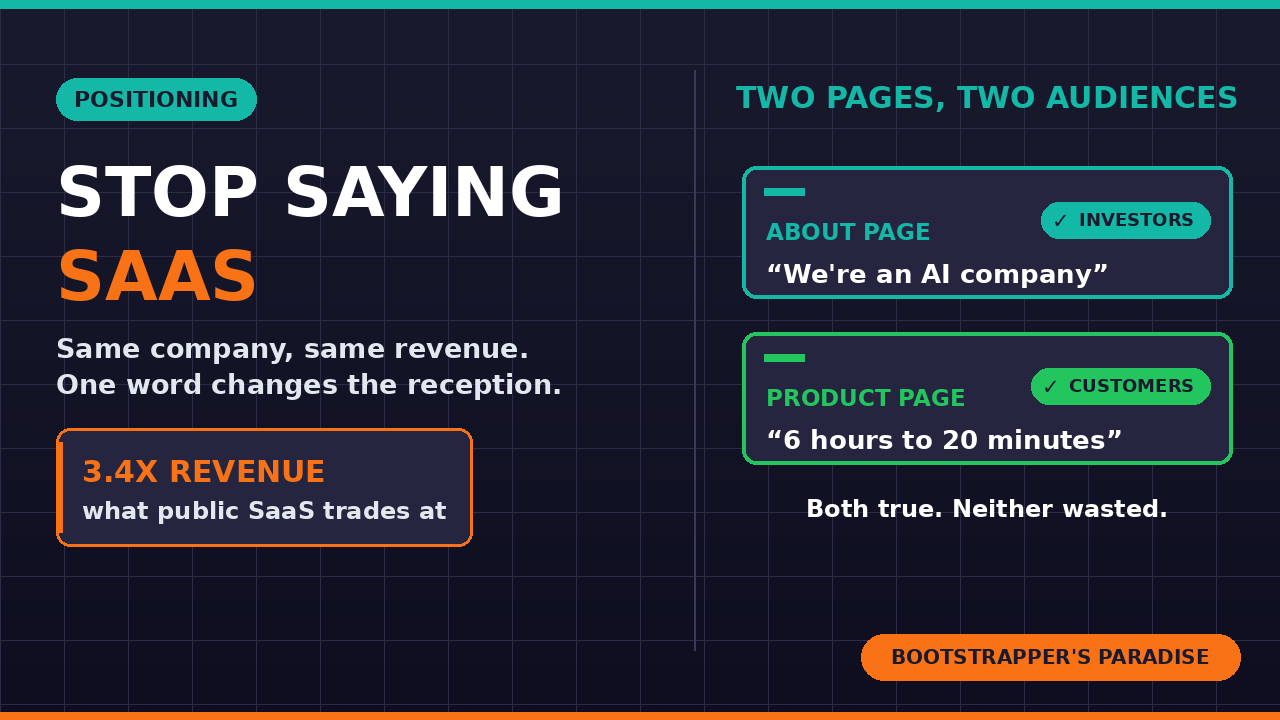
Public SaaS now trades around 3.4 times revenue. For context, that's a multiple that used to belong to businesses nobody really got that excited about.
I've covered elsewhere why that reaction was overblown and why companies mostly aren't successfully building their own software. The short version is that it isn't playing out the way they thought it would. Internal projects are stalling at a remarkable rate, and SaaS companies that have adjusted to the new rules are doing better than ever.
Here's the thing though. For branding purposes, it doesn't matter whether the market is right. It matters what the market believes right now, and right now it believes SaaS is the category getting disrupted. You don't want to waste time and money arguing with a label. It's easier and better for your business if you pick a different one.
What the AI label is actually worth
So what does the other label get you?
SaaStr ran the numbers across more than six hundred thousand startup valuations. In that dataset, AI-first products are landing at roughly 11 to 14 times ARR, while traditional SaaS sits at 6 to 9 times depending on growth rate.
At the extreme end it gets outright goofy. A legal AI company has moved from three billion to five to eight and now to eleven billion inside about a year. A voice AI company closed at roughly eleven billion as well. These numbers barely make sense, and I'm sure you've noticed that too.
Those extremes aren't you and they aren't me. What matters for us is the direction and the mechanism. Largely the same business, same revenue, same product, described slightly differently gets a different reception from investors, from acquirers, and even from customers.
One honest caveat, since it changes how you should use this. That same SaaStr analysis concludes the premium tracks growth rate more than it tracks the label. A traditional SaaS company growing 80% gets valued above a slow-growing AI company at 30%. At 20% year-over-year growth, adding the AI label won't save you.
So the word opens a door. It doesn't carry you through it. If you're raising, selling, or just trying to get a meeting, that's still not a small thing. Every little bit helps when you're a bootstrapped founder.
The catch, and it has teeth
One condition that's likely obvious, but I want to mention it so you don't fall into an easy-to-avoid trap.
You have to actually be using AI to do something useful for your customer. Easy to understand, a touch harder to implement. Everyone wants to jump on a trend, and I want you to do it the right way, because if you don't, it will burn you later.
I'm not talking about a chatbot bolted onto a settings page. Not a thin wrapper around somebody else's API with your logo on it. Investors have already caught up to that. Venture firms now openly say they're skipping generic productivity tools and thin AI wrappers built on existing APIs, so the label without substance doesn't even work for its primary purpose anymore.
Here's the part that goes beyond embarrassment though.
The SEC started bringing enforcement actions for what they call AI washing, meaning overstating your AI capabilities. The first cases in March 2024 were two investment advisers, settling for four hundred thousand dollars combined. In early 2025 the agency issued a cease-and-desist against a company that described its product as proprietary AI when regulators found it was largely a third-party vendor plus significant human intervention.
Then it escalated. In April 2025 the SEC and the Department of Justice jointly charged a founder who raised over forty-two million dollars presenting his shopping app as AI-powered. That one is especially messy.
The SEC created a dedicated unit for emerging technology enforcement. The FTC ran its own sweep called Operation AI Comply. Enforcement has continued across two different administrations, and the SEC named AI a key examination priority for this fiscal year.
One line from the legal coverage stuck with me: "everyone says it" is not a defense.
I'm not telling you this to scare you off. If AI genuinely does real work in your product, you're fine and you should say so. I'm telling you because the gap between "we use AI" and "we're an AI company" is a gap everyone is scrutinizing, regulators included, and most founders don't have this on their radar.
Brand the company, sell the outcome
Now here's the distinction that makes all of this work, and almost everyone gets it backwards.
"AI company" is a category claim. It's who you are. It belongs on your about page, in your investor materials, in how you introduce the business, in press and partnerships.
"AI-powered" is a feature claim. It's what your product does. It belongs almost nowhere, honestly.
I've said this before and it's worth repeating. Gartner found half of US consumers would rather buy from brands that don't use generative AI in customer-facing work. Nearly two thirds would prefer companies didn't use AI in customer service at all.
So those two audiences want opposite things. Investors and acquirers reward the AI category. Customers increasingly penalize the AI feature badge.
The resolution is simple once you see it. Brand the company as AI. Sell the outcome in the product.
Your about page says you're an AI company building for law firms. Your product page says you cut invoice prep from six hours to twenty minutes. Both are true, neither is wasted on the wrong audience.
Pro Tip – most founders do this exactly backwards. They plaster "AI-powered" across the pages customers read and then describe themselves as a SaaS tool to the investor who'd have paid a premium for the other word. Flip it around to make your journey easier.
How to actually say it
So how do you phrase it without sounding like everyone else?
The weak version is "we're an AI-powered SaaS platform." That's three category words and zero information, and it's what most of your competitors are saying right now.
The strong version names the AI, the market, and the outcome in one line. "We're an AI company that automates billing for law firms." Category, vertical, job. Done.
Notice what that does. It claims the AI category, which is the part doing work with investors. It narrows to a vertical, which is what makes you credible rather than generic. Then it names a job somebody actually has, which speaks to your specific buyer.
That's also a sentence you can defend if a regulator or a diligence process ever asks what the AI does, which brings us back to the condition from a minute ago.
Why this is a "for now" play
Last thing, and it's what matters most for now.
This is a timing call, not a permanent truth. With everything in constant motion these days, consider this a trend, which just means it's subject to change.
Labels get re-rated. "SaaS" was the premium word for twenty years and then it wasn't. "Dot com" was the premium word before that. The AI label is in its favorable window right now, and windows do eventually close.
Here's what will likely close this one. One analysis put it well: the AI label earns a higher entry valuation, but it also earns AI-level expectations. If you grow at normal software rates while calling yourself AI, you get re-rated to a software multiple anyway, just with further to fall.
On top of that, as every company adopts the word it stops carrying information. That's already happening.
So use it while it works, stay honest about what's underneath it, and expect to revisit this in a couple of years. The underlying business you're building shouldn't change based on what we call it.
Your playbook to follow
- Be honest with yourself first. Does AI do real work for your customer, or is it just a label you slapped on? That answer decides everything else.
- If yes, claim the category. You're an AI company, and say it in the places investors, acquirers and partners read.
- Keep "AI-powered" off the pages your customers read. Sell the outcome there instead.
- Write one sentence: AI company, specific vertical, specific job. Use it everywhere.
- Make sure you could defend that sentence in a diligence process, since "everyone says it" is not a defense.
- Revisit this in a year. The label is a timing call, not an identity.
Sources
- SaaStr, what 600,000 startup valuations show about what VCs are funding
- SaaStr, the top 1% of AI startups valued at 3 to 10 times normal multiples
- SEC, first AI washing enforcement actions, March 18, 2024
- Harvard Law School Forum on Corporate Governance, decoding the SEC's first AI washing actions
- SEC litigation release, charges against the founder of Nate Inc., April 2025
- Debevoise, the SEC and DOJ signal continued focus on AI washing
- DLA Piper, DOJ and SEC send warning against AI washing
- FTC, Operation AI Comply enforcement sweep
- Gartner, half of US consumers prefer brands that avoid generative AI in consumer-facing content
- Bloomberg Law, Harvey raising at an 11 billion dollar valuation
Where to go next
If you want to build a successful SaaS business, start with my free resources. The SaaS Idea Validator is the right place to pressure test what you're building and the positioning around it: tools.bootstrappersparadise.com/validator
If you want to map out your own path with me directly, I take a small number of founders for private 1:1 coaching: bootstrappersparadise.com/#coaching
The word changed. The work didn't.
You're still finding a real problem, building something that solves it, and getting people to pay you for it repeatedly. Call it whatever gets you the best reception this year, then follow your plan and do the job well.
Ready to Build Your Own SaaS?
Learn how to go from idea to launch in my free 5-day email course — no coding or big budget required.
Start the Free Course