The Best Day Job For Building SaaS On The Side
The strongest day job for building SaaS on the side combines product judgment with engineering and design. Here is the path from specialist to Product Builder.
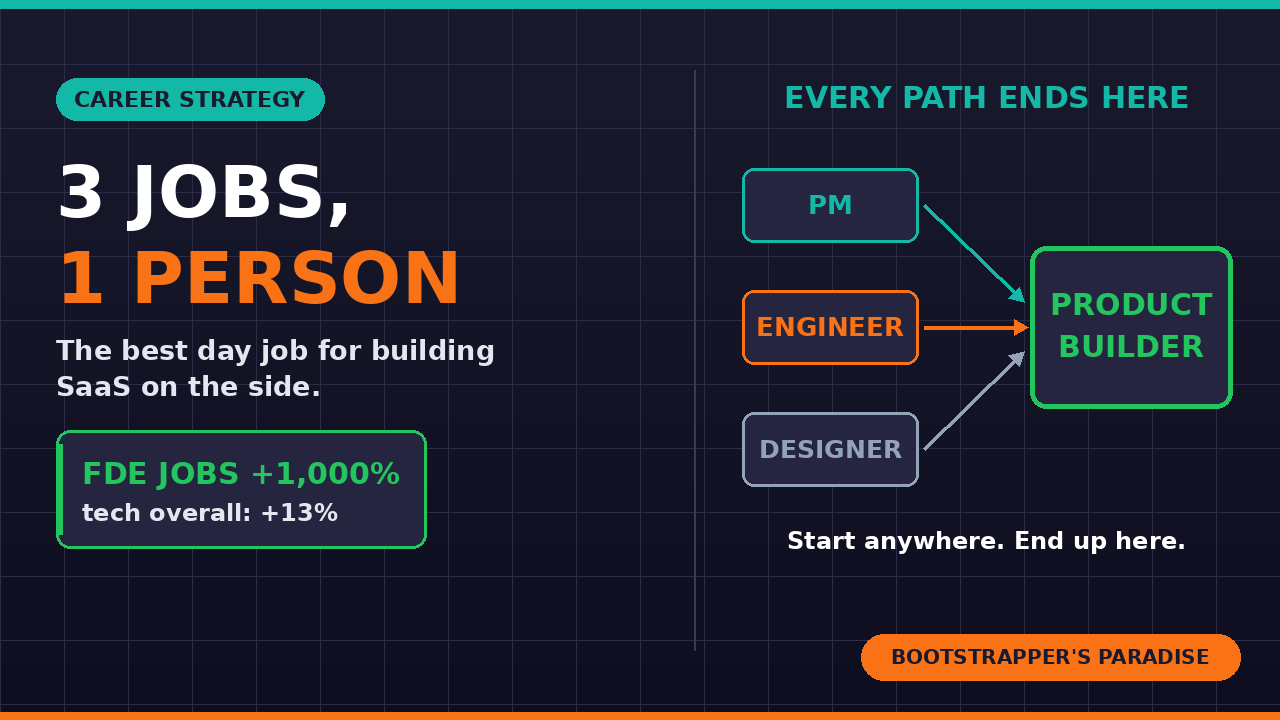
If you're building a SaaS on the side, your day job isn't neutral. It either feeds the side project or it starves it.
The best day job pays you well, teaches you the exact skills your product needs, and doesn't evaporate as AI reshapes the industry. There's one role that does all three right now, and most people aren't thinking about it this way.
It's product management. With two upgrades. Here's why.
The team that collapsed
Here's how software got built for the last twenty years.
A product manager figures out what the customer actually needs. A designer mocks it up. An engineer builds it. Three people, three specialties, a lot of meetings between them.
In the AI era, that's collapsed to two people, and often one.
This isn't my prediction. It's already happening at companies you'd recognize.
LinkedIn shut down its Associate Product Manager program and replaced it with an Associate Product Builder program, which trains people across product, design, and engineering together. One person, all three disciplines.
The 2026 CPO Insights Report from Products That Count and Mighty Capital, which draws on more than 1,500 product leaders, describes the boundaries between product, design, and engineering collapsing into exactly that hybrid Product Builder role. A new title is showing up in job descriptions too: Product Engineer. Someone who can reason about the user problem, design the experience, and ship the code.
The ratios are breaking
The staffing ratios tell the same story.
The classic rule was one PM for every eight engineers. That's breaking down, since the job now includes producing working software rather than just describing it. One of the best-known AI educators has described teams moving from roughly one PM per four engineers toward two PMs per engineer.
Whichever direction a specific company moves, the underlying shift is the same. The handoffs are disappearing, and the person who can do more than one of those jobs is worth dramatically more than the person who can only do one.
That person could be you.
Why PM is the best base
So why start from product management rather than the other two?
The PM skills are the ones AI is worst at, and the ones engineers and designers most often lack.
Figuring out what a customer actually needs versus what they say they want. Deciding what not to build. Making a defensible call when the data is incomplete. Reading weak signals from support tickets and cancellations. Knowing when something is good enough to ship.
Those are judgment skills, and judgment is exactly what doesn't automate easily.
The market agrees. Product manager openings hit their highest level in over three years in early 2026, with more than 7,300 open roles tracked globally, according to TrueUp data analyzed by Lenny's Newsletter. Design roles, meanwhile, have been roughly flat since early 2023, and PM has been pulling away ever since.
Here's the part you need to hear, though. Those skills alone aren't enough anymore, which is why I said two upgrades.
Upgrade one: add engineering and you're an FDE
Upgrade one is software engineering.
Learn to actually build, and combined with your product instincts you're essentially a forward deployed engineer. That's the role Palantir pioneered and that OpenAI, Anthropic and Google are now hiring for aggressively. An FDE embeds with a customer, figures out what they really need, and builds the thing that works in their actual environment. Part engineer, part operator, part owner of the outcome.
Look at the demand. Job postings for forward deployed engineers rose more than 1,000% between January and August of this year compared to the same period last year, and more than 4,600% compared to 2023, according to Lightcast data reported by Fortune. The broader tech job market grew 13% over the same stretch.
The pay follows. The median advertised salary for the role is above $188,000, compared to roughly $145,000 for traditional software engineers, and some roles at the frontier labs reach well beyond that.
Upgrade two: add design
Upgrade two is design. Not pixel-perfect visual design, but enough taste and enough tooling to mock up a flow and know when something feels right or wrong. AI tools make that far more accessible than it used to be.
Add both upgrades to a product foundation and you're the full package. You can be the entire dev team as one person.
What's shrinking, what's growing
Let me be honest about the other side of this, since I'd want someone to tell me.
Parts of the PM job are shrinking fast. Writing detailed specs, running status updates, formatting stakeholder reports, coordinating handoffs. AI handles a meaningful chunk of that now, and the Scrum-style product owner role is being folded in or eliminated at a lot of companies.
There's a question going around product circles that I think is the right one: what do you do in a day that an engineer with an AI coding tool in the next room can't do faster?
If your answer is "I write tickets," you have a problem. If your answer is judgment, customer understanding, and the ability to ship, you're in the strongest position in software.
One more honest note for anyone considering the design path specifically. Open design roles have been roughly flat since early 2023, while PM and engineering both grew. Design as a standalone career is under more pressure than the other two. Design as a skill attached to product or engineering is more valuable than ever. That's the distinction to internalize.
The same skills build your SaaS
Here's why this matters so much for what we do.
Every one of these skills is the same skill you need to build your own SaaS. Finding a real problem. Deciding what to build. Designing something usable. Shipping it. That's the day job and the side project, using the same muscles.
Most people's day job is a tax on their side project. This one is training for it, and it pays you while you train.
The contracting option
There's a third option worth naming, and it's the version of all this that I do while I'm building my SaaS products. Contract or consult instead of taking a salary.
You typically earn more per hour, you choose your projects, and most importantly you control your calendar. That flexibility is what actually determines whether your side project ships, since the constraint is almost never motivation. It's hours.
The tradeoff is real: less stability, you handle your own benefits, and you have to find the work. If you're early in your career, take the salary and learn on someone else's time. Once you have the skills and a network, contracting gives you the most leverage.
Your plan, wherever you're starting
Here's the specific plan depending on where you are now.
If you're a PM today
Add engineering first, design second.
Pick one real internal problem and build the whole thing yourself, front to back. Not a prototype, a working tool somebody uses. You'll learn more from one shipped thing than from six months of courses. Learn enough about how your system actually works that you can have a real architecture conversation. Then get comfortable mocking up flows so you stop waiting on a design queue.
If you're an engineer today
Add product first, design second.
Your gap isn't technical, it's proximity to the customer. Get yourself into support tickets, sales calls, and cancellation surveys. Practice deciding what not to build and being able to defend it. Own an outcome, not a ticket, and measure yourself on whether the business metric moved rather than whether you shipped.
If you're a designer today
Add product first, engineering second.
You already have the instinct for the user. Add the commercial side: pricing, retention, what actually drives revenue. Then learn to ship your own designs into production. Given that design hiring has been flat for three years, this is the most urgent of the three paths.
Notice the pattern. Whichever corner you start from, you're heading to the same place.
Your playbook to follow
- Pick your base. Product management is the strongest starting point, since judgment is the least automatable part.
- Add the missing disciplines in the order above, based on where you're starting.
- Ship one real thing end to end. That's the proof, for employers and for you.
- Aim at roles where the blur is the job. Product Builder, Product Engineer, forward deployed engineer.
- Once you have the skills and a network, consider contracting for the additional flexibility and control.
- Run your own SaaS on the side the whole time, since it's the best portfolio you'll ever have.
Sources
- Fortune, forward deployed engineer job posting growth, Lightcast data, September 3, 2026
- IT Brew, the rise of the forward deployed engineer
- Lenny's Newsletter, State of the Product Job Market in Early 2026, TrueUp data
- Fast Company, the three-way standoff between designers, engineers, and PMs
- LinkedIn replacing its APM program with a full-stack builder model
- LinkedIn ending its associate product manager program, Business Insider via AOL
- Products That Count and Mighty Capital, The 2026 CPO Insights Report
- 2026 CPO Insights Report announcement, May 27, 2026
Where to go next
If you want to build a successful SaaS business, start with my free resources. The SaaS Idea Validator is a good place to pressure test what you're building on the side: tools.bootstrappersparadise.com/validator
If you want to map out your own path with me directly, I take a small number of founders for private 1:1 coaching: bootstrappersparadise.com/#coaching
In the AI era, the three-person development team is collapsing to two, and likely eventually to one. That's scary if you're the specialist getting squeezed, and it's the best news you've had in years if you're the person building something alone at night.
You were already trying to be all three. The market just started paying a premium for it.
Ready to Build Your Own SaaS?
Learn how to go from idea to launch in my free 5-day email course — no coding or big budget required.
Start the Free Course