The B2C SaaS Playbook: Ads First, Then Own The Traffic
A practical B2C SaaS playbook: validate demand with ads, track unit economics, then replace paid traffic with branded, transactional, and AI-cited organic discovery.
A bunch of you asked for a B2C version after my B2B sales piece, so here it is.
I'll say up front what I said there: I think B2C is harder. It isn't impossible, and I've built several profitable B2C SaaS tools. It's just a different game, and most people are thinking about it all wrong. I know, because I used to as well.
Two kinds of B2C SaaS
There are two kinds of B2C SaaS plays, and you have to pick one on purpose.
The first is the billion-dollar business. The Instagrams of the world. That playbook is simple to describe: raise millions, burn through it trying to become the dominant player in your category, then get acquired or go public. Simple to describe, almost impossible to execute. For every Instagram there are at least a thousand attempts that went to zero.
That's the one that gets all the attention. It's a trap, and I'm here to tell you to avoid it.
The second kind is the profitable business. Usually much smaller, often unglamorous, and completely achievable by one person. That's what I build, and that's what I'd encourage you to build as well.
Spend a dollar, make more than a dollar
Everything below comes out of one rule.
I don't do anything that isn't profitable right away. If I'm spending a dollar, I need more than a dollar back. The numbers have to work, and when I say numbers I mean economics, not vanity metrics.
That rule is why the billion-dollar path isn't for me. It requires you to be unprofitable on purpose for years, funded by somebody else, betting you'll be the one in a thousand.
The profitable path has a much higher probability of success. It tells you quickly whether it's working, and if it works, you own it rather than a giant cohort of investors.
Your price point picks your channel
Here's the constraint that shapes your whole strategy.
Your B2C product probably isn't expensive. Somewhere from ten dollars a month to maybe a few hundred at the high end. That price point makes the decision for you.
You can't sell this manually. No in-person selling, no low-leverage cold outreach, no getting on calls. Not because those don't work, but because they cost too much relative to what a customer is worth. Your acquisition cost would blow past your lifetime value and you'd lose money at scale.
That sounds like a limitation. It's actually a gift, since it eliminates most of your options and leaves you with a short list of what works.
So what should you do instead? Your whole world is ads, at least in the beginning. Ads all day, every day. The great part is that ads are measurable with real quantitative data, so you'll know whether it's working in less than a week, sometimes in a couple of days. That kind of feedback is actionable, and it means you can iterate fast.
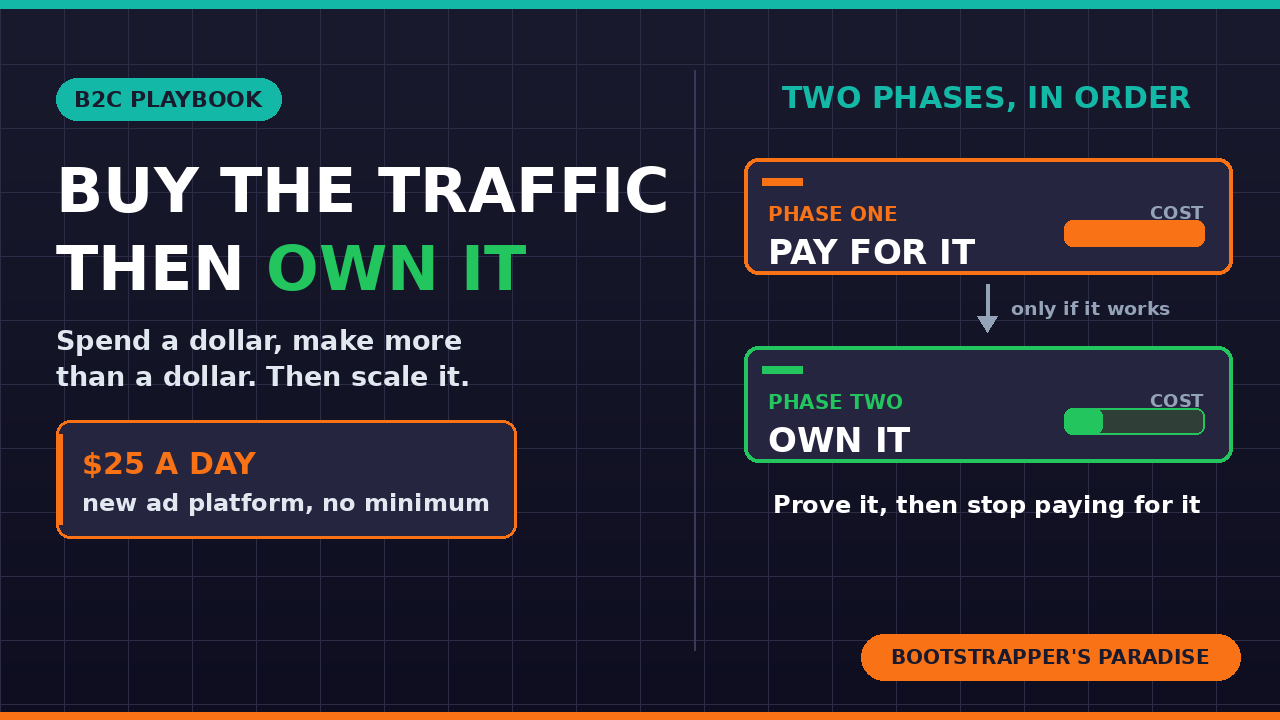
Phase one: buy the traffic
Which ads?
The answer is any platform where you can get cost-effective, relevant traffic to your site. For me that's historically meant Google search ads, which are still relevant, and Meta ads on Facebook and Instagram, depending on your target market and where your customers are looking for a solution.
Increasingly it means AI platforms too. OpenAI started showing ads in ChatGPT in February this year. The self-serve Ads Manager opened in May with no minimum spend, down from a pilot that reportedly required six figures. The minimum daily campaign budget is twenty-five dollars.
Translation for you: a brand new, high-intent ad platform just became accessible to a solo founder with a small budget. That window doesn't stay open forever. Early platforms are always cheaper than mature ones.
There are other options like Reddit and LinkedIn, but I'd start with that first group.
Test it before you build it
Here's my favorite part, and it's the thing I wish more founders did.
You can run this experiment before you build anything.
Spin up a landing page in about an hour with something like Lovable. Make it look like the product is ready. Fire up an ad campaign to capture leads. Then measure the conversions against your spend.
That's it. That's the test. You learn whether people want this, what it costs to get their attention, and whether the math has any chance of working, all before you build anything.
I walk through the details of that experiment in my free 5-day email course. If you take one thing from this piece, let it be that you can find out whether there's a market for a product like this before you build it.
The numbers that decide
Once ads are running, phase one becomes one big test. Do people sign up? Do they convert to paid? Do they stay?
Those answers give you the three numbers that decide everything.
Customer acquisition cost. What you spend to get one paying customer. Self-serve products often benchmark around a couple hundred dollars, though at ten dollars a month you need it far lower than that, so this depends heavily on what you charge.
Payback period. How many months of gross profit it takes to earn that back. Median across SaaS is about 6.8 months, and B2C is the fast end at roughly 4.2 months versus 8.6 for B2B. That's one of the genuine advantages of B2C. Everything is faster.
Lifetime value to acquisition cost. Three to one is the accepted floor. B2C subscription runs about 4.1 to 1 at the median. Only 44% of SaaS companies actually hit the three to one bar.
One thing worth internalizing: speed of cash recovery beats a beautiful ratio. A five-to-one with a two-year payback is worse for you than a three-to-one that pays back in eight months, since you're funding this yourself and cash you get back is cash you can reinvest.
If the return is positive, turn it up. That's the other beautiful thing about ads. You control the dial. Up, down, on, off, whenever you want.
Phase two: stop paying for it
Assuming phase one works, what's next?
Phase two is bringing your costs down by competing for that same traffic organically.
The logic is simple. Every visitor you capture without paying for them increases your return, since organic traffic is close to free. Phase one proved which keywords, which messages, and which audiences convert. Phase two is about capturing that same traffic in a more cost-effective way.
These two phases are sequential, not competing, which is convenient. Ads first, organic second, and you only start the second one if the first works.
The catch is that you need a genuinely good organic content machine. Relevant content your market is actually searching for, solving their real problems, with your product as the centerpiece that drives conversions.
That's the 1-2 punch. Now I need to tell you what changed, because the version of this advice from two years ago will waste your time.
Organic changed. Here's what survived.
Organic search got hit hard, and you should know the numbers before you invest a year into content.
AI Overviews now appear on roughly 48% of Google queries. Independent studies measuring the click-through impact all point the same direction, with the magnitude varying by method: Amsive found an average 15.5% drop across 700,000 keywords, Ahrefs measured a 58% decline in position-one click-through, and Seer Interactive measured informational-query click-through falling from 1.76% to 0.61%. Pew's behavioral study found users click a traditional result 8% of the time when an AI summary is present versus 15% without.
So the old approach of pumping out "how to" and "what is" articles to catch informational search traffic is aiming at exactly the content AI answers now absorb.
Here's what survived, and this part is genuinely good news.
That Amsive study across 700,000 keywords found something the headline number buried. When an AI Overview appears, click-through on branded queries goes up almost 19%, while non-branded queries drop about 20%. When an AI Overview and a featured snippet stack together, the drop reaches 37%.
People searching for your name still click. People searching for a generic answer don't.
Worth knowing: there's evidence of a partial recovery through 2026. Seer's tracking shows organic click-through on AI Overview queries rebounding from that 0.61% floor to around 2.4% by February 2026. The gap versus queries with no AI Overview is roughly 37%, and that gap looks like the new structural baseline rather than a temporary dip.
So phase two still works. It just aims differently. Three targets.
Your brand query, so that when the ads and the content make people curious, they find you. Transactional and comparison content, since purchase-intent searches still produce clicks. Then getting cited inside the AI answers themselves, since that's where a growing share of discovery now happens.
Same strategy, updated targets. Done right, this lets you stop paying for the traffic you already proved converts.
Your playbook to follow
- Pick the profitable business, not the lottery ticket. Be intentional about it.
- Accept that ads are your channel. Your price point dictates your budget.
- Run the landing page and ad test before you build anything.
- Track acquisition cost, payback period, and lifetime value to acquisition cost from day one. Positive return or fix it.
- When the math works out, turn it up. That's what the dial is for.
- Then go take that traffic organically, aimed at brand queries, buying-intent content, and AI citations.
Sources
- ChatGPT Ads Manager self-serve launch and removal of the minimum spend
- ChatGPT Ads pricing, CPC and CPM ranges as of mid-2026
- How to advertise on ChatGPT, current setup and eligibility
- ChatGPT Ads self-serve guide for small budgets
- Amsive, AI Overviews CTR study across 700,000 keywords
- Search Engine Land on the branded versus non-branded split
- Pew Research Center click behavior with AI summaries present
- AI Overviews statistics including the 2026 Seer recovery data
- AI Overviews and AI Mode statistics for 2026
- Google AI Overview coverage statistics
Where to go next
The pre-build experiment is the highest-leverage thing in this piece, and I break it down step by step in my free 5-day email course: bootstrappersparadise.com/#free-course
If you want to build your acquisition strategy with me directly, I take a small number of founders for private 1:1 coaching: bootstrappersparadise.com/#coaching
B2C is harder than B2B. It's also very doable if you refuse to spend money you can't make back, and if you pick the profitable business instead of wasting money on lottery tickets.
Spend a dollar, make more than a dollar, then do it again bigger.
Ready to Build Your Own SaaS?
Learn how to go from idea to launch in my free 5-day email course — no coding or big budget required.
Start the Free Course