Automate the Bottleneck: The Simplest Formula for a Profitable SaaS
Every business has a bottleneck. Find it. Automate it. Charge a fraction of the value. That is the simplest, most repeatable formula for building a profitable SaaS product.
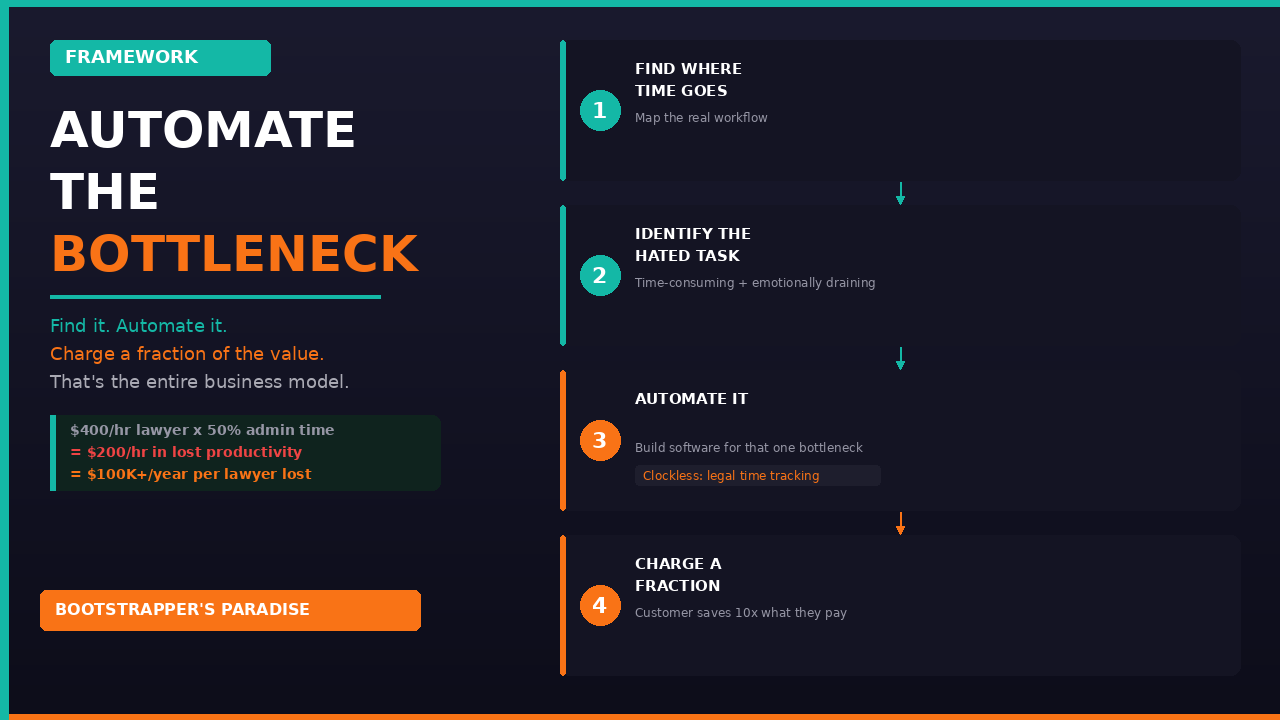
Every business has a bottleneck. Some slow, painful, expensive process that everyone hates but nobody can avoid. Your entire SaaS business should be built around one idea: find that bottleneck, automate it, and charge a fraction of the value you create.
That is the simplest, most repeatable formula for building a profitable SaaS product.
Time is Literal Math
Every professional has an effective hourly rate. A lawyer bills $300–$500/hour. An accountant bills $100–$300. A consultant, a contractor, a designer — every one of them has a number attached to their time.
Not all of their time is spent doing the work they're paid to do. A huge chunk is consumed by administrative tasks, busy work, processes they hate but can't skip. Lawyers spend nearly half their working hours on non-billable administrative tasks. A lawyer billing $400/hour who spends half their day on admin is leaving $200/hour in lost productivity on the table. Every hour. Every day.
That gap between what they could be earning and what they actually earn because of bottlenecks — that's your opportunity.
The Theory of Constraints
There's a book called The Goal by Eliyahu Goldratt. Time Magazine named it one of the 25 most influential business management books ever written. Jeff Bezos requires his senior leaders to read it. The core idea is deceptively simple.
Every system has one bottleneck — one constraint that limits the output of the entire system. A chain is only as strong as its weakest link. Improving anything other than the bottleneck is an illusion. The system can only produce at the speed of its slowest point.
As a SaaS founder, your customers have bottlenecks. Painful, time-consuming processes that slow their entire operation. Tasks they hate but can't avoid. If you identify that bottleneck and automate it, you don't have a feature — you have a business.
The 4-Step Framework
Step 1: Find where the time goes. Understand how your target customer actually spends their day. Not how they think they spend it — how they actually spend it. Map their workflow start to finish.
Step 2: Identify the hated task. Look for the intersection of two things: a task that consumes a lot of time AND a task they don't enjoy doing. People pay to eliminate work they hate far more willingly than work they enjoy. You want the task that makes them say "I didn't go to school for this."
Step 3: Automate it. Build software that handles that specific bottleneck. You don't need to automate their entire workflow — just the part choking their productivity and draining their energy.
Step 4: Charge a fraction of the value. If your customer loses $200/hour to a bottleneck and you eliminate half that waste, you're creating $100/hour in value. Charging $30–$50/month is a no-brainer. They save thousands. You earn recurring revenue. Everyone wins.
Clockless: The Case Study
Lawyers have a massive bottleneck: time tracking and billing. Lawyers who wait until the end of the day to record time lose 10–15% of billable hours. Wait until end of week: 25%. Some studies put it as high as 50%.
In dollars: a lawyer billing $400/hour who loses even 15% of billable time is leaving $60/hour on the table. Over a year, that's over $100,000 in lost revenue per lawyer.
They hate tracking time. It's tedious, it interrupts focus, and nobody went to law school to fill out time sheets. That's a bottleneck — painful, expensive, emotionally draining, and it limits the output of the entire practice.
Clockless automates that bottleneck. It handles the time tracking so lawyers can focus on practicing law. If it saves a single lawyer even a fraction of those lost hours, the product pays for itself many times over.
5 Techniques for Finding Bottlenecks
1. Follow the time. Ask your target customer to walk through a typical day. Where do the hours actually go? Look for the gap between what they're paid to do and what they spend time doing.
2. Listen for complaints. Go to Reddit, forums, professional communities. Search "I hate having to," "worst part of my job," "I spend way too much time on." Those complaints point directly to bottlenecks.
3. Look for workarounds. When people build spreadsheets, manual checklists, or cobble together three tools for one process — that's a bottleneck. The workaround proves the existing solution is failing them.
4. Calculate the cost. Put a dollar amount on it. Hours consumed multiplied by hourly rate. If the number is hundreds or thousands per month, you've found a bottleneck worth automating.
5. Validate the emotional weight. The best bottlenecks aren't just expensive — they're emotionally draining. Tasks people resent. Tasks that make them feel like they're wasting their potential. That emotional component turns a nice-to-have into a must-have.
Pricing Becomes Obvious
When you automate a bottleneck, pricing is straightforward. Your customer loses $5,000/month to a bottleneck. Your product eliminates half that waste, creating $2,500/month in value. You charge $100–$300/month. Customer saves 10x what they pay.
That's a no-brainer ROI. They never cancel. They tell colleagues. The product sells itself. This is why outcome-based pricing beats per-seat pricing. You're not charging for access to software. You're charging for time saved, revenue recovered, pain eliminated.
Your Homework
Pick one industry. Do three things this week:
- Find five professionals and ask what they spend the most time on that they wish they didn't have to do.
- Go to Reddit or industry forums and search for complaints about that same work.
- Calculate the cost: hours per week multiplied by hourly rate. That number tells you if it's worth automating.
Got a bottleneck in mind? Pressure test your idea with the free SaaS Idea Validator before you write a single line of code.
Ready to Build Your Own SaaS?
Learn how to go from idea to launch in my free 5-day email course — no coding or big budget required.
Start the Free Course